Last week Dell launched a 17% off “sitewide” coupon that, unfortunately, excluded all Alienware Aurora gaming desktop PCs. Today, that’s changed. Almost every Alienware desktop is now eligible for the 17% off code, and better yet it stacks with any instant discounts. If you’ve been hunting for an RTX 30 series video card, buying a prebuilt PC is pretty much the only way to score one. With this coupon, Alienware’s prices are probably the cheapest that you’re going to find right now.
Dell’s Extra 17% Off Coupon Code Now Works on Alienware RTX 30XX Gaming PCs
Alienware gaming PCs equipped with the latest RTX 30 series video cards are not as expensive as you think. In fact, if you opt to buy a config without adding any unneeded upgrades (and swapping components yourself), you’ll actually pay a price that’s less than what you’ll find almost anywhere else. For example, an RTX 3080 desktop PC would run as low as $2070. Check out all of the options below, from an RTX 3060 all the way to an RTX 3090.
Upgraded Alienware Aurora Gaming PCs Available
If you don’t want to deal with the hassle of upgrading computer components yourself, you can customize the configs above. Alternatively, Dell offers some configs that are already upgraded out of the box. There are some AMD options here as well.
Dell XPS Intel Core i7 RTX 3060 Ti PC for $1369
Enjoy high end PC gaming on a budget. There is one of the best deals we’ve seen for an RTX 3060 Ti equipped PC and handily beats out a similar deal we saw on Labor Day by over $100. The RTX 3060 Ti is a very powerful video card; it’s better than the previous generation’s RTX 2080! It’s a big upgrade from the 3060 non-Ti model and the one to get if you’re going to play games at resolutions of 1440p or higher. This particular deal is found on the Dell Small Business site, but anyone can purchase there just like on Dell’s regular site; you can treat Dell Small Business as exactly the same as Dell Home.
Arcade1Up Pac-Man Arcade Cabinet
The classic Arcade1Up Pac-Man cabinet dropped to a new historical price low today, plus you’re getting free shipping from Walmart. The Pac-Man arcade cabinet is a 3:4 scale replica that measures 4 feet tall. A themed riser is also included that raises the cabinet by an extra 1 foot, so you can choose to play comfortably while sitting or standing. The included games are Pac-Man, Pac-Land, Pac-Man Plus, Super Pac-Man, Pac-Mania, Galaxian, Galaga, Dig Dug, Dig Dug 2, and Mappy Rompers. The entire package comes flat packed, but it is very easy to assemble and should take you less than one hour.
50% Off 6 Months of Ad-Free HBO Max
HBO Max is taking 50% off your first 6 months of its ad-free streaming service. That drops the price to only $7.49/mo. HBO Max hosts some of the biggest recent releases like Malignant, Suicide Squad 2, Mortal Kombat, Godzilla vs Kong, Zack Snyder’s Justice League, Tenet, and more. You’ll look forward to watching Dune on October 22 and Matrix 4 on December 22 with your HBO Max subscription as well. You also have access to some great TV shows like Lovecraft Country, Friends, Rick & Morty, and South Park. This is one of the best streaming services around and at this price it’s a steal.
Amazon Buy 2 Get 1 Free Board Game Sale
Amazon has brought back its excellent B2G1 FREE board game sale. There are plenty of choices here, including highly rated games like Pandemic, Dungeons & Dragons Starter Set, Splendor, Ticket to Ride, One Night Ultimate Werewolf, and much much more. Add the three eligible board games to your cart and check out. You’ll see the discount at the last step of checkout right beforeyou pay.
Back in Stock (Including 1TB Model): WD Black SN850 M.2 SSD with Heatsink
The Western Digital official storefront has all models of the SN850 SSD with heatsink in stock right now, and that includes the extremely hard to find 1TB model. This is currently the most popular (and probably the best) SSD to get for your PS5 storage upgrade. It’s blazing fast drive with transfer speeds rated at up to 7,000 MB/s and a PCIe Gen4 interface and it comes preinstalled with a heatsink. It’s also confirmed by Western Digital themselves to be compatible with the PS5.
Diablo 2: Resurrected releases this week, and unlike the original PC-exclusive game, the remade version is coming to everything from PC to PS5 and Nintendo Switch. It also supports cross-progression, allowing you to keep your game progress if you decide to switch from one platform to another or want to jump back and forth between a few. But how does Diablo 2: Resurrected cross-progression work? We’ll give you the rundown.
What Is Diablo 2: Resurrected’s Cross-Progression?
Cross-progression is a feature distinct from cross-play–it doesn’t mean you can play with your friend on PC if you are playing on Xbox Series X. Instead, what cross-progression allows you to do is play your character on one platform and then pick up where you left off on another. This way, if your friend only plays on PlayStation and you prefer PC, you can still temporarily jump to PlayStation in order to play cooperatively with them. This feature was not included in Diablo 3–nor was cross-play–so you could only play on people with the same system as you. You do still have to buy the game separately on all platforms you’ll be using.
Click To Unmute
Size:
Want us to remember this setting for all your devices?
Now Playing: Diablo II: Resurrected – Official Cinematic Trailer
How To Enable Diablo 2: Resurrected Cross-Progression
To do this, you just need to have a Battle.net account that is linked to the platform in question. If you’ve played Diablo 3 or Overwatch on a console already, there is a pretty good chance you’ve already done this.
If you haven’t, there are a few ways to do so. From your game screen, you can choose the “link accounts” box under the options menu and then pull up a browser, which you can sign in to in order to link Battle.net to whatever platform you’re on.
The easier way is to log in on your computer or phone. Sign in to Battle.net and go to the Connections page, click “Connect,” select the platforms you’re going to play on, and sign in to each of them using their own websites.
Diablo 2: Resurrected releases as Activision Blizzard is embroiled in a state of California lawsuit as well as an SEC investigation surrounding alleged sexual harassment and workplace intimidation, as well as perpetuating a “frat boy” culture.
Not long ago, your chosen PSN username was locked in and unchangeable. That was bad news for anyone who chose a name that was embarrassing or too complicated to remember or otherwise just unwieldy. Fortunately, Sony has shifted that policy now, allowing you to change your username as many times as you wish–if you’re willing to pay. Here is everything you need to know about changing your PSN ID.
The cost of changing your PSN name
Sony allows you to change your password for free once, allowing you to correct an old username easily as long as you’re certain what you want to change it to. Any further changes beyond that point, though, and you’ll have to pay for the privilege. Subsequent instances will cost cost $10 per change for standard PlayStation Network members, or $5 per change if you’re a PlayStation Plus subscriber.
But there are some costs to changing your PSN ID that go beyond the standard dollars and cents calculations. Sony warns that some PS4 games could experience issues after you’ve changed your ID. PlayStation put together a list of PS4 games that could be impacted by a name change, including problems like losing your Trophies or even loss of paid currency. PS3, Vita, and PS/TV games and apps don’t support the name change as well. Sony also warns that there may be other games that experience issues that didn’t arise during its testing, so it’s a slight gamble either way.
With those caveats in mind, here’s how you go about changing your PSN ID.
How to change your PSN ID
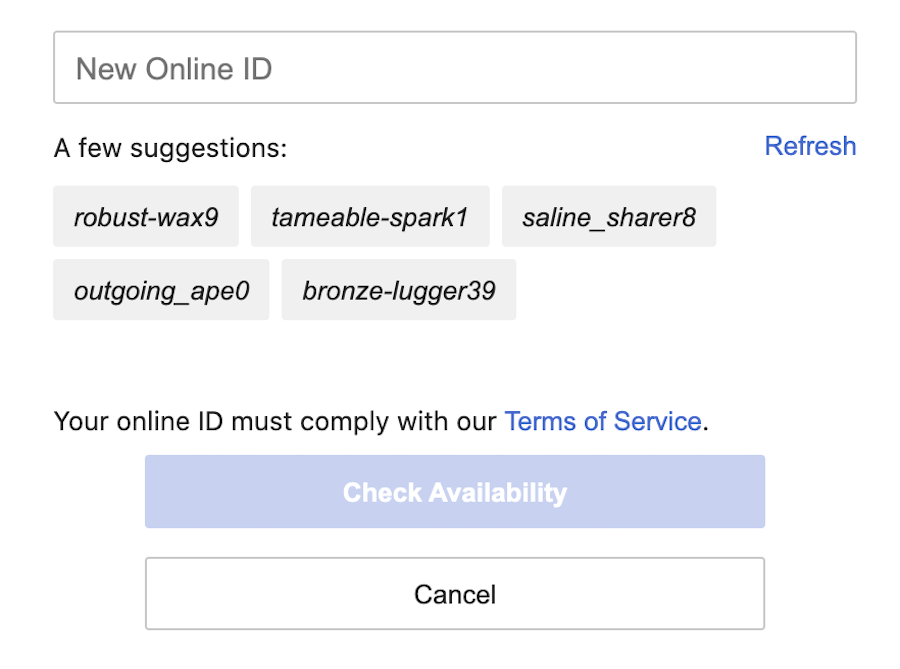
There are three methods to change your PSN ID, based on which platform you’re using to actually commit the change. Keep in mind that after each of these, you’ll be signed out of all devices and will need to re-login anywhere you were previously signed into PSN. Sony will also provide you with several suggestions when changing your ID. Feel free to use “robust-wax9” if you’re so inclined.
Phasmophobia developer Kinetic Games celebrated the horror investigative game’s one-year anniversary and announced an “anniversary update.”
The most significant tweak in the update was the Journal’s makeover. The Journal is an information resource in Phasmophobia, providing investigative clues, photos, ghost info, and more. Now it’s a little less clunky to use: You can cross off clues on the ghost evidence page, access the pause menu in the journal, and change all settings using the journal.
Click To Unmute
Size:
Want us to remember this setting for all your devices?
Now Playing: Phasmophobia – The Ultimate Beginner’s Guide
Other changes are small edits like being able to see what the ghost type was when you fail a mission and no longer getting $10 for failing a contract, instead receiving insurance depending on the difficulty setting.
Our one year anniversary update is now out!
I would just like to thank everyone for their amazing support over the past year. It has been an incredible time!
Some of the fixes also include getting rid of glitches that made it easier for players to elude the ghosts. The one where you could hide your head in something to avoid detection by ghosts is gone, as well as several safe spots where ghosts cannot access players standing at higher spots. You can check out Phasmophobia’s Steam page for full details on all changes.
Kinetic Games’ last major update was titled Exposition and was added in August. Two new ghost types–The Goryo and Myling–became active in the game, and players could also track ghosts with a new equipment called The DOTS Projector.
Phasmophobia was a surprise hit in 2020 and won the Best Debut Game at the 2020 Game Awards. It’s still going on strong in 2021, and players have a Halloween update to look forward to, as promised by Kinetic Games in the Anniversary Update notice.
Microsoft’s backwards compatibility team created a system called FPS Boost, and it does just that–it increases the frames per second for Xbox games on Xbox Series X and S. In some cases, frame rates can be doubled, which in turn can make games look and run smoother to provide a better experience overall. Not every game Xbox game uses FPS Boost, but plenty do–close to 100 as of September 2021–and we’re rounding them all up here.
Another important thing to know is that, to unlock higher frame rates, some games make a compromise that brings down the resolution to accommodate this. In these cases, which Microsoft says only make up “select” group of titles, FPS Boost is not automatically toggled on for Xbox Series X specifically. However, if you do what to experience higher frame rates at the tradeoff of lower resolution, you can toggle it on manually. Here’s a video explaining how:
There is also a new guide overlay located in the upper right corner when you tap the Xbox button on your controller that lets you know if FPS Boost is enabled or not. An extensive breakdown of FPS Boost and troubleshooting support can be found on Microsoft’s website.
How To Enable/Disable FPS Boost
Microsoft’s support site mentions that most games that use FPS Boost have it toggled on by default. For those where it must be triggered manually, all you have to do is:
Go into the “Manage game” page for the title
Check the box for FPX boost
To disable FPS Boost, uncheck the box. This also applies to the auto HDR settings for a game.
Some games, like Battlefield 1 and Star Wars Battlefront II, support frame rates up to 120fps. But you will need a supported TV or monitor for this. If you’re in the market for a new TV, you can check out GameSpot’s list of the best 4K/120fps TVs for gaming. Also of note is that, because of the increased horsepower of the Series X relative to the Series S, some games on Series S may not have frame rates as high as on Series X.
How To Enable 120fps
Microsoft’s support site has a full rundown of how to enable 120fps for your games, provided they support this increased frame rate and you have a compatible TV. Here are the instructions:
Make sure that your console is on the latest update:
Press the Xbox button to open the guide, and then select Profile & system > Settings > System > Updates.
Apply any updates listed as needed.
Make sure that your TV supports the 120 Hz refresh rate. This varies by TV model. Be sure to consult your owner’s manual for your TV to enable this.
Change your console display settings to 120 Hz:
Press the Xbox button to open the guide, and then select Profile & system > Settings > General > TV & display options.
Select Refresh rate > 120 Hz.
Enable FPS boost in the compatibility settings for the game:
In My games & apps, highlight the game desired, and then press Menu > Manage game & add-ons > Compatibility options.
Enable FPS boost.
You can see the full rundown of Xbox games that support FPS boost below, as compiled by Microsoft’s Major Nelson. We will update this post if and when more games are added.
As a free-to-play standalone game, Halo Infinite multiplayer embraces microtransactions in its business model, just like Fortnite, Call of Duty: Warzone, Apex Legends, and many others. 343 Industries has now begun to lay out its vision for Halo Infinite as it relates to what will be available in the store to buy with real money.
Now Playing: 5 Things To Know About Halo Infinite’s Multiplayer Preview
Starting with cosmetics, players can unlock new customization items in Halo Infinite multiplayer at launch through a variety of means, including by spending real money. Specific price points have not been announced yet, however.
Spending money is just one way to unlock the cosmetic content, as players can also earn this through weekly rewards, grinding through the battle pass, taking part in special and seasonal events, reaching specific skill ranks, and even by achieving “various accomplishments” in Halo Infinite’s campaign. You can also unlock cosmetic content through Halo’s deals with brands like Mega Construx and Rockstar Energy.
In addition to cosmetic content, players can spend real money on the following:
Challenge Swaps — These allow you to swap out one of your weekly challenges. These can also be earned through gameplay and other means [read more here].
XP Boosts — These give players double XP for weekly and daily challenges. The boosts run for 30 minutes, though this is a non-final time as the game remains in development. Boosts can also be earned through gameplay and other means [read more here].
343 also shared some of its overall philosophy about Halo Infinite customization, saying it has a “player first” approach. “We want to ensure that we’re respecting players’ time for unlocks they’ve earned and purchases they make. For customization, this means ensuring that each unlock comes from a consistent vector.”
As an example, anyone who buys a battle pass outright can rest assured that the content it contains “won’t be offered via any other means.” This should help players feel their purchase holds value, or at least that’s the idea. Additionally, content unlocked during Halo Infinite’s seasonal events won’t be available elsewhere, though this won’t necessarily always be the case. Some DLC from promotional partnerships that is exclusive for a period of time may eventually be released for everyone later one.
Here is a quick rundown of all the ways you can unlock cosmetics in Halo Infinite multiplayer:
Weekly Ultimate Rewards
Seasonal Battle Pass rewards (both free and premium tracks)
Fracture Events – i.e. the “Yoroi” / Samurai armor
Special or Seasonal Events – i.e. a special nameplate commemorating a real-world event, earning a Unicorn nameplate during a 343 Playdate, etc.
Partnership and promotional items – i.e. Mega Construx codes or Rockstar Energy Drinks
Skill Ranks – achieving a specific Skill ranking/tier for a season will award a unique cosmetic item
Xbox Game Pass Ultimate Perks
In- game store purchases
Halo Infinite Campaign – some unique Multiplayer cosmetics are rewarded for various accomplishments within the Campaign
Again, 343 has not yet announced the specific price points for any of its microtransaction offerings or the battle pass. It is no surprise that Halo Infinite will have a robust microtransaction/live service offering, as a job ad called for someone to use human psychology systems to encourage people to keep coming back. As a free-to-play game, getting people to come back is essential to the ongoing health of Halo Infinite multiplayer.
After a big delay, Halo Infinite’s free multiplayer and campaign are set to be released on December 8. The next Halo Infinite multiplayer beta test is coming up on September 23, featuring 4v4 Arena Slayer. After that, 343 will run a test for Halo Infinite’s new Big Team Battle mode. Here is the full schedule for the upcoming Halo Infinite beta tests.
The trailer for Marvel’s Hit-Monkey has been released. The animated series stars Ted Lasso’s Jason Sudeikis, and it premieres on Hulu on November 17.
Hit-Monkey is based on the Marvel comic book by Daniel Way and Dalibor Talajić. The title character is indeed a monkey who becomes an assassin–specifically, a Japanese Macaque out for vengeance against a criminal gang. Sudeikis voices Bryce, a deceased hitman who appears only to Hit-Monkey, and offers him advice from beond the grave. It looks like an unusual, action-packed series that at the very least stand out from other Marvel shows out there. Check the trailer out below:
Hit-Monkey’s voice-cast also includes George Takei (Star Trek) as a politician named Shinji and Olivia Munn (the X-Men movies, The Predator) as his niece Akiko. The showrunners are Josh Gordon and Will Speck, who are best known for directing the hit comedies Blades of Glory and Office Christmas Party.
The show was first announced back in 2019, when it was one of four new animated Marvel shows in development at Hulu. One of these was Patton Oswalt’s MODOK, which premiered back in May. However, the other two shows–Tigra & Dazzler Show and Howard The Duck–were both canceled before they reached production.
The next live-action Marvel show will be Hawkeye, which arrives on Disney+ on November 24. The series stars Jeremy Renner as Clint Booth and Hailee Steinfeld as Kate Bishop–check out the trailer here.
Halo Infinite marks a big change for the sci-fi series in terms of player progression for multiplayer, with the game focusing exclusively on encouraging players to advance through a battle pass-based system. There is no per-match XP and there will not be a separate XP progression system outside of the battle pass at launch.
In the September edition of Inside Infinite, 343 Industries responded to the feedback about this, saying it is “actively exploring” giving players more weapons to progress through multiplayer beyond the battle pass alone.
Click To Unmute
Size:
Want us to remember this setting for all your devices?
Now Playing: 5 Things To Know About Halo Infinite’s Multiplayer Preview
“We have heard community feedback around wanting more progression options including things like ‘match XP’ to feed into the Battle Pass and an entirely separate, incremental system along the lines of earning SR152 in Halo 5: Guardians,” 343 said. “Expanding multiplayer progression offerings is something the team is actively exploring, and we look forward to continuing to evolve the experience in future seasons post-launch.”
All About The Battle Pass
The “one primary progression path” in Halo Infinite at launch will be the battle pass exclusively, and many have voiced their discontent for this online.
The Halo Infinite battle pass includes free items and content you can unlock with real money. Some of the cosmetics to be offered include helmets, visors, and armor coatings. Some “consumables” like XP boosts can be unlocked by earning XP by completing challenges. “Every tier of the pass will require the same, consistent amount of XP to unlock from beginning to end. So, regardless of whether you’re working to unlock tier 2 or tier 52, each unlock across the 100-tier Pass will require the same amount of XP,” 343 said.
In a change from other popular free-to-play multiplayer games, Halo Infinite’s battle passes will never expire. When a new multiplayer season comes around, previous battle passes will remain available.
Outside of the battle pass for each new Halo Infinite multiplayer season, there will be “limited-time event passes.” These are free and they will be available during “specified event periods.” The progression track and rewards, too, are separate from the main battle pass. “In general, an event will be available from one to multiple weeks, including weekends, offering players multiple opportunities to unlock available rewards,” 343 said.
Halo Infinite’s Season One main event is called Fractures: Tenrai, and this is how players can unlock the Yoroi armor core. “This event will be available for all players approximately one week per month during Season One, and the event will come and go throughout the season; available for players to make progress. Each time the Fracture returns, your progress will carry over, giving players multiple opportunities to unlock all 20 tiers of rewards on the event pass.”
Weekly And Daily Challenges
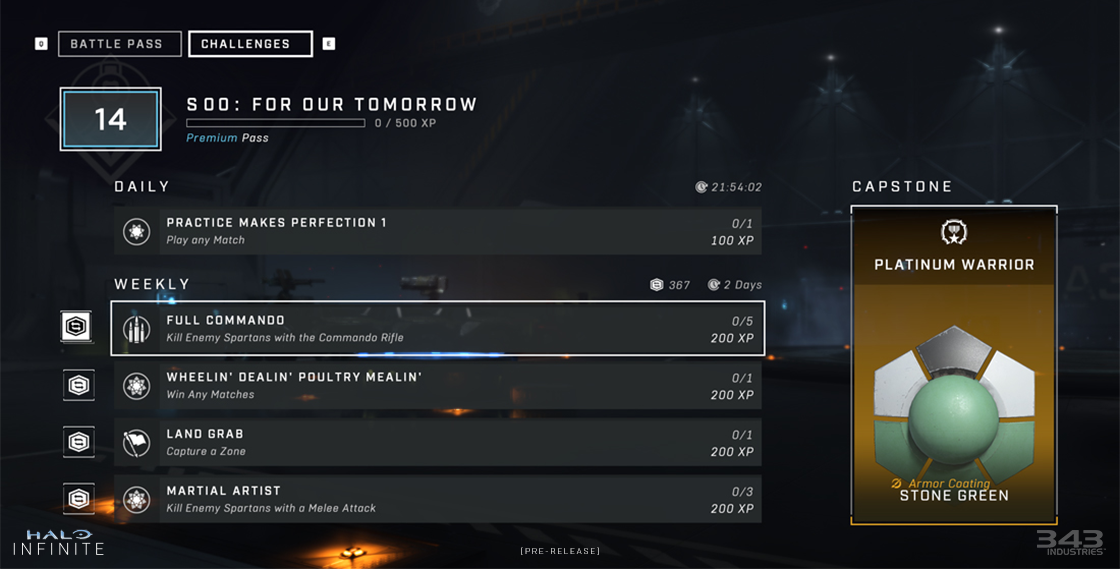
Halo Infinite will have weekly and daily challenges. One of the criticisms of Halo Infinite’s battle pass-focused progression system is that people might upset the natural flow of a multiplayer match in the pursuit of challenges. However, 343 said the challenges are–in general–designed to be “straightforward and never directly conflict with the objective of the match.”
For weekly challenges, players will be randomly given about 20 challenges out of a pool of “several hundred” possibilities. “Within this group of 20, some challenges will be pulled from the ‘easier’ tier while others will be pulled from the ‘harder’ tier with the XP reward being commensurate to the difficulty and time investment required,” 343 said.
What challenges look like in Halo Infinite
“The specific Weekly Challenges a player gets are unique per player so while there may be some overlap, in general players won’t all be chasing the same specific challenges at the same time. This means that it is extremely unlikely that everyone in the same match will need the same ‘Get X Kills with the S7 Sniper’ challenge,” the developer added. “However, the total amount of obtainable weekly challenge XP is the same for every player. By default, all players will have 3 active challenges at any given time but players who purchase a Battle Pass will be granted a 4th slot. Again, the total # of achievable challenges and total potential XP available is the same for ALL players but Pass owners will get one extra ‘active’ slot as a perk.”
If a player completes every weekly challenge, they will receive an “Ultimate Challenge” that will pay out a unique reward like an armor coating or an emblem.
Here are some examples of the weekly challenges you could receive:
Stay Off My Yard – Kill an Enemy Spartan Attacking a Friendly Zone (0/1)
For the Win – Win a Quick Play Match (0/1)
Castle Crasher – Complete a Strongholds Match (0/1)
Spartan Killer – Kill Enemy Spartans in Slayer (0/3)
Large Squad Scuffle – Complete a Big Team Battle Match (0/1)
Play Ball – Play an Oddball Match (0/1)
Back Smack Attack – Kill an Enemy Spartan from behind with a Melee Attack (0/1)
Wargames Warrior – Kill Enemy Spartans (0/10)
Banshee Bomber – Kill Enemy Spartans with the Banshee’s Fuel Rod Gun in PvP (0/5)
Mortar Minimizer – Destroy an Enemy Wraith in PvP (0/1)
Spread the Love – Kill Enemy Spartans with the Battle Rifle in PvP (0/15)
Big Wheel Bully – Destroy Enemy Choppers in PvP (0/3)
Gaptacular – Knock an Enemy Spartan off the map with the Repulsor in PvP (0/1)
Noisemaker – Kill an Enemy Spartan with a Rocket Launcher in PvP (0/1)
Wheelin’ Dealin’ Poultry Mealin’ – Win Any PvP Matches (0/3)
Chef’s Kiss – Kill an Enemy Spartan using a kinetic semi-auto or burst weapon with peak efficiency in PvP (0/1)
Flag Switching – Capture Enemy Flags in PvP (0/10)
Separation Anxiety – Kill Enemy Spartans by Sticking them with a Plasma Grenade or Spike Grenade in PvP (0/5)
Grapple-jack – Grapple to and Hijack Enemy Vehicles in PvP (0/3)
Autopilot Engaged – Kill an Enemy Driver of a moving vehicle with a Sniper Rifle in PvP (0/1)
And as an example of an Ultimate Challenge:
Tactical Precision – Kill Enemy Spartans with a Headshot in PVP – (0/15) – “Rewards Abby Lime Sniper Rifle Coating.”
For daily challenges, these are aimed to be the “XP drip” for progression in the battle pass. “Daily challenges come in three varieties starting with the ‘easy tier’ and progressing into challenges that have slightly higher and more specific requirements,” 343 said. “Initially, players will have a large pool of daily challenges along the lines of ‘play any multiplayer match’ which awards XP for playing any MP mode that operates on a trusted server (i.e. Bot Arena, Arena, and BTB playlists). Once a player has completed all of their ‘Stage One’ Daily Challenges, they’ll move into ‘Stage Two’ which includes a slew of dailies that now awards slightly more XP but requires playing PvP matches (i.e. Bot Arena no longer counts). And finally, once a player has exhausted all their ‘Stage Two’ challenges for a given day, they move into ‘Stage Three’ which awards slightly more XP for winning multiplayer matches.”
Daily challenge allotments will reset each day, taking players back to Stage One. 343 said it should take about 16-18 hours to run out of daily challenges, so unless you are playing an extreme amount of Halo Infinite each day, you should always have more to do.
That said, 343 again acknowledged that some players want a per-match XP system–but it’s not happening. It’s all about the battle pass in Halo Infinite multiplayer.
“While we understand the community’s feedback around wanting a steady drip of match XP and more ways to earn XP for the Battle Pass, we are optimistic that the system available at launch will give players adequate means of continually having something to accomplish and a means to progress,” 343 said. “Looking further ahead beyond launch, we expect these systems to evolve in direct partnership with player feedback.”
Another element of Halo Infinite’s free multiplayer are what are called “challenge swaps.” Players are able to change out one of their assigned weekly challenges–but this does not apply to dailies. As mentioned above, challenges are assigned different difficulty tiers, and the game won’t let you swap a harder one for an easier one to avoid players taking advantage of the system to grind through the battle pass faster. Challenge swaps can be unlocked through the battle pass or the limited-time event pass, or they can be purchased with real money. Some challenge swaps will also be available through “partnerships and promotions.”
XP Boosts
Finally, 343 discussed Halo Infinite XP boosts, which will give players double XP for their weekly and daily challenges. XP boosts are timed for 30 minutes, but this is not final; 343 is still evaluating what duration might be best. XP boosts can be unlocked through the battle pass, by purchasing them with real money, or through promotions and partnerships.
The full blog post runs through a ridiculous amount of depth and detail on Halo Infinite’s multiplayer and progression system–go read it here.
Halo Infinite has two more multiplayer betas coming up, the first of which begins this weekend and is focused on 4v4 Arena Slayer. The next will let players try out Big Team Battle.
In Kena: Bridge of Spirits, everyday items are imbued with new, unseen emotional significance. A wooden mask is a link to the spirit of the person for whom it was made. Objects like a construction hammer or a box filled with food are tied to memories of people who have been lost. Locations that were once the sites of vibrant and happy times are scarred with the pain and trauma suffered within them.
Looking at common things with new eyes is a running theme of Kena, and that theme often applies to its gameplay as well. Though the game is filled with some fairly common action-adventure genre tropes–it has melee combat that feels akin to titles such as Star Wars Jedi: Fallen Order or even Sekiro: Shadows Die Twice, climbing sections similar to Uncharted or Tomb Raider, platforming that recalls games such as Ratchet and Clank, and puzzles like what you might see in The Legend of Zelda–it manages to combine a familiar approachability with some fresh spins on the ideas. Combined with emotional, character-driven storytelling, some tough-but-excellent fights, and mechanics that make the world feel alive around you, Kena is an exciting, often heartbreaking journey that will make you want to explore every corner and crevice to see all that you can.
Gallery
The story and world of Kena: Bridge of Spirits center on a village beset by tragedy. Its inhabitants are all gone, wiped out by misfortune, and their pain has physically poisoned the once-vibrant land around it. That pain has drawn Kena, a young spirit guide, to seek out the trauma at its center and heal it. Her link to the spirit realm allows her to help the ghosts of the village find peace, and in so doing, she’s able to push back the corruption that has gripped the land, restoring it to its former glory.
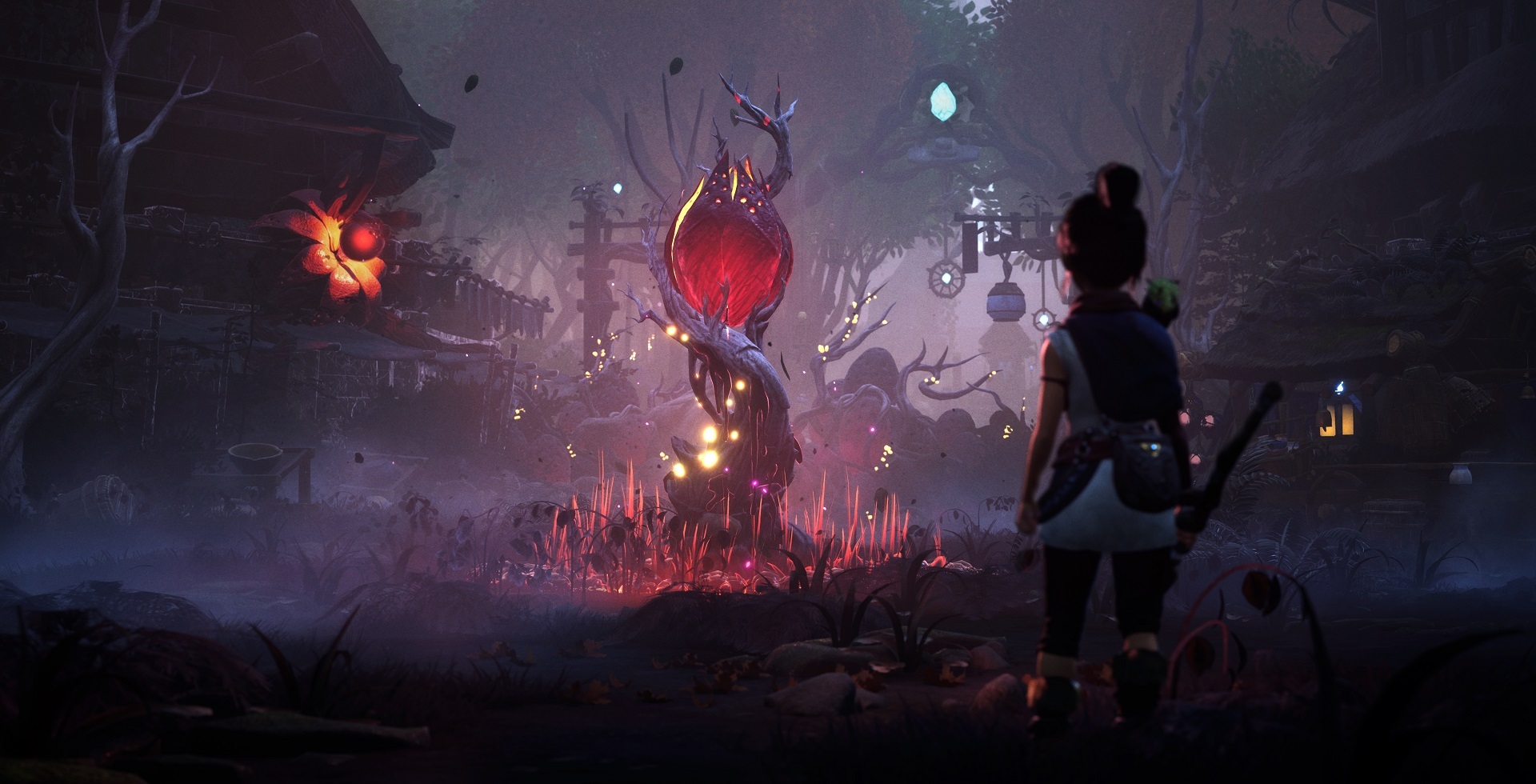
In practical terms, you do that by wandering the large, semi-open space of the village and its surrounding environs, battling the corrupted spirits of both the people who once lived there and the nature their pain has twisted. Most every interaction comes down to a combination of combat and puzzle-solving. Your goal is usually to beat back a host of enemies, freeing up the ability to destroy a nearby corrupted “heart”–a sort of evil flower bulb–with a blast of spirit energy you can pulse from Kena with the touch of a button. Kill the heart, and the corruption recedes, along with the corrupted enemies.
Combat itself is mostly familiar, with Kena fighting off enemies with the use of her spirit staff. You get light and heavy attacks you can combo together, but even in the normal difficulty, enemies hit hard and can knock you off your game if you’re not paying attention. Like similar action games, you have a dodge that can get you out of trouble most of the time, and you can generate a spirit shield with limited power that will stop attacks. Take too many hits, and the shield breaks, sending you flying and dealing you damage, but if you can time your block just right, you’ll parry an enemy and open them up to a counter-attack.
Both Kena’s puzzles and its combat add a twist in the form of the Rot, which are little spirit pals you can find in the environment. The Rot are a bit like Pikmin or the minions seen in games such as Overlord. In combat, you can send them to attack and distract enemies, allowing you to get in a few free hits or attack a weak point, and they’re essential to making hearts vulnerable in the middle of fights, which can allow you to stop enemies from respawning so you can advance.
The Rot are the thing that makes Kena stand apart from similar games, and finding them, powering them up, and utilizing them effectively adds a tactical layer to fights that goes beyond just dodging and parrying. Since the Rot are all pretty small, you need to work up their courage to bring them into the battle. As you deal damage and kill enemies, you fill a meter that gives you a Rot action, and you can deploy them in a fight with a single button or use them to power up one of your attacks for a big hit. The Rot are also crucial for taking advantage of the environment–you have to send them at hearts in order to neutralize them, and the only way to heal Kena is to expend a Rot action.
Working with the Rot in combat forces you to constantly be on the attack and to pay attention to your environment. You need to mentally log the location of hearts that spawn enemies and the items you use to heal, and it’s often essential that you knock out smaller, weaker enemies to build Rot charges so you can distract and take down bigger, tougher ones. Deciding how best to use the Rot in combat keeps you balancing a big-picture view of a fight with the smaller, more intense moments of parrying a big hit or sniping a weak point.
Occasionally, the combination of those elements can be a bit annoying, because it’s easy to blow a single dodge or block and have failure cascade on you, or to accidentally send the Rot to attack the wrong enemy as things get hectic. With some bosses, you’ll probably need to die a few times just to figure out how badly they’re capable of wrecking you. But death isn’t the point, and at least with PlayStation 5’s lickity-split load times, the game is always quick about getting you back into the action with as little punishment as possible. It also offers a story mode difficulty, which seems like a very good addition, given how deceptively difficult some of its fights can be. Kena’s combat is generally tough and exciting, executing well on familiar dodge-and-parry mechanics, but it’s the addition of the Rot and the versatility in how you can use them that really makes battles in Kena feel fun and intelligent.
That also goes for the game’s various puzzles. Outside of combat, Rot follow you around or pop up on ledges and bridges as you move through the environment, and can be sent to do contextual actions in the world, like moving climbable objects to help you reach a high platform. Kena does a good job of combining the need to give the Rot commands with smart uses of Kena’s abilities, creating situations in which solutions need you to think about what you can do with the unlockable bow or platform-levitating bombs, as well as what the Rot can do to alter the environment.
Gallery
Where Kena nails the balance is in providing you with tons of puzzles that mostly reward your observation skills, without overly taxing your ability to solve them. Most of the time, spotting something the Rot can move or seeing an object you can interact with using spirit energy is enough to illuminate the path forward. You might be climbing along a wall and see a less-obvious spot where you can jump down, and every time, noticing something like this will take you to a reward.
The only drawback is that, with the game hinging so much on observation, it’s very easy to miss the one item that would point you in the right direction. One particular puzzle, which required shooting several torches in a specific order, had me wandering the area trying to figure it out for a good 10 minutes before I realized how simple the solution really was, but that I hadn’t caught on to the single-use clue the game had included to show me what to do. Mostly, though, these puzzles are just difficult enough to make you feel smart for catching on. Kena is also brimming with collectibles, including Rot spirits hidden in the environment and hats to customize them, and while chasing those items is largely inessential, the addition of all those little side paths and tiny rewards encourages you to explore and lose yourself in Kena’s world.
And it is a beautiful world to explore, thanks to phenomenal art direction and an excellent, immersive score, made more so by the stories of the spirits found within it. Developer Ember Labs has its beginnings in animation, and the game takes full advantage of that background with cute characters and gorgeous cutscenes that help to invest you even further in uncovering what has happened in the village and setting it right. You can’t save these people, but you can help them move on and forgive themselves.
In each section of the game, you venture out to find one particular tormented spirit and help them achieve peace, and your journey through the location is all about piecing together the story of who these people are and what became of them. In each, you’re not just helping free a human spirit who has been corrupted and twisted into a powerful and dangerous boss by their trauma–you’re also helping the spirits of the people who loved them but cannot reach them. The interactions with the characters you find in each section of the game helps imbue the areas in and around the village with a character of their own, and despite the fact that the place has been all but destroyed, you can feel the life that once thrived there.
What’s missing from the story, though, is Kena herself. The game hints that some tragedy in Kena’s past has scarred her, much like the spirits she sets out to help. Near the climax of the story, the game digs into some of Kena’s motivations and history but wraps things up so quickly and neatly that it feels like some aspect of her tale might have been cut. Kena is more or less in the same place at the end of the story as at the beginning, and in a game where so much development is given to the stories of the inhabitants of the village, the attention paid to the protagonist feels anemic by comparison.
The act of meeting and understanding all those other characters is powerful, though. Kena: Bridge of Spirits is ultimately a game about making those connections, just like it’s about making a connection with the game world around you through the Rot. It centers on characters who tried valiantly but failed to help one another, and what dealing with that pain did to them. It’s about exploring a world and seeing what it once was, and helping to restore it again. And while Kena: Bridge of Spirits is full of familiar-feeling combat and exploration, its ability to find different ways to look at those ideas makes for a beautiful, emotional, and exciting journey.
One of Disney’s many new Star Wars TV shows in the works, the Obi-Wan Kenobi project featuring Ewan McGregor in the title role, has finished filming. Not only that, but McGregor said he believes the show will live up to expectations.
“It was really, really good fun; I really enjoyed working with [director] Deborah Chow and I think it will not disappoint. I think it’s going to be good,” McGregor said to Variety (via IGN). McGregor added that he also enjoyed Kenobi’s use of new technology, which was a different experience compared to the prequel films that he starred in.
McGregor made his comments after winning his first Emmy this weekend for the TV show Halston.
McGregor previously told The Hollywood Reporter that he was working almost exclusively with bluescreens on Revenge of the Sith, and it was far from ideal, which is why he’s happy to film the new Kenobi show in a different way.
“After three or four months of that, it just gets really tedious–especially when the scenes are … I don’t want to be rude, but it’s not Shakespeare,” he said of the earlier Star Wars films from George Lucas. “There’s not something to dig into in the dialogue that can satisfy you when there’s no environment there. It was quite hard to do.”
For the Obi-Wan series, McGregor said he is excited to get to work using the new StageCraft technology. “They project [the virtual backgrounds] onto this massive LED screen. So if you’re in a desert, you’re standing in the middle of a desert. If you’re in the snow, you’re surrounded by snow,” he said. “And if you’re in a cockpit of a starfighter, you’re in space. It’s going to feel so much more real.”
As announced previously, Lucasfilm is working with Fortnite studio Epic Games and Star Wars effects company Industrial Light and Magic on new tech called StageCraft that uses Epic’s Unreal Engine to project scenes onto LED screens surrounding the physical set.
The series is being directed by Deborah Chow, who previously helmed episodes of The Mandalorian. While plot details are currently under wraps, Lucasfilm has confirmed that the show will take place 10 years after Revenge of the Sith.
Kenobi, which doesn’t have a release date, is one of various new Star Wars shows in development for Disney+. Others include The Book of Boba Fett, Andor, Lando, and Ahsoka. For more, check out GameSpot’s guide to everything we know about all the upcoming Star Wars movies and shows.