The Artful Escape Review – Nowhere Nephew

The Artful Escape is a visual treat–a platforming journey that takes players on a journey from Earth to the galaxies beyond and renders every location with gorgeous care. Evoking a variety of influences, from the artist Charlie Immer to the bright aesthetics of Lisa Frank, The Artful Escape captures the sheer cinematic thrill of watching your helicopter explode in a Call of Duty mission or falling off a cliff in a Naughty Dog set-piece, but transplants the action to a voyage that goes far beyond the realm of the real. It’s gentler, too, telling a story about learning how to be who you really are, and not who someone else expects you to be. There’s no violence to be found here; just easygoing platforming, low-pressure musical riffing, and adventure gaming that goes heavy on the dialogue and omits the puzzles entirely.

As the game begins, you are Francis Vendetti, a teen in a leather jacket, chunky boots, and eyewear that could be steampunk goggles or the perfect circle glasses that John Lennon made iconic. Francis is sitting on a bench on a cliff and the first prompt we see instructs us “To strum a folk ballad about the toil of a miner’s life, hold X.” It’s immediately pretentious, and that’s intentional. Francis is the nephew of Johnson Vendetti, who is a legend in the world of The Artful Escape. In Calypso, the small town where Francis has lived his whole life, his uncle is a hometown boy who made good. But “Press X to sing about miners” is not who Francis is at all. It rings hollow (and it should) because Francis is attempting to be someone he isn’t. But his first performance as a musician is scheduled for tomorrow, and Francis will be expected to perform that false identity for everyone he knows. Francis will grow as a character over The Artful Escape’s six-hour runtime, but this gameplay will remain the same. You spend a lot of time in this game holding X to strum on your guitar.

Then Francis meets Violetta, a punky girl with a bad attitude and an Edna Mode haircut. Violetta seems to see something in Francis and tells him to seek out Lightman’s–ostensibly a store in Calypso. But Francis has lived in Calypso his whole life and knows there’s no such place. Doesn’t matter–Violetta is off and Francis heads home to get some sleep before his concert the next day. It turns out Francis didn’t need to find Lightman’s. Instead, Lightman, an aging musician voiced by Carl Weathers, comes to him, taking Francis to a spaceship called The Lung and sweeping him up in an intergalactic voyage. He promises Francis will be back in time to play his concert.

When Francis leaves Earth behind he leaves folk music behind, too. In space, he can be someone else, someone new, and hopefully, someone closer to who he really is. This journey takes the younger Vendetti to a variety of planets with just as many environments which he will platform across, bouncing off unidentifiable launching pads and reaching improbable heights. All the while, you can strum on Francis’ guitar, shredding out piercing solos that feel right at home in the alien landscapes. Levels often conclude with you Simon Says-ing out a guitar solo by following the lead of an alien creature. This is all exhilarating and part of the reason it works is that The Artful Escape takes its time starting off. We see Calypso, we see the flyers for Francis’ concert that feature a huge picture of his uncle and a stamp-sized picture of him, and we hear how the other people in town talk to him, how they relate to him not as himself, but as someone who matters only inasmuch as he shares a family tree with someone who matters.

This story works well, but it mostly succeeds in spite of The Artful Escape’s dialogue. Francis, and many of the alien creatures he meets on his journey, speak in strange metaphors that aim for artful but end up hitting hackneyed. Most of this dialogue is spoken once Francis leaves Earth, so it seems that the intent is to highlight the difference of this strange world in the way the characters speak. That’s a fine goal! But you can only choose between dialogue options describing something as “like a record playing in a dream-room” or “like clinging to a re-entry ramjet” so many times before it all begins to feel like a performative quirk.

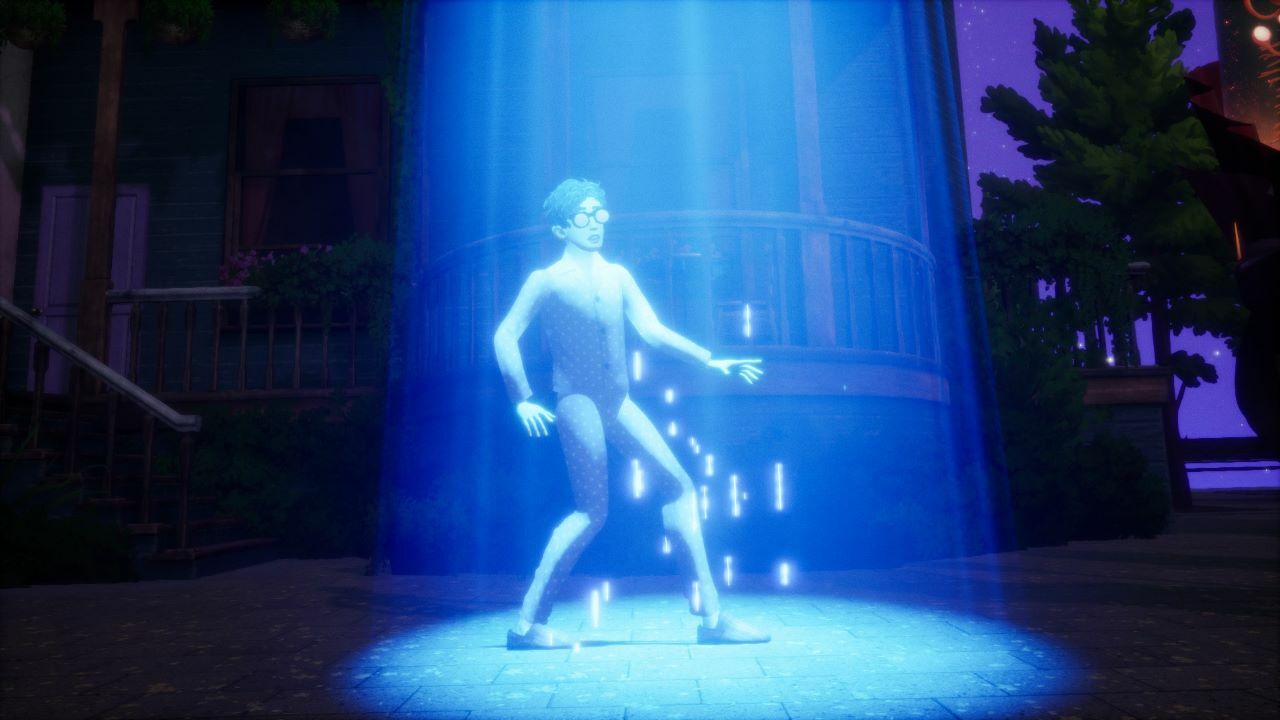
The art here is brilliant, though, and it’s the star of the show. It most reminds me of the work of Charlie Immer, an artist who makes colorful paintings where the shiny roundness of everything helps you overlook how gruesome it all really is. The Artful Escape isn’t at all violent, as Immer’s work is, but it shares his infatuation with gleaming colors and soft edges. I’ve rarely played a game that committed so thoroughly to putting its aesthetic front and center. Developer Beethoven & Dinosaur have worked overtime to ensure that nothing distracts from how beautiful the art is, how strange the designs, and how soaring the set pieces are. Whether The Artful Escape is summoning the cozy greenery of a temperate forest you could see on our world, or inventing gleaming alien cities, the environments are stunning. I like this approach because The Artful Escape is willing to commit to a distinct aesthetic, but is unwilling to alienate players by making anything too difficult. You may like or dislike this game, but it will almost certainly be on the basis of whether you click with its vibe, not because you bumped into any mechanical friction. You simply run and jump through these environments holding X to play your guitar, but the level around you goes absolutely gangbusters with soaring alien ships, or strange wildlife, or bizarre cosmic phenomena.
No Caption Provided

Gallery

That commitment to its art style makes The Artful Escape a little difficult to talk about as a game that you play. It’s a platformer, it’s a music game, it’s an adventure game–it’s a little bit of each, but not fully any. It incorporates the vibes of all three, but it isn’t interested in, mechanically, committing to any of these genres. There are no tough puzzles, no difficult platforming challenges, and no complicated strings of notes to stretch your fingers. Instead, The Artful Escape incorporates the elements of each genre in order to emphasize the different elements of its story and the settings in which it takes place. To understand Francis’ discomfort with the expectations placed upon him, we need dialogue. To show off the wondrous locales that developer Beethoven & Dinosaur have crafted to populate this galaxy, we need the pulled-back perspective of a cinematic platformer. And, to show Francis’ musical journey, and the excellence that he has within him, we need musical gameplay, but it can’t be a real challenge. Everything is in its place here, and it feels right when you play it. But The Artful Escape can be difficult to sum up as a result.

Challenging as that may be, The Artful Escape is nevertheless a thrilling adventure that commits fully to showcasing its gorgeous art in soaring set pieces. Though some of the dialogue doesn’t work, the game is largely successful at stripping out anything that would distract from its masterful presentation. Unlike Francis Vendetti at the beginning of his journey, The Artful Escape knows exactly what it is.

Xbox Game Pass Adding 13 More Games This Month, Including 8 New Releases

Microsoft has announced the next wave of Xbox Game Pass titles headed to the subscription service throughout September, and there are lots of games coming. The company also ran through the titles leaving the service and revealed more games that now support touch controls for streaming over the cloud.

Of the 13 games announced for Game Pass, eight of them are launching day-and-date in the library. The games launching on day one into Game Pass include the 2D action platformer Flynn: Son of Crimson (September 15), the wacky and wonderful-looking I Am Fish (September 16), and the extreme sports game featuring a bird, SkateBird (September 16).

September is another big month for Xbox Game Pass

The stealth-action co-op game Aragami 2 (September 17) also releases day one on Game Pass, as does the puzzle-adventure game Sable (September 23). The “4D” battle game Lemnis Gate (September 28) launches day one on Game Pass as well, while subscribers can also play the JRPG Astria Ascending (September 30) and the RPG Unsighted (September 30) at launch through Game Pass. You can see the full rundown of titles coming to Game Pass throughout the rest of September below.

This is the second wave of Xbox Game Pass titles coming to the library this month. The first batch included Final Fantasy XIII, Surgeon Simulator 2, and The Artful Escape, among others. Here is the full list of September’s Game Pass titles so far.

Xbox Game Pass Titles For Remainder Of September

September 15

  • Flynn: Son of Crimson — cloud, console, PC

September 16

  • I Am Fish — cloud, console, PC
  • SkateBird — cloud, console, PC
  • Superliminal — cloud, console, PC

September 17

  • Aragami 2 — cloud, console, PC

September 23

  • Lost Words: Beyond the Page — cloud, console, PC
  • Sable — cloud, console, PC
  • Subnautica: Below Zero — cloud, console, PC
  • Tainted Grail: Conquest — PC

September 28

  • Lemnis Gate — console, PC

September 30

  • Astria Ascending — cloud, console, PC
  • Unsighted — console, PC

October 1

  • Phoenix Point — console

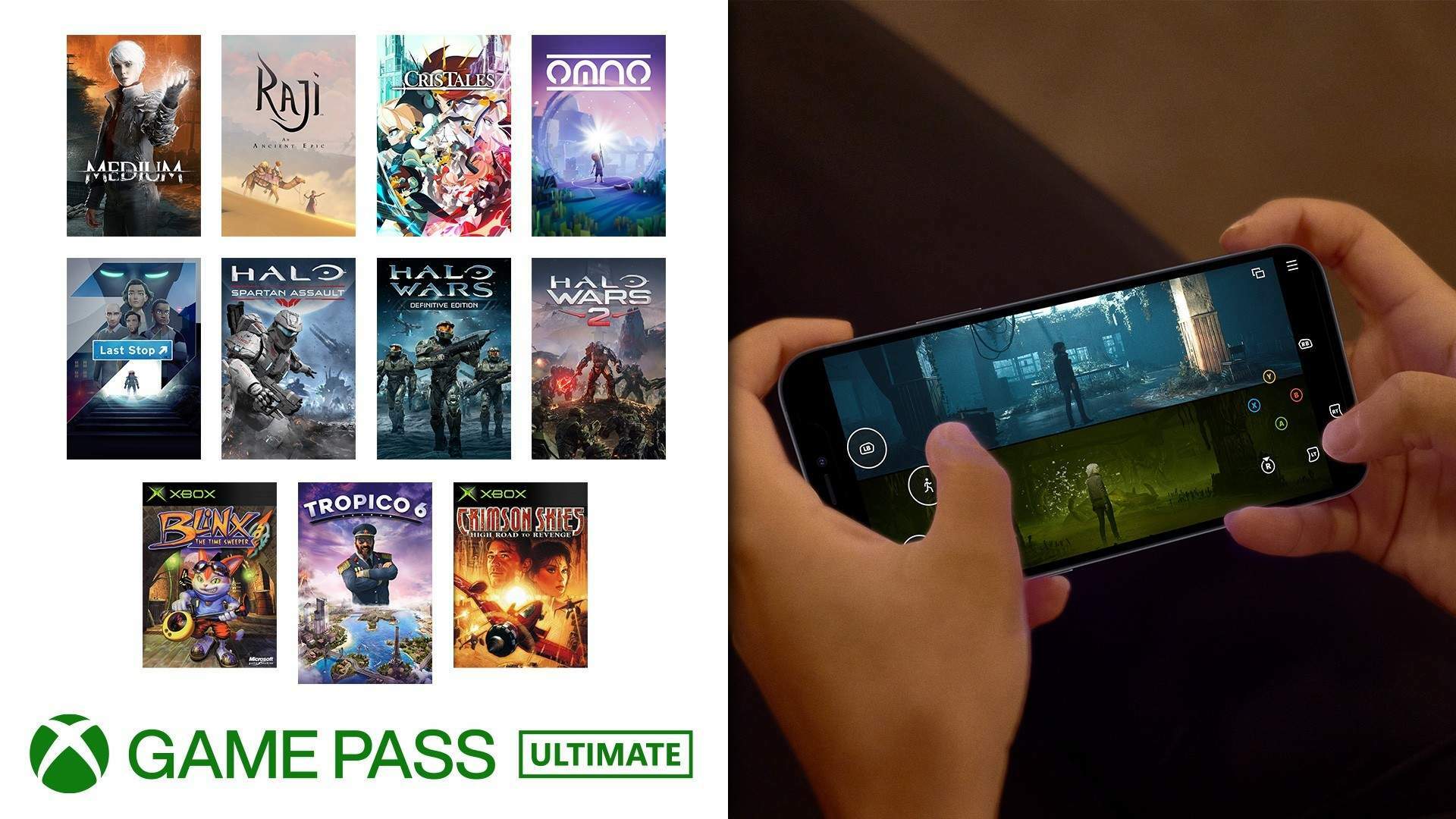
For Xbox Game Pass Ultimate subscribers, 11 more games now support touch controls for cloud streaming. including Halo Wars 2, Last Stop, and Tropico 6. Here is the full list.

Game Pass Titles That Now Support Touch Controls (September 2021):

  • Blinx: The Time Sweeper
  • Crimson Skies: High Road to Revenge
  • Cris Tales
  • Halo: Spartan Assault
  • Halo Wars: Definitive Edition
  • Halo Wars 2
  • Last Stop
  • Omno
  • Raji: An Ancient Epic
  • The Medium
  • Tropico 6
11 more Game Pass titles now support touch controls

And in terms of Xbox Game Pass titles leaving the program, five are on the way out on September 31. These include Warhammer Vermintide II, Kathy Rain, Night in the Woods, Ikenfell, and Drake Hollow. Members can purchase these for 20% off before they go away.

Xbox Game Pass Titles Leaving September 31

  • Drake Hollow (cloud, console, PC)
  • Ikenfell (cloud, console, PC)
  • Night in the Woods (cloud, console, PC)
  • Kathy Rain (PC)
  • Warhammer Vermintide II (cloud, console)

Xbox Game Pass is a subscription-based service that grants access to a wide library of games. Individual console and PC subscriptions are available for $10 per month apiece, or as a combined Xbox Game Pass Ultimate subscription that also includes cloud gaming and Xbox Live Gold for $15 per month. The cloud gaming beta recently expanded to PC, giving PC players access to some previously console-only games.

The Guilty Review

The Guilty was reviewed out of the Toronto International Film Festival, where it made its world premiere. It will have a limited theatrical release on Sept. 24 and hit Netflix on Oct. 1.

A one-location, mostly one-man show from director Antoine Fuqua, The Guilty follows a 911 dispatcher in a race against time as he scrambles to save a kidnapped woman on an L.A. highway. As a self-contained movie, it’s occasionally thrilling, and features an explosive and engaging lead performance by the ever-reliable Jake Gyllenhaal. However, as a remake of Denmark’s 2019 Oscar entry Den skyldige, it occupies a strange place as a beat-for-beat carbon copy that attempts to re-frame its story for modern America without changing all that much.

Gyllenhaal plays Joe Baylor, a short-tempered LAPD beat cop on his final early-morning dispatch shift before being let back out on the streets. He’s due in court later that day for reasons the film withholds, and raging California wildfires have complicated his last day manning the phones. He has little time or patience for calls that aren’t life-or-death, and he even blames several callers for their own misfortunes. But when he gets a mysterious call from a distressed woman being held in a moving van — Emily (Riley Keough), who pretends to be speaking to her young daughter to avoid tipping off her ex-husband, Henry (Peter Sarsgaard) — Baylor’s night takes a number of winding turns, and he begins to play fast-and-loose with standard procedure.

The film rarely cuts away from Gyllenhaal, who anchors the American version of the story with a mix of aggression and exhaustion. Baylor fancies himself a righteous protector, even though neither the people of L.A., nor the coworkers he rubs the wrong way with his temper, seem to agree. Like in the Danish film, the character’s self-righteousness is one half of what drives him to go off-book and bend the rules if it means bringing Emily home safely to her daughter. The other half of his motivation, however, was concocted for the remake (which was written by True Detective creator Nic Pizzolatto), and adds significant thematic heft. Unlike the dispatcher in the original, Baylor is a father to a young girl, and his impending court case has put significant strain on his marriage. In Emily and Henry, he sees two versions of himself — a loving parent, and a seemingly violent man who deserves to be punished for his transgressions — and so the situation becomes immediately personal.

In addition to this change in backstory, the remake also makes a few notable aesthetic adjustments. The dispatch center in Fuqua’s version is much gloomier, and the way he and cinematographer Maz Makhani capture Baylor adds a sense of unease. Their camera floats and shakes with every new reveal and each time Baylor’s emotions intensify, and even though the character is mostly shot in close-ups, the long lenses both obscure him behind computer screens and other obstructions out of focus, and create a haze of light around him from sources in the distance (the room is much bigger than in the original, too). The result is a constant lack of clarity, both in Baylor’s background and in what lies in front of him, and even his most intimate moments feel as though they’re being peered in on from a distance.

However, despite these adjustments that work in a micro, moment-to-moment sense, the overarching changes feel strangely noncommittal. The wildfires raging elsewhere in the city are a nice location (and era) specific touch, and they occasionally throw obstacles in the path of the officers and other dispatchers who Baylor speaks to over the phone, but the film also steps outside the dispatch office on two occasions, to briefly portray the chase as it unfolds amid the fiery mayhem. These scenes of smoke and ash fade over Baylor’s close-ups, and whether they’re meant to portray the reality of events on the ground or merely Baylor’s conception of them, they end up so fleeting and infrequent as to be almost meaningless. For a film that stays fixed on one character and his mood for nearly 100% of its runtime, these rare moments when it breaks away from him add little to his story. The imagery is intense, and the fades border on impressionistic — no other characters are seen around the flames, only hints of people, vehicles and ideas, contrasted with Baylor’s close-ups in a cold constricting environment — but these shots aren’t employed with much thought toward what this raging fire represents for Baylor, beyond the mechanics of the plot. Before long, the film discards what could have been an interesting visual idea.

The other idea that feels only half-committed to is what the film wants to say about policing. Like the original story, it uses the systemic abuse of power as a general backdrop, between Baylor’s past actions (which the film reveals at dramatically precise moments) and his callousness toward several callers. But in both the original and this remake, this premise is merely an excuse to focus on a powerhouse performance, which, in this case, sees Gyllenhaal plunge into a desperate fury, which in turn forces Baylor to reflect on himself as more details of Emily’s case come to light. The film is intimate, but isolated; it isn’t a story about top-down corruption, or about structures that protect violent offenders in uniform, even though these are part of its setting. It doesn’t need to be these things, either — it’s a mere slice of the bigger picture, not a telling of the bigger picture itself — but Fuqua and Pizzolatto attempt to sprinkle additional commentary on top of the existing story, rather than weaving it organically into its plot or characters.

The overarching changes feel strangely noncommittal.

Like the original, The Guilty is inherently constricting from a thematic standpoint. Its hyper-focus on one single character leaves little room to explore the wider world around him — this is by design. Using this structure to make broader statements about American policing, without also adjusting the plot or the one-location gimmick, results in half-hearted commentary that takes the form of stray lines of dialogue from minor characters who don’t factor into the story, and audio clips of news broadcasts meant to evoke recent conversations about policing and injustice. These are about as useful to a claustrophobic thriller as captions explaining the subtext, as if viewers might miss the fact that Baylor is a cop with anger issues after the tenth time he snaps at his coworkers.

Despite its clumsy attempts at social commentary — in a story where the commentary was already apparent — The Guilty proves to be riveting at times, thanks to Jake Gyllenhaal’s performance, and the way he wears complicated and conflicting emotions on his sleeve. Those who enjoyed the original will likely find little else to grab onto, but both versions are worthwhile for their leading men, and you could do a lot worse than 90 minutes of Gyllenhaal at his most intense.

Idris Elba’s Luther Is Becoming a Netflix Movie

Idris Elba is reprising his iconic role as DCI John Luther for a new Netflix film that will also star Andy Serkis and Cynthia Erivo.

Netflix announced the news on Tuesday, revealing the first batch of cast members reporting for duty on the Luther feature film penned by series creator Neil Cross. Elba will appear alongside franchise newcomers Serkis, star of The Lord of the Rings and The Hobbit movie trilogies, and Erivo, who is coming off of starring as Aretha Franklin in S3 of Nat Geo’s Genius.

The Hollywood Reporter decided to crack open the dossier on the newly-announced Luther film and discovered that Jamie Payne, who directed the fifth season of the acclaimed crime series, is on board to helm the drama’s first feature-length outing, which is being made by Netflix in association with the BBC and begins shooting in November.

According to the trade, the upcoming film will act as a “continuation of the Luther saga” with Elba’s titular character back in business donning his proverbial detective hat once more as he comes up against a double threat. Erivo is playing a fellow detective, described as “Luther’s nemesis,” while Serkis is referred to as “the story’s criminal villain.”

Speculation surrounding a Luther film swirled for years prior to this announcement. It was previously reported that Elba had been tapped to star in a Luther prequel film that would trace the character’s early career as a cop while his marriage to Zoe is still intact. However, that feature-length project failed to get off the ground.

This time, Elba is returning to star in and produce the Netflix movie with Luther series creator Neil Cross. Peter Chernin, Jenno Topping, and David Ready of Chernin Entertainment are also onboard to produce while Chernin’s Dan Finlay is serving as executive producer, together with Kris Thykier, and BBC Studios’ Priscilla Parish.

Adele Ankers is a freelance writer for IGN. Follow her on Twitter.

The Nintendo GameCube Is Twenty Years Old Today

Two decades ago on September 14, 2001, the Nintendo GameCube officially launched in Japan. Nintendo fans in the US would have to wait until November 18 to get their hands on the console, while European markets officially received units of the successor to the N64 in May of 2002. Nintendo’s latest gaming device was the first home console from the company to use optical discs, as even in the era of the PlayStation and the Sega Saturn, the company had stuck to cartridges for the N64.

In typical Nintendo style, the GameCube made an effort to stand out from the pack with several interesting design choices. Games shipped on mini-discs that could hold 1.46 GB of data and were designed to prevent piracy, while the format also conveniently allowed Nintendo to avoid having to pay licensing fees to the DVD Forum, a consortium responsible for developing DVD technologies.

Nintendo GameCube
Nintendo GameCube

That decision did result in the GameCube having no DVD playback features, a selling point that Sony used to shift record numbers of PlayStation 2 consoles in the market as consumers bought into the idea of an all-in-one home entertainment unit. The Panasonic Q version of the GameCube did eventually turn the console into a home DVD player, but that stainless steel version was a Japan-exclusive.

What the GameCube lacked in movies though, it more than made up for with the games that were available on it during its run. Titles such as The Legend of Zelda: The Wind Waker, Super Mario Sunshine, Luigi’s Mansion, Pikmin, Metroid Prime, and Super Smash Bros. Melee weren’t just great games to play, they became milestone entries in the Nintendo library and memorable experiences to anyone who owned them. Third-party exclusives also made a big splash, with two prime examples being the Metal Gear Solid remake Twin Snakes that was co-developed by Silicon Knights and Resident Evil 4, which was a GameCube exclusive until it wasn’t.

Compared to other consoles, the GameCube also stood out with its physical design. Living up to its title, the boxy console came in a variety of colors, had support for up to four players, and a convenient handle at the back for when you wanted to take it with you to a friend’s house. Possibly the best feature of the console was its controller, which improved tremendously on the dangerous groin-puncturing angles of the N64 peripheral and featured more gentle curves in its shape.

For Smash Bros. purists, the GameCube controller is the only controller worth having for serious competitive play, and Nintendo brought out Wii U and Switch-compatible versions of the controller in the years after the GameCube left the market. The GameCube wasn’t a runaway sales success for Nintendo though, as despite having strong momentum on launch, it couldn’t match the PlayStation 2’s mainstream appeal and only managed to sell 21.74 million units. This made the GameCube Nintendo’s second worst-performing console ever, only above the Wii U which sold 13.56 million units during its lifespan.

Nintendo announced in February 2007 that it had ceased first-party support for the GameCube, with the company focusing instead on the Nintendo DS and Wii consoles. The GameCube may not have been Nintendo’s most successful console, but it left behind an influential legacy of terrific video games and one of the best controllers of all time. Plus, it was the only home console that you could play the Donkey Konga drums on.

Ubisoft’s Driver Game Is Becoming A Live-Action TV Show

Ubisoft’s Driver video game series is becoming a TV show. Ubisoft has announced a deal with the new gaming-focused streaming service Binge for a live-action Driver TV show.

The show is being developed exclusively for Binge.com, an upcoming streaming service from Allan Ungar, the director of that incredible live-action Uncharted fan film with Nathan Fillion. Ubisoft’s Film & Television department is producing the show alongside Binge.

A Drive TV show is coming to Binge

Binge was announced during E3 2021. It will focus on producing streaming video content specifically for gamers. The company is aiming to do it “in a way that respects the fans and the games that inspire them,” Bingie says. Binge is scheduled to launch in 2022.

Ungar said in a statement, “Having the opportunity to adapt Driver alongside the team at Ubisoft Film & Television is a dream come true.”

Ungar added: “As longtime fans of the franchise, we’re excited to deliver an original, premium and rich storytelling experience that will take fans and newcomers on a thrilling ride.”

Binge and Ubisoft will announce more details on the Driver series “at a later date.” The game series dates back to the ’90s and has spanned numerous entries over the years. The latest installment in the series for console was 2011’s Driver: San Francisco, which was followed up by Driver: Renegade 3D for the 3DS and Driver Speedboat Paradise for iOS and Android.

Binge isn’t ready to talk specifics, but the company says it has already reached deals with “incredible partners,” including “the world’s most popular content creators, game publishers, and studios.” The new original series will cover retro, indie, and blockbusters titles alike. “From cult classics to the biggest hits, Binge provides a premium platform for every story,” reads a line from the press release.

Binge has a feature called Squad Parties which allows users to watch together and earn rewards for doing so.

You can sign up for updates on Binge’s website here. Binge has no connection to the streaming service called Binge that’s already available in Australia.

GameSpot may get a commission from retail offers.

Lost in Random Review – Six Appeal

Lost in Random makes a poor first impression. The overly dark and dreary opening areas are disjointed, rushing through the setup in a confusing and off-putting manner. It feels like you’ve been dealt a dud hand. Persist, though, and the cards start falling into place. The deck-building strategic layer gradually settles until it successfully blends with the core action of the combat, and the world eventually reveals a much more interesting, brighter, more colorful and character-filled side. Lost in Random overcomes a rocky start to tell a genuinely affecting tale of friendship, sibling bonds, and the cruelty of inequality.

The world of Random is ruled by a capricious Queen who determines the fates of her subjects with a roll of the dice. Ones are left to labor in the working-class slums while Sixers are whisked off to the Queen’s castle in the clouds, their newfound societal elevation relieving them of the burden of ever again interacting with the poor. Even is a young girl living in Onecroft when her older sister, Odd, rolls a six and they become separated. Even is rightly suspicious of the Queen and so sets out to rescue her sister.

Even quickly recruits a companion, Dicey, and learns how to fight by playing cards and rolling a dice–and yes, before you say anything, the game uses “dice” not as a plural but as a singular. Combat is the heart of this action-adventure, and it takes a bit of getting used to. Even can’t attack enemies without first playing a card that grants her an ability, but to be able to play a card at all she must first collect enough crystals to be dealt one. When she has cards up to a full hand of five she can roll Dicey and play a number of cards equal to the number on the dice. What at first feels like a lot of unnecessary complications soon comes together to offer plenty of clever tactical and strategic choices.

Throughout combat, there are always different approaches to take. The crystals used to power the dealing of cards can be collected from range by using Even’s basic slingshot to shoot clusters attached to enemies, or up close by correctly timing a dodge through an enemy while it attacks. Just this simple distinction fosters two separate play styles.

Cards offer a wide range of abilities that allow you to further tailor your style of play. Some grant weapons, equipping Even with a sword capable of quick slashes, a giant hammer for heftier blows, or a bow and arrow, among others, all of which deal direct damage to enemies while letting you make meaningful choices about whether to do so from range or in melee, fast and light or slow and heavy.

Other cards allow you to deploy various assistants on the battle arena in the shape of what are essentially a range of mobile and stationary turrets, each of which will do their own thing but hit hard when they connect. Here, you’re trading the reliability of using your own weapon for the potential to deal much greater damage. You can even turn Dicey into a bomb, but honestly, it feels a bit rude. The poor guy’s got enough on his plate as it is.

The selection of cards I found myself drawn to was the slightly more esoteric picks. One lets you deal damage to an attacking enemy when you dodge through it, and another enables you to deal damage to an enemy whenever you shoot a crystal cluster off them. There are loads of others, too, adding poison attacks, slowing down time, several methods of healing and granting additional card uses, and so on. It adds up to a lot to consider and the limits on how and when you can play your cards force you into important tactical decisions throughout every combat encounter.

There’s a recurring concern about abiding by or rejecting the rules, and how willing people are to accept their place in life. Or indeed, accepting the idea that there is a place in life to accept

You’ll settle on some favorites and discover how certain cards compliment others, but then a new enemy will show up, or a new combination of enemy types will appear together, to confound your planning and force you to reconsider. Your deck is limited to 15 cards, including multiples of the same card if you have them, and during combat the deck is shuffled between each hand, meaning you can’t always rely on getting dealt the exact cards you want in any given situation. And even if you get lucky and find yourself dealt the hammer and the healing that you wanted, for example, if Dicey only rolled a 1 then you’re only able to play one of them.

Improvisation is vital, and what’s impressive is how regularly Lost in Random places you in a tight spot and provides you with the tools to get out of it, even if they weren’t the specific tools you had in mind. While every card is useful, there were quite a few occasions where I realized I’d entered a combat encounter with a deck balance ill-suited to the task at hand. That I still managed to struggle through in many of those occasions is a credit to the flexibility of the combat system. And when I didn’t, it was simply a case of dying, tweaking my deck, and trying again. There’s no punishment for failure.

Outside of combat, Lost in Random is less sure of itself. Even travels the six worlds of Random, each modeled on a different face of the dice, chasing up tenuous leads in pursuit of her sister. Exploring these worlds is cumbersome, with Even’s inability to jump (except at certain prescribed locations) and tendency to get snagged on irregular shapes in the environment making basic traversal rather awkward. Although quite distinct from each other, the worlds feel samey within, full of new passageways that look like the one you just visited and mostly absent of truly memorable locations.

True to the oppressive nature of the Queen’s rule, the worlds too often feel lifeless, despite the best efforts of the many people Even can stop and talk to and run quests for. Too many areas remain etched in shadow and shrouded in fog, sadly dulling the more eye-catching sights and diminishing an incentive to explore. Offering relief from the relentless gloom elsewhere, later areas are more likely to be brightened by sunlight and provide a superior showcase for the consistently surreal fairytale architecture. It’s just a shame that so much of the creativity and imagination of the landscapes finds itself obscured.

Still, it’s worth exploring every nook and cranny to chase down every last treasure pot hidden throughout Random, plundering extra loot to allow Even to purchase more cards to take into battle. More cards mean more options to build your deck and more choices to make in combat, further enhancing the game’s greatest strength.

And despite the lackluster environments making it tough to truly feel invested in the fate of Random, the city’s people will win your heart. Even is such a wonderful central character. She’s tenacious and stubborn and fearless, like a kid who has yet to understand the limits of her ability to change the world. But she’s also tender and worried and full of doubts about what she’s doing and her place in the world. Clever writing of her conversations with Dicey–he speaks only in unintelligible noises, but Even understands him and you can parse what he’s just said by the various dialogue options she can choose in response–reveal a strong friendship built on bonds of trust and a shared sense of humor. They both emerge as well-rounded–or perhaps well-cubed–and memorable characters who possess a genuine affection for each other.

No Caption Provided

Gallery

Random is full of similarly memorable characters, albeit none as quite so fleshed-out as the two leads, all sending Even on a quest that will at some point tie into her main objective and intersect with the central narrative themes. There’s a recurring concern about abiding by or rejecting the rules, and how willing people are to accept their place in life. Or indeed, accepting the idea that there is a place in life to accept. Random is a world ruled by the 1% who decide, on a whim, at the roll of the dice, the life of everyone else. It’s a world where that power has so far remained unchallenged because divisions are sewn to pit its people against each other, to distract them from the actual source of their misery and oppression. At one point, Even remarks, “You grow up with it so you think it’s normal, but the whole thing is madness.” She’s talking about dice determining a person’s fate, but she could easily be talking about many aspects of our neoliberal capitalist world and the severe inequality it continues to inflict on all of us.

Lost in Random may have the look of a grubby Dickensian child, yet there’s a surprising amount of meat on its bones. It may not always do its world justice, but there are charming and stirring stories to find if you can see through the dreary fog. In one memorably witty scene, it even manages to redeem its consistently incorrect use of “dice” to represent the singular. And best of all, there’s a great combat engine that smartly implements deck-building mechanics to reward both strategic preparation and tactical invention. Make it past the slow start and you’ll be lost in no time.

PS5’s SSD Expansion Update Arrives Tomorrow for all Users

We already knew that Sony planned to offer support for PS5 owners to expand their internal storage in their console. Today, the gaming giant announced that the next major system update will roll out to everyone tomorrow.

The second major PS5 update will allow users the option to install their own M.2 SSD drive to expand the internal storage in their console with compatible SSDs ranging from 250GB to 4TB. Sony previously detailed which M.2 SSDs are compatible with the console and that any compatible M.2 SSD you install will require a heatsink to dissipate any additional heat generated by the new SSD.

Previously, PS5 owners could use external hard drives or SSDs, but the use was limited in various ways. In an April system update, Sony did allow PS5 owners to move PS5 games stored on the internal SSD drive to compatible external USB drives, but you could not play the games stored there.

Along with SSD expansion, Sony also noted in a detailed PlayStation blog post that the September system update will also include user experience enhancements. This includes more transparency on cross-gen games; if a game includes a PS4 and PS5 version, both versions will now appear separately in the “Installed” tab of the Game Library as well as the system’s Home screen.

Other quality of life improvements coming to the PS5’s UX include equalizer settings for Pulse 3D headset owners, a new trophy tracker that lets you keep track of your trophy progress in the Control Center, as well as the option to choose which Control Center functions are visible at the bottom of the screen.

PlayStation Now subscribers will also benefit from the new update, allowing them to choose between 720p or 1080p resolution (depending on the individual game you are streaming), as well as a new connect test tool that allows you to troubleshoot any problems with your connection seamlessly.

Taylor is the Associate Tech Editor at IGN. You can follow her on Twitter @TayNixster.

Andrew Garfield Had ‘a Few Meetings’ About a Spider-Man vs. Sinister Six Movie

Andrew Garfield says that he had a ‘few meetings’ about a Spider-Man vs. Sinister Six movie, before Spidey became part of the MCU.

In an interview with Collider, Garfield was asked whether he had met up with director Drew Goddard around the time that a potential Sinister Six movie was set to be made, and discussed how close the film came to becoming a reality.

“I don’t know how close it got, but I definitely had a few meetings, and it was really exciting,” said Garfield. “I’ve got to say, because I love Drew so much, and I love Cabin in the Woods, and the other stuff that he’s made. We just got on like a house on fire. I loved his vision, he’s so unique and odd and off-kilter and unconventional in his creative choices. So that was definitely a fun couple of months, but life.”

Garfield played everyone’s friendly neighborhood web-slinger across Sony’s two-film reboot of the superhero franchise in 2012 and 2014 respectively. Despite on numerous occasions speaking about his love for the role, Garfield was replaced as Peter Parker by Tom Holland in 2015 as Sony scrapped the Amazing Spider-Man series and the hero moved over into the MCU. At the time, Garfield had said that he’d felt a “little heartbroken” by the news that he wouldn’t be returning to play Spider-Man for a third time but also stated that he was excited “just to be a fan again.”

In among the news that the character was transferring into the MCU and that Garfield’s Amazing Spider-Man series would be shelved by Sony, any talk of a Sinister Six movie quickly died down as the unproduced film became another product to be scrapped as a result of the deal between the two companies.

While it’s been seven years since fans last saw Andrew Garfield sporting the webhead’s famous red and blue spandex, many fans are hoping to see the actor return to the franchise in Marvel’s upcoming Spider-Man: No Way Home. The title, which has already teased characters from across both Garfield’s Amazing Spider-Man series and Sam Raimi’s earlier trilogy of films, will release on December 17.

With the film’s teaser trailer showing off what seems to be Tom Holland’s portrayal of Peter Parker haphazardly opening up the MCUs version of the multiverse, a return for Garfield as Peter Parker could feasibly be on the cards. Despite a flurry of rumors and speculation surrounding Garfield’s return in No Way Home, however, the actor has stood firm on speculation, emphasizing on a number of occasions that he is not involved in the upcoming movie.

Jared Moore is a freelance writer for IGN. You can follow him on Twitter.

PS5 Update Gives All Consoles M.2 Drive Support Tomorrow

Following a two-month-long firmware test where users could expand their PS5’s storage with an NVMe M.2 SSD, Sony is comfortable with giving extra drive support to the masses. A system update for the PS5, slated to launch tomorrow, will enable M.2 storage expansion for the console, along with 3D audio and some other quality-of-life changes.

M.2 NVMe SSDs, which can be found on the shelves at any brick-and-mortar electronics store, are the same as what users can find inside of their PS5 or Xbox Series X|S. While Microsoft’s expansion option is proprietary, Sony is giving PS5 users a bit more choice. There is still a slew of specs that M.2 SSDs have to adhere to for use in a PS5, including PCIe Gen4 support, but a number of currently available drives either meet or exceed them.

Tomorrow’s system update for the PS5 will also bring the console’s 3D audio tech from headsets to built-in TV speakers. Players will be able to measure the acoustics of their room using their DualSense controller and accurately have their two-channel built-in TV speakers output three-dimensional sound. Owners of Sony’s Pulse 3D Wireless Headset will likewise receive access to an equalizer as part of tomorrow’s update. It’s not clear if users will be given the option to tune other headsets in the future.

Some quality-of-life changes are also coming with tomorrow’s update, mostly centered around the PS5’s various UIs. After downloading tomorrow’s PS5 system update, players can customize their Control Center by rearranging or hiding certain buttons, send messages from the Game Base, and see more details at a glance about their owned games in the Game Library.

Here are the full patch notes for September’s PS5 software update:

PS5 September system software update changes

PS5 UX Enhancements

The PS5 September Update features new UX enhancements that make it easier than ever for players to view, personalize and manage their game content and console experience:

  • Control Center customization. Players can now customize their Control Center more freely by rearranging or choosing which controls to hide or unhide at the bottom of the screen.
  • Enhanced Game Base. Players can now easily view and write messages to friends and Parties directly from Game Base in the Control Center.
  • Game Library and Home Screen updates. If you have PS4 and PS5 versions of the same game installed, they’ll now appear separately in the “Installed” tab of the Game Library and on the Home screen. Each game’s tile now also clearly indicates its platform.
  • Screen Reader controls. Players can now pause or resume Screen Reader (Press “PS + Triangle buttons”) and have it repeat anything it reads (Press “PS + R1 buttons”).

New Gaming and Social Experience Customizations

  • PlayStation Now resolution selector and connection test tool. PlayStation Now subscribers can choose between 720p or 1080p (depending on individual game) to accommodate their preferred video resolution for game streaming. A streaming connection test also helps them identify and troubleshoot any problems with their connection.
  • New Accolade Type: “Leader.” Following an online match, players can award others with a fourth accolade type, “Leader,” which is visible on players’ profiles.
  • Automatic capture of “personal best” videos. When players compete in challenges for a better time or a higher score and set a new personal best, a video clip of the action will automatically be recorded. Players can also share clips of their personal bests directly from the challenge card in the Control Center, or from their Media Gallery. Players have direct control over this functionality via their Captures and Broadcast settings.
  • New Trophy tracker. We’ve added a new Trophy Tracker that lets players quickly access up to five trophies per game through the Control Center.

3D Audio Support for Built-In TV Speakers

The PS5 September Update adds support for players to experience 3D audio through their built-in TV speakers. Once enabled in the Sound menu, this feature transforms standard two-channel TV speaker audio into three-dimensional sound, heightening the sense of gameplay immersion.* Players can measure the acoustics of their room using the microphone on their DualSense wireless controller to apply the 3D audio setting that’s optimized for their room.**

3D audio via compatible headsets on PS5 has been a popular feature among fans and developers. We’re thrilled to bring this feature to life for players directly through their built-in TV speakers, in addition to the headset support that’s been available since launch.

In addition, players with a Pulse 3D Wireless Headset now have access to equalizer settings within Sound Controls, allowing them to customize the sound profile according to their preference.

M.2 SSD Storage Expansion

Starting tomorrow, PS5 players around the globe can expand their storage capacity with an M.2 SSD, a type of high-speed solid state drive that can be installed in the PS5 console or PS5 Digital Edition console.

Once installed in the PS5 or PS5 Digital Edition console, M.2 SSD storage can be used to download, copy, and launch PS5 and PS4 games, as well as media apps. You can play PS5 and PS4 games directly from M.2 SSD storage and freely move games between storage options.

PS Remote Play App and PS App Enhancements

  • PS Remote Play App over mobile networks
    • With the PS Remote Play app, players have enjoyed the ability to remotely stream and play PS4 and PS5 games, switch between games, and browse their console’s menus on any compatible device connected to their broadband network.*** Now, players using the mobile app for iOS and Android have the option of using a mobile data connection when WiFi is not available.
    • Broadband internet with at least 5Mbps is required for PS Remote Play. For the best experience, we recommend a high-speed connection with upload and download speeds of at least 15 Mbps.
    • To help manage the amount of data used through a mobile connection, players can select their preferred video quality for mobile data streaming.
    • Please note the quality and connectivity of your Remote Play experience may vary depending on your mobile carrier network and network environment.
  • View Share Screen broadcasts on PS App
    • Starting next Thursday, Sept. 23, a PS App update will begin rolling out globally and give users the ability to view their friends’ Share Screen broadcasts together.
    • To start, join a party voice chat from your mobile device with a friend who’s playing on a PS5 console. Then ask your friend on PS5 to start their Share Screen broadcast. Please note, only players on PS5 can broadcast via Share Screen.
    • The Android version of the update is a phased release and may take one week until the update is available on your mobile device.

PS4 Console Enhancements

We’re also introducing some new features for PS4, including the ability for players to view their PS5 trophies on their PS4 profile and Trophy list. Players can also view other players’ PS5 trophies on PS4. On both PS4 and PS5 consoles, Party owners now also have the ability to disband a Party without having to remove players individually.