Dead Space Doesn’t Need A Remake, But Here’s How It Could Benefit From One

Few games hold up as well as Dead Space. Despite releasing 13 years ago, Visceral Games’ space horror shooter is still as intense and scary today as it was then. In fact, it’s shockingly good–you can get it on PC right now, and it still controls exceedingly well, features some great shooting mechanics, and looks pretty great.

But most importantly, Dead Space can still scare the hell out of you, with a combination of great sound design, excellent jump scares, ridiculously gross monsters, and awesome set piece moments.

So that’s what makes the rumors of a Dead Space remake coming from EA Motive so…weird. Supposedly, Electronic Arts looked at the massive success of Capcom’s Resident Evil 2 remake and thought that Dead Space was ripe for a similar treatment. But Resident Evil 2 on the original PlayStation is today, realistically, kind of ugly and clunky. It’s a tough game to go back to in its original form despite being full of great ideas and frightening moments. It’s the kind of game where a visual and mechanical overhaul helps bring its best ideas forward into a modern setting.

Meanwhile, Dead Space might be getting on in years, but the technical leaps from the seventh generation of consoles to now aren’t nearly as drastic as those from the PlayStation 1 era. Games from 12 years ago play pretty much the same way as they did then, and they still look pretty damn good. As a massive Dead Space fan, I’ve been itching for that franchise to be reinvigorated in some way (although without Visceral behind it [RIP], will it even be the same?), but a remake seems like an unnecessary expenditure of resources for an already great game.

The more I think about it, though, the more I think it’s possible for a remake of Dead Space to do wonders for the phenomenal and distinct franchise. There are a ton of great ideas that don’t need changing in Dead Space, and while a graphical overhaul would be nice, it’s definitely not essential. But there’s a whole lot of room for a remade Dead Space to expand itself and revive the whole franchise like yet another unkillable necromorph: through story.
No Caption Provided

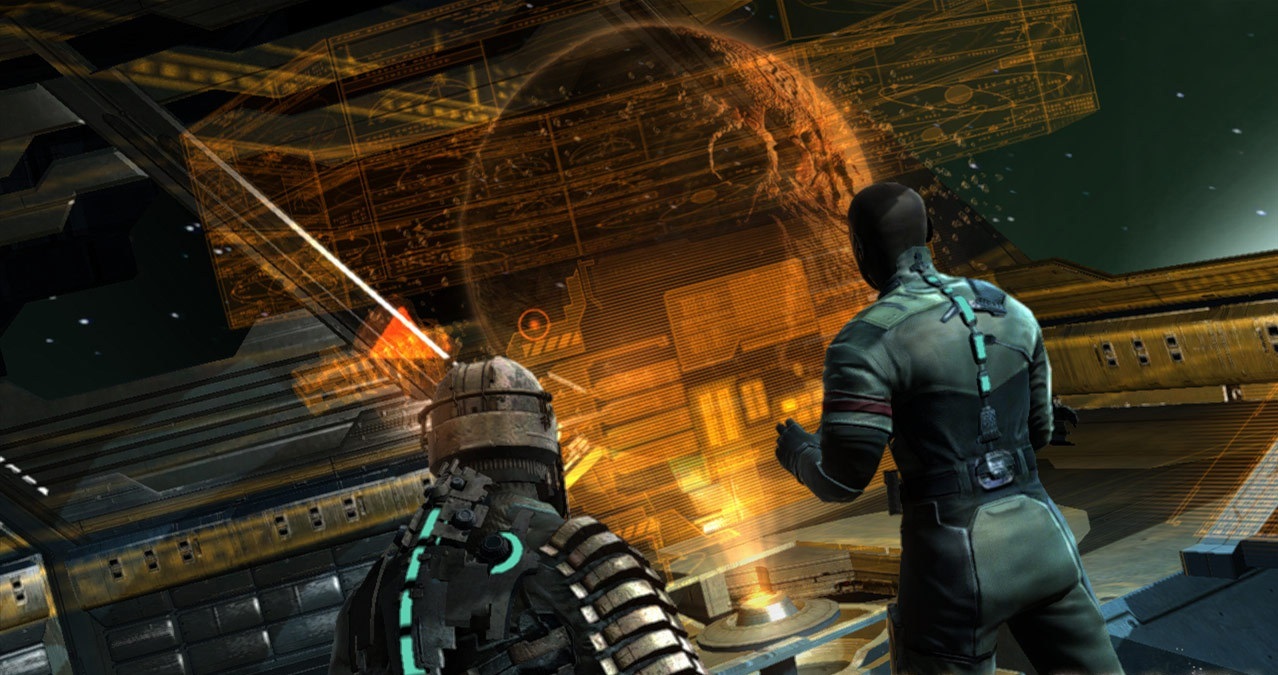
When it was released, Dead Space came at a time when games were starting to really lean into doing some smart things with narrative but didn’t quite have the resources or graphical power to put that narrative on screen. The result was (and is) a heavy reliance on audio logs. Dead Space has characters who show up in certain places to talk with the player character, Isaac Clark, and they’ll call out on the radio to discuss objectives or pressing situations. But really, like BioShock and countless others from the era, Dead Space is a game when you arrive after the disaster–and the only way to learn about it is by finding tidbits left behind by the people who are already dead.

That setup is kind of fundamental to Dead Space, and I’m not advocating for a change to it (although, as Dead Space 2 showed, being caught in the middle of a disastrous outbreak of undead monsters is just as frightening as arriving in its aftermath). But there’s a lot that could be done to tweak Dead Space’s story and worldbuilding to make them more clear and immediate, to pull players in deeper, and ultimately make future Dead Space titles more viable.

The story of the USG Ishimura, where Dead Space takes place, is one tied to the planet Aegis VII. A mining colony, the people on the planet discovered an alien artifact called a Marker, which first started working on the colonists’ minds to make them hallucinate and go mad, eventually turning them into a bunch of mutated undead necromorph monsters.

You learn tidbits of this story from audio logs all over the Ishimura–how it arrived at Aegis VII just before the disaster, how it brought the Marker on board, and how it ultimately succumbed to madness and monsters of its own. But most of that story has to be imagined and parsed by the player, and we never see it play out during the game.

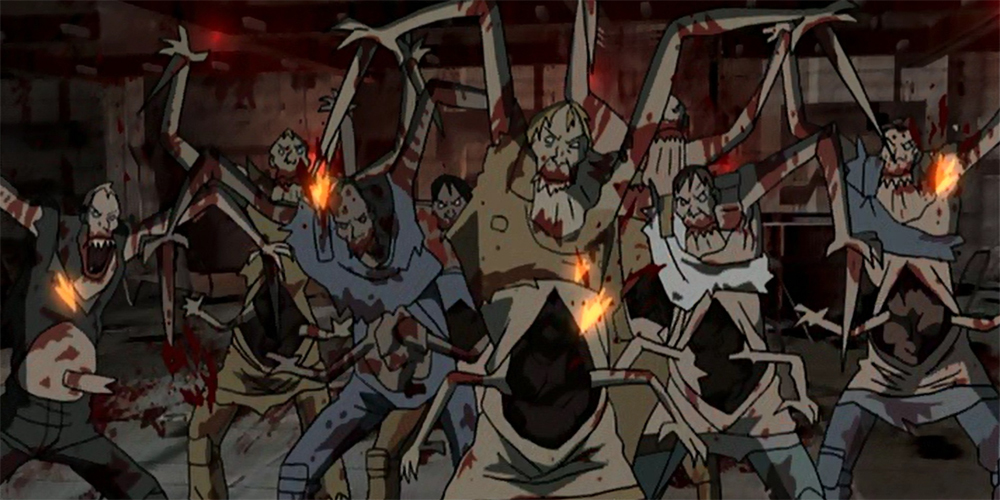
But Dead Space has a bunch of additional materials that fill in the gaps in what happened during that first game and could absolutely expand on what’s in a Dead Space remake. There’s a motion comic that was released beside the game that tells the tale of the outbreak on Aegis VII, and an animated movie, Dead Space: Downfall, that shows what happened aboard the Ishimura before your arrival. If you were a Dead Space player but not a die-hard fan, you’ve probably never seen all this extra material–to say nothing of the other comics and novels that tie into the universe.
No Caption Provided

So with advances in gaming tech over the last decade, plus a whole lot of ancillary story material that already exists, there’s no reason Dead Space has to relegate itself to being a story mostly told in audio logs and text messages. In fact, there’s no reason Dead Space has to stick with only the story of what happens in the existing game at all. Dead Space is actually a huge, interesting world, with a lot of moving political parts as relates to corporations, governments, militaries, and religions. They’re all essential to the story Visceral tells in this first game and in the subsequent games. Dead Space is already a really rich world with a lot of extra story material. And this is a perfect opportunity to get that stuff shown on screen rather than just piped through speakers or headphones.

I still love Dead Space as it was released in 2008, but if Electronic Arts wants a horror remake on par with Resident Evil 2, it has to take some serious notes from that game as well. RE2 isn’t just a spiffed-up version of an old game–it’s a reimagined version, with changes both subtle and expansive, to make it a better game in many respects. A lot less work needs to be done on Dead Space’s mechanics and visuals than was necessary for RE2. But when it comes to story, there’s a vast amount of interesting, disgusting, frightening stuff into which a new Dead Space could tap. EA can learn something from the haunting demands of the Marker: unify the story, expand the world, and make Dead Space whole.

Daily Deals: Check Out All These Early 4th of July Tech Sales

The long weekend is upon us, and to kick things off, we’re highlighting some of the best tech deals that Friday had on offer. Mac products are once again discounted at Amazon, so if you held off last time, it might be worth checking out the MacBook Pro or Air this time around. The Apple Watch Series 6 (the newest one) is also discounted, as are an array of other handy tech and household items.

Daily Deals for July 2nd 2021

[poilib element=”commerceDeal” parameters=”slug=daily-deals-july-2-2021″]

Night of the Animated Dead Will Reimagine George A. Romero’s Horror Classic

The zombie genre is returning to its roots. More than 50 years after its release, George A. Romero’s landmark 1968 feature Night of the Living Dead is getting an animated adaptation, per The Hollywood Reporter.

Night of the Animated Dead will feature characters from Romero’s original film. The voice cast includes Josh Duhamel as Harry Cooper, Dulé Hill as Ben, Katharine Isabelle as Barbara, James Roday Rodriguez as Tom, Katee Sackhoff as Judy, Will Sasso as Sheriff McClelland, Jimmi Simpson as Johnny, and Nancy Travis as Helen Cooper.

[ignvideo url=”https://www.ign.com/videos/2021/05/26/a-zombie-expert-answers-questions-about-the-undead”]

The new adaptation is being helmed by Jason Axinn, who last directed 2019’s animated horror film To Your Last Death. Warner Bros. Home Entertainment plans to release Night of the Animated Dead sometime this fall on Blu-ray, DVD, and digital.

Romero’s original Night of the Living Dead follows a group of strangers who take shelter in a farmhouse as the dead begin to rise and attack the living. Tensions come to a head when the survivors bunker down after night falls.

While the word “zombie” is never uttered in Night of the Living Dead, Romero’s film is largely seen as a horror touchstone that pioneered how the undead are portrayed within the genre. Romero directed five more sequels, including Dawn of the Dead, Day of the Dead, and Land of the Dead.

[widget path=”global/article/imagegallery” parameters=”slug=must-watch-horror-anime&captions=true”]

Though George A. Romero died of lung cancer in 2017, his widow Suzanne Romero is developing Twilight of the Dead, a new movie based on a project that the late director was working on before his passing. After working with a team of three screenwriters, Suzanne Romero is preparing to meet with directors for the project.

[poilib element=”accentDivider”]

J. Kim Murphy is a freelance entertainment writer.

Pokemon Wonder Is a Beautiful New Japanese Theme Park That Celebrates Nature

The story goes that Pokemon was inspired by kids collecting bugs in Japan, and as such the association with nature has always been a pillar of the franchise. The Pokemon Company is applying this philosophy to a brand new theme park in Japan.

As reported by Kotaku, The Pokemon Company has officially announced Pokemon Wonder, a 48,000-square foot forest theme park where its main attraction is experiencing nature and Pokemon together.

Rather than a traditional amusement park with rides and mascots, Pokemon Wonder is situated in a vast forest that remained untouched for 20 years. There, attendees can explore the forest and look for handcrafted Pokemon made from items like leaves and acorns.

You can check out a gallery of the park below.

[widget path=”global/article/imagegallery” parameters=”slug=pokemon-wonder-theme-park&captions=true”]

According to Kotaku, the park is located behind Yomiuriland, Tokyo’s largest amusement park. The Pokemon Company bills the park as a “nature adventure” and it will operate for a limited time in Japan from July 17 to April 3, 2022.

Exploring nature informs a lot of the Pokemon games. Walking about is a core part of Niantic’s Pokemon Go and this year’s Pokemon Go Fest will once again host live events outdoors.

The upcoming Pokemon Legends Arceus is also taking the outdoor concept to the next level with what looks like one of the biggest open-worlds in a Pokemon game yet.

[poilib element=”accentDivider”]

Matt T.M. Kim is IGN’s News Editor.

James Cameron Reveals How He Was High On Ecstasy When He Came Up With John Connor For The Terminator

Terminator 2 celebrates its 30th anniversary this year, and to mark the occasion, The Ringer has published a large oral history featuring James Cameron and other major creators associated with the film.

There are a number of interesting new tidbits scattered throughout the expansive piece, but there’s one in particular that talks about the origins of John Connor — the last hope of the human resistance and persistent target of Cameron’s killer robots from the future. It’s well-known that the idea of The Terminator came to Cameron in a dream, but he’s never really talked about the origins of John Connor himself, at least, until now.

[ignvideo url=”https://www.ign.com/videos/2019/10/30/the-evolution-of-the-terminator”]

As Cameron tells it, he was quite high when he conceived of John Connor, who is an unborn child in the original film and a snarky 90s kid in the sequel. Cameron remembers, “I remember sitting there once, high on [ecstasy], writing notes for Terminator, and I was struck by Sting’s song, that, ‘I hope the Russians love their children too.’ And I thought, ‘You know what? The idea of a nuclear war is just so antithetical to life itself.’ That’s where the kid came from.”

The song Cameron is referring to is titled, aptly enough, “Russians.” The song goes, “There is no monopoly on common sense / On either side of the political fence / We share the same biology, regardless of ideology / Believe me when I say to you / I hope the Russians love their children too.”

[widget path=”global/article/imagegallery” parameters=”slug=best-reviewed-movies-of-2021&captions=true”]

John Connor, of course, would go on to be a key part of the Terminator mythos. He is most famously played by Edward Furlong, who according to the oral history was cast off the street with no acting experience. Furlong purportedly nailed the audition on the first try, and Cameron had his John Connor.

We recommend giving the entire oral history a read, since it has a lot of fantastic info. In the meantime, check out our review of Terminator 2 on Blu-ray and where it ranks in the 25 best summer blockbusters of all time.

Game Scoop! 632: PlayStation’s Busy Week of Acquisitions Hints at Next-Gen Strategy

Welcome back to IGN Game Scoop!, the ONLY video game podcast! This week your Omega Cops are helmed by guest host Tina Amini, who is joined by Kat Bailey, Samuel Claiborn, and Justin Davis to discuss Sony’s purchase of Returnal developer Housemarue, Remedy’s announcement of a Control multiplayer spinoff, what Bloober and Konami’s partnership announced this week means for a potential for a Silent Hills return, and more… And as always, we play a rollicking round of Video Game 20 Questions!

Watch the video above or hit the link below to your favorite podcast service.

Listen on:

Apple Podcasts

YouTube

Spotify

Stitcher


Find previous episodes here!

Iceland May Be Connected to a Sunken Continent Named Icelandia, Study Finds

A new scientific report claims that there is a secret sunken continent under Iceland.

This news comes by way of StudyFinds, which reports that the belief that Iceland sits atop a sunken continent has long been held by some in the science community.

[ignvideo url=”https://www.ign.com/videos/2021/06/23/a-new-ocean-has-been-named”]

StudyFinds’ report is based off a scientific study published to GeoScienceWorld written by a team that believes Icelandia might be a sunken continent that spans 1 million square kilometers, or 386,102 square miles. Icelandia could stretch from Greenland to Europe and the team’s findings place its size at around 230,000 square miles.

However, it stretches to the 386,102 square mile number when discussing Greater Icelandia, which includes additional underwater land west of Britain, according to the report. While it’s not yet proven — a lot of very expensive tests will need to take place first to confirm initial findings — if the team does go on to prove Icelandia is a sunken continent, it could prove that Pangea, long thought to have been completely broken up, is not actually broken up in full.

The idea of continental crust existing under Iceland, rather than the oceanic crust long believed to have existed there, stems from the makeup of Iceland and the surrounding areas.

[widget path=”global/article/imagegallery” parameters=”slug=gorgeous-photos-of-earth-from-space&captions=true”]

“Until now, Iceland has puzzled geologists as exiting theories that it is built of, and surrounded by, oceanic crust are not supported by multiple geological data,” Durham University Emeritus Professor of Geophysics, Gillian Foulger, told StudyFind. “For example, the crust under Iceland is over 40km thick — seven times thicker than normal oceanic crust.”

“This simply could not be explained. However, when we considered the possibility that this thick crust is continental, our data suddenly all made sense. This led us immediately to realize that the continental region was much bigger than Iceland itself — there is a hidden continent right under the sea.”

If it’s determined that Icelandia is real, it could change country access to minerals and hydrocarbons in the area, according to StudyFinds.

[ignvideo url=”https://www.ign.com/videos/2015/01/21/japan-wants-to-build-an-underwater-city-ign-news”]

“Under certain conditions, the United Nations Convention on the Law of the Sea grants coastal states exclusive rights to the non-living resources of their adjacent seabed if scientists can prove that the seabed is a submerged extension of the continental landmass,” StudyFinds writes.

The team behind the science report is working with fellow scientists around the world to test their theory and once COVID-19 restrictions allow for things to resume as normal, the team could run electrical conductivity surveys and collect zircon crystals in Iceland and surrounding areas, according to StudyFinds. Other tests include “seismic profiling and drilling,” which would cost millions in funding, although the team believes that countries this could affect would help cover the cost.

“Countries around the world are spending enormous resources conducting subsea geologic research in order to identify their continental shelves and claim exclusive mineral rights there,” Durham University’s professor, Philip Steinberg, said.

[widget path=”global/article/imagegallery” parameters=”slug=google-earth-timelapse-1985-vs-2020&captions=true”]

“Research like Professor Foulger’s, which forces us to rethink the relationship between seabed and continental geology can have far-reaching impact for countries trying to determine what area of the seabed are their exclusive preserve and what areas are to be governed by the International Seabed Authority as the ‘common heritage of humankind.'”

In the meantime, someone should let Lars Eriskssong and Sigrit Ericksdottir of Eurovision fame know that it’s possible they don’t hail from a remote fishing village on Iceland, but possibly a remote fishing village that sits atop a whole secret continent. For more about what may be hiding under the ocean, check out this story about a reef discovered in Australian that’s taller than the Empire State Building.

[poilib element=”accentDivider”]

Wesley LeBlanc is a freelance news writer and guide maker for IGN. You can follow him on Twitter @LeBlancWes.

Zola Review

You can do one of two things with a crime caper based on a famous string of tweets. The first is a straightforward adaptation; the second and more oblique option is to recreate the feeling of watching a story unfold online. Zola, a darkly comedic romp directed by Janicza Bravo, tries to split the difference, both by fleshing out the 148-part Twitter novella by A’Ziah-Monae King (a.k.a. @_zolarmoon) and by staging a series of zany, disjointed comedic moments that feel like a seedy Florida fairytale. The film is amusing and incredibly sure of its narrative goals, even if the result is less compelling than King’s original thread.

The film, like the Twitter tale, begins with the now-popular refrain: “Y’all wanna hear a story about why me & this bitch here fell out? It’s kind of long but full of suspense.” The description undoubtedly applies to King’s narrative micro-drip, a mostly-true story in which she’s roped into a road trip with a white sex worker named Jessica, her boyfriend Jarrett and her pimp, “Z” — named Stefani, Derek, and “X” in the movie — in a scheme that goes from bad to worse as the group weaves in and out of the orbits of various gun-toting side characters. The film, while less suspenseful, retains the story’s Murphy’s Law conceit by sprinkling surprising oddities throughout its 90-minute runtime. Where it stands out in the comedy landscape, however, is in its mimicry of social media. It isn’t just an adaptation of a story told on Twitter, but an approximation — to a fault — of what it feels like to be terminally online, with all the resulting anxieties.

Zola (Taylour Paige) meets fellow pole dancer Stefani (Riley Keough) while waitressing at a Detroit restaurant, and the two immediately hit it off. Although they return to their normal routines — Zola lives with her boyfriend, while Stefani has a baby at home — they begin texting each other non-stop. The last decade of film and television has depicted online messaging with a focus on the texts themselves, which often pop up on screen, but Bravo’s visual approach is similar to an old epistolary film where dialogue and voiceover narrate written letters, and the focus remains strictly on characters’ close-ups, connecting them across time and space as the film repeatedly cuts between them. The key difference is the way Bravo uses sound to convey instant, constant distraction. The beeps and whistles of messages received and sent pile up with a fury, and draw attention from other tasks. It’s incredibly annoying, though that’s kind of the point, and it doesn’t fade until Zola and Stefani are in each other’s company once again. They’re kindred spirits who offer each other a unique sense of calm, at least at first.

[ignvideo url=”https://www.ign.com/videos/zola-official-trailer”]

On their long drive to Tampa, they’re accompanied by Stefani’s timid white boyfriend Derek (Nicholas Braun), and by a mysterious, flashy Nigerian gentleman, “X” (Colman Domingo), who code-switches smoothly between accents, and transitions frighteningly between upbeat and dangerous. En route to their destination, they show each other Vines and take videos and selfies together, and the film’s visual boundaries begin to blur. Not only does the camera hop between the filmmakers’ “objective” vantage and the subjective lens of the characters’ phones, but the screen itself veers between a movie screen as we know it, public and collective, and the more private screen of an iPhone, with times and dates displayed up top, and shots of scenery sliding to a bottom corner with distinct “clicks,” as if the characters were taking not just photographs, but screenshots of the film itself. However, at no point does the film feel like a screen recording or an entry in the “Screen Life” genre, like the 2018 desktop thriller Searching or this year’s Sundance hit R#J, a modern retelling of Romeo & Juliet told across various phone screens. Zola’s gimmick isn’t quite so simple.

When the group arrives at their motel, the film takes a step back and captures them leaving the car and grabbing their bags in a long, languid shot as a couple of kids play basketball in the background — only they aren’t really playing basketball. Rather, they’re repeating the same dribbling motion over and over again, and the sound of the bouncing ball begins to fall into a specific, overpowering rhythm — a background hum that goes on long enough to become hilariously surreal. The film lives and breathes in strange moments like these, in which the mundane begins to feel extraordinary or even dangerous the more you focus on specific details. A similar highlight unfolds when Zola and Stefani join a prayer circle of Tampa strippers about to go out on stage, whose repetitive chants become hypnotic.

Zola interjects with voiceover at key moments, providing adequate context and foreshadowing along the way. She soon discovers that she isn’t just a friend along for a business vacation with some stripping and frolic, but is essentially being pimped out by “X.” Stefani seems resigned to being a pawn in his scheme, though Zola begins turning things around in surprising fashion, providing Stefani with various tips and tricks to attract more clients for a higher fee — and in the process, making Stefani value herself more than “X” does. It’s quite a sweet dynamic, despite Zola growing more fed-up with Stefani’s antics.

Like in the original thread, much of the fun comes from Zola being a (relatively) passive observer roped into idiosyncratic lives and situations. Although, Bravo and co-writer Jeremy O. Harris (of the Broadway hit Slave Play) have a keen understanding of the unique space King’s story occupies as a fixture of Black Twitter, at once a wellspring of new language, memes, and ideas meant for online Black audiences, as well as the beginning of a wider cultural pipeline which spreads, contorts and eventually waters these ideas down as they enter the white “mainstream” (the ultimate fate of words like “woke”). It’s one of the pitfalls of being an online in-group. Even your in-jokes are hyper-visible, and everyone wants in on them — a struggle between the private and public, reflected whenever the film adopts and alternately drops its aforementioned iPhone aesthetics.

[widget path=”global/article/imagegallery” parameters=”albumSlug=best-reviewed-movies-of-2021&captions=true”]

Stefani and Derek, played by Riley Keough and Nicholas Braun, embody at least some elements of this relationship between whiteness and Black culture. Their speech, appearance and mannerisms feel distinctly influenced by Hip Hop, yet their movement through the plot remains free from the judgment and watchful eyes that would likely befall Black characters moving through the world the same way. Derek, for instance, is nonplussed by the presence of police sirens and even police brutality, and no one really objects to the subtle racism hurled at Zola throughout the film (if they notice it at all).

The most interesting question arising from the film’s shifting point-of-view is whose story is being told in the first place. Zola herself is an observer for the most part, but she also silently comments on everything Stefani, Derek, and other white characters get up to and the uncomfortable things they say to her. This commentary often takes the form of precisely timed reaction shots of Taylour Paige, who has the difficult task of guiding the viewer through a hyper-active saga while herself remaining subdued. She more than succeeds.

The way Zola is framed in a given scene centers both the story she’s telling as well as her relationship with it. She’s often a background fixture to some other action or exchange of dialogue, but she’s rarely out of focus. “X” is at his most terrifying not when the camera is focused on him, but when his face envelops half the screen in soft-focus, and Zola is made to look diminutive in the other half, much further away, as if she’s being consumed by his ploy. Ari Wegner’s cinematography is incredibly adept at framing and re-framing perspective in micro ways, which always seem to keep social media in mind; how would one visualize “Zola telling a story,” if not by having her bear witness to these events?

However, the film’s fatal flaw is that it’s almost too dedicated to dramatizing the wider net of social media. King’s thread was a singular story. The film is more of an approximation of scrolling through a jumbled, haphazard timeline with too many conflicting ideas coming at you at once — a feeling recently parodied by comedian Bo Burnham. While the film tries to flesh out the spaces between King’s tweets, often expanding on details and adding bits of backstory (using a Rolling Stone article as an alternate source), the resulting narrative is too discordant and disjointed in the way it moves from scene to scene, and at times, from shot to shot. Its lack of fluidity seems to be part of its point, but its point feels miscalculated, given the way the original story zipped from one intense moment to the next, drawing the reader into its world and keeping them there.

[widget path=”global/article/imagegallery” parameters=”albumSlug=worst-reviewed-movies-of-2021&captions=true”]

There’s a rather amusing sex montage where things finally become harmonious — while visually recreating what it feels like to scroll through Instagram — but otherwise, the edit’s jagged edges act as a barrier. The film sucks the viewer into specific, hyper-charged moments, but it rarely holds on to any feeling or emotion for long enough. Even its one potential masterstroke, a late, Rashomon-like POV shift that speaks to the film’s perspective on race, is too short-lived to make an impact beyond its hysterical arrival.

Mica Levi’s melodic, synth-heavy score imbues certain moments with a dreamlike quality, especially the brief interludes in which Zola reflects on her identity and outward persona in front of a series of mirrors (an element that feels like O. Harris’s doing, given his use of mirrors on stage). However, more often than not, the film shakes itself awake from most of its nightmarish scenarios before they reach the peak of their weirdness or intensity. The film is punctuated by performances that feel nuanced and caricatured in equal measure — Domingo and Braun in particular, whose imposing presence and neurotic insecurities, respectively, complement each other well — but it rarely commits to its most interesting visual and narrative ideas. Its loopy character drama, therefore, often falls by the wayside. 

Ultimately, Zola’s flourishes are fleeting, but they’re different enough to stand out from the usual crop of American comedies, even if the film doesn’t live up to its own potential. Gaps between its funny moments are seldom filled with anything imaginative or intriguing, but the moments themselves are still funny enough. Whatever else Zola is or isn’t, it’s rarely boring.

You Don’t Need To Think Of Lego Builds Ever Again With This AI-Powered App

Assembling Legos can be rough, what with the exorbitant amount and often mismatched bricks we have just laying around. However, the process has been simplified by developer Brickit’s app of the same name, which uses AI to scan and offer suggestions on what to build.

Brickit, available now on iOS with an Android version coming this fall, uses your phone’s camera to assess the assortment of Legos you have and then spits out various creations that can be made with step-by-step instructions.

All you need to do is dump your Legos into a pile, point your phone’s camera at it, and let Brickit do the rest. After a brief scanning period, the app then suggests a plethora of constructs while pointing out the bricks you’ll need. It even tells you how many bricks are necessary and which ones are missing.

This app should significantly cut down on the time it takes to think of, assemble, and build an entire Lego project from scratch. And though some Lego packs come with build instructions, Brickit is a digital database. It contains virtual, easy-to-follow guides with illustrations on how to build.

In other Lego news, the company and DC Comics confirmed that a sequel to 2017’s The Lego Batman Movie won’t happen because of licensing issues.

Watch live streams, videos, and more from GameSpot’s summer event. Check it out

WitcherCon Schedule and How to Watch

Netflix and CD Projekt Red announced WitcherCon, a digital celebration where fans of The Witcher can indulge in deep dives into the making of the shows and games, interactive panels featuring the people behind them, discussions about Witcher lore, trivia games, and more. If you’re interested in virtually attending WitcherCon, here’s everything you need to know, from when and where you can watch it to the full schedule.

When is WitcherCon?

WitcherCon takes place on July 9, with the first stream starting at 10am PT/1pm ET/6pm BST. The second stream starts on July 9 at 6pm PT/9pm ET. That’s July 10 at 2am BST, if you’re in the UK.

For our folks watching in Australia, both streams will air on July 10 at 3am and 11am AEST.

How to Watch WitcherCon

WitcherCon will be watchable on YouTube and Twitch on The Witcher/CD Projekt Red and Netflix channels. Here’s the full list of places you can watch WitcherCon.

[ignvideo url=”https://www.ign.com/videos/2021/06/11/netflixs-the-witcher-season-2-teaser-trailer-reaction”]

WitcherCon Schedule – July 9, 10am PT

WitcherCon consists of two streams: The first featuring all wholly original programming based on the descriptions found on the WitcherCon official site. The second stream has original programming as well, although there appear to be a few repeats sprinkled in. That said, both streams look to have plenty of reasons to tune in. See the full schedule for the first stream below:

The Witcher Season 2: Deck of Destiny Panel

Showrunner Lauren Schmidt Hissrich and cast members Anya Chalotra, Freya Allan, Mimî M. Khayisa, and Paul Bullion answer fan questions and talk about their experiences filming season two of The Witcher.

Welcome to GWENT: The Witcher Card Game

A look at the popular trading card game from The Witcher, Gwent.

Converging Destinies

Anya Chalotra and Freya Allan discuss the journeys of Yennefer and Princess Cirilla throughout season one and offer a look at what’s to come for them in season two.

Memories from the Path: Stories Behind The Witcher Games Panel – Part 1

CD Projekt Red developers talk about what it’s been like bringing the stories of The Witcher to life through video games.

Geralt of T-Rivia Panel

CD Projekt Red’s acting lead quest designers Błażej Augustynek and Philipp Weber and Netflix series showrunners Lauren Schmidt Hissrich and Declan De Barra put their Witcher universe knowledge to the test.

Inside Kaer Morhen

A dive into the lore behind The Witchers’ guild, Kaer Morhen.

Monster Slayer: Live the Life of a Witcher

A look at the upcoming mobile game, The Witcher: Monster Slayer.

The World of The Witcher Figures

A look at Witcher figures and the process behind creating them.

Tales from the White Wolf Panel: A Spotlight Conversation with Henry Cavill

Henry Cavill sits down with panel moderator Josh Horowitz to discuss “fantasy, destiny, and the wider Witcher Universe.” The WitcherCon website hints there may be a “surprise or two” planned for this panel.

WitcherCon Schedule – July 9 at 6pm PT

See the full schedule for the second stream below:

The Witcher Season 2: Deck of Destiny

Showrunner Lauren Schmidt Hissrich and cast members Anya Chalotra, Freya Allan, Mimî M. Khayisa, and Paul Bullion answer fan questions and talk about their experiences filming season two of The Witcher.

Welcome to GWENT: The Witcher Card Game

A look at the popular trading card game from The Witcher, Gwent.

CD PROJEKT RED’s The Witcher: Beyond Video Games Panel

A look at an upcoming board game and comic books inspired by The Witcher.

Memories from the Path: Stories Behind The Witcher Games Panel – Part 2

Studio Mir gives a behind-the-scenes look at the creation of the upcoming Netflix anime film, The Witcher: Nightmare of the Wolf.

Geralt of T-Rivia Panel

CD Projekt Red’s acting lead quest designers Błażej Augustynek and Philipp Weber and Netflix series showrunners Lauren Schmidt Hissrich and Declan De Barra put their Witcher universe knowledge to the test.

Strokes of Genius

Monster Slayer: Live the Life of a Witcher

A look at the upcoming mobile game, The Witcher: Monster Slayer.

The World of The Witcher Figures

A look at Witcher figures and the process behind creating them.

Inside Kaer Morhen

A dive into the lore behind The Witchers’ guild, Kaer Morhen.

We’ll be covering all the news out of WitcherCon so make sure to check back here for the full recap.

[poilib element=”accentDivider”]

Felicia Miranda is SEO Editor at IGN. You can find her on Twitter at @FeliciaVagabond.