CoD: Black Ops Cold War Multiplayer Review in Progress: Beta Impressions

[Editor’s Note: We’re kicking off our review in progress of Call of Duty: Black Ops Cold War’s multiplayer mode with impressions of the first Alpha weekend and now the extended Beta period from our reviewer, Simon Cardy. Given that we have yet to see the breadth of content that will be available at launch we certainly won’t be drawing any conclusions just yet and won’t be issuing any scores until we do, but this is where you’ll find his ongoing thoughts on Cold War’s mechanics, maps, and modes as they evolve into the final multiplayer review at or soon after launch on November 13.]

Progress! On the whole, Cold War’s multiplayer is a more balanced and smoother gameplay experience in the Beta when compared to the uneven Alpha from last month, with tweaks to movement and weapons going a long way. The new map and modes that have entered the mix don’t all hit as well as I’d like though, and that further drives home the point that the Black Ops series is at its best when sticking to its core, stripped-back principles.

The most welcome change from the Alpha has been the noticeable nerfing of snipers. It’s great to be able to run 10 yards across the dunes of the Satellite map without being picked off by one of many waiting marksmen. Sniper rifles are now only one shot kills if a headshot or upper torso bullet lands, which instantly gives a better balance to the class. This has led to fewer snipers on the battlefield and thus naturally encourages a more run’n’gun approach to matches, and that suits Cold War’s map design much better.
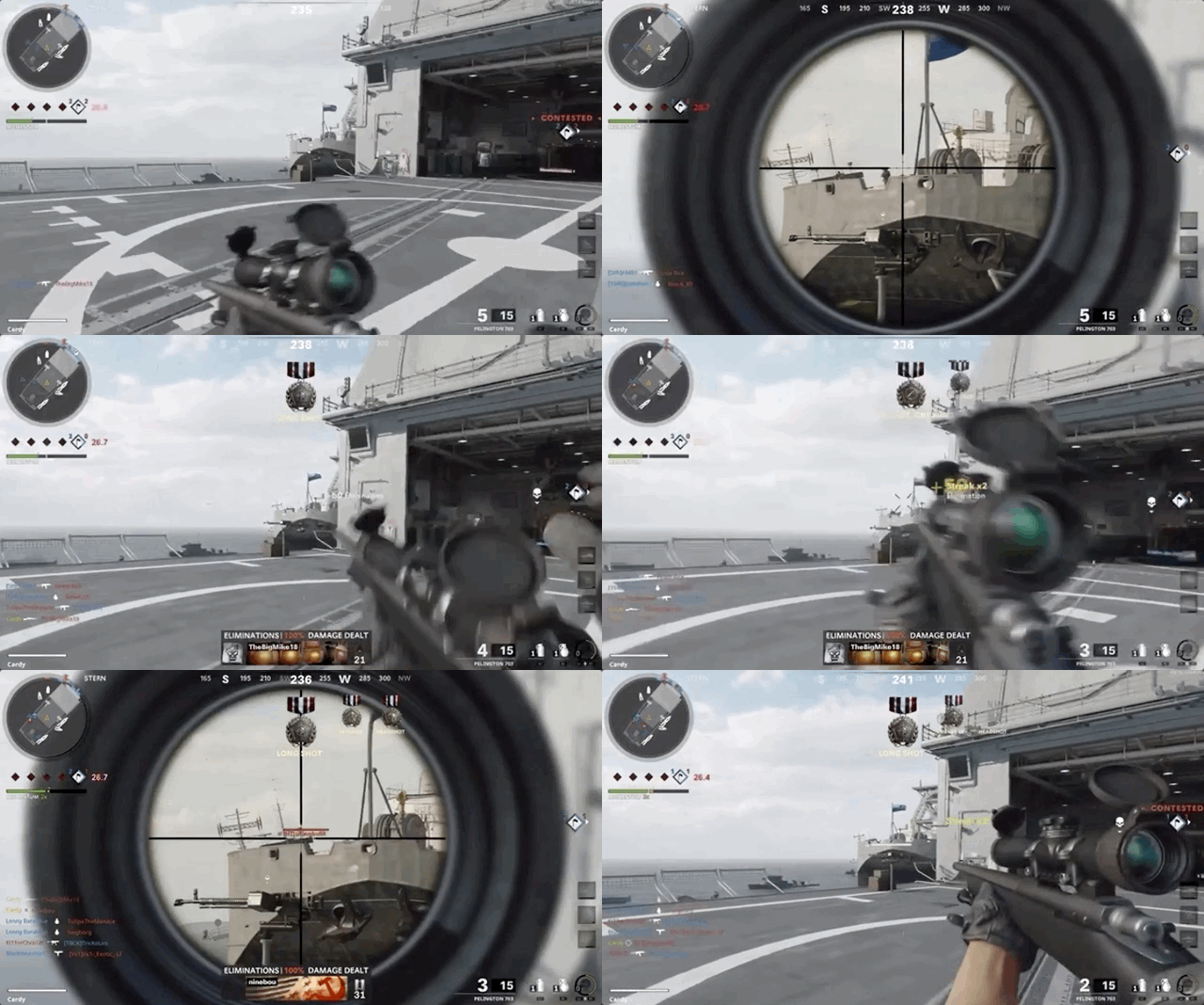
Armada has quickly become my favourite of the maps due to the number of different flanking routes available. Moving around the multiple hulking ships is a more fluid experience thanks to ziplines feeling snappier and consistently more responsive when triggering. Thankfully, the smaller, pilotable boats now take considerably less damage to destroy and no longer require you to unload all of your ammunition into them to produce results.

[poilib element=”quoteBox” parameters=”excerpt=Armada%20has%20quickly%20become%20my%20favourite%20of%20the%20maps%20due%20to%20the%20number%20of%20different%20flanking%20routes%20available.”]

This map, combined with the new Assault variety of Combined Arms (the large-scale, 12v12 mode) has made for my most consistently fun time with Cold War so far. Assault differs from Domination in that both teams are only fighting for control of one point at a time rather than 5 simultaneously, but it moves around the map. It’s fairly similar to Hardpoint and just makes for more exciting encounters as both sides are forced into one area instead of being spread out into small pockets of action.

The same can be said when playing on the new map introduced in the Beta, Cartel, which is set in the Nicaraguan jungle. It’s a fun map at times, especially when playing the larger Combined Arms modes, but isn’t without its faults. Most prominent of these being that it falls afoul of the same feeling of emptiness that maps like Miami and Moscow evoke when playing any of the 6v6 modes. It’s simply too vast for that few players to be operating in and often results in running loops of the same areas before being picked off just as you see an enemy. This leads onto another one of the faults with this map, which is an issue that bleeds into Cold War in general.

[ignvideo url=”https://www.ign.com/videos/call-of-duty-black-ops-cold-war-27-tips-tricks-for-the-beta”]

Cartel is the only map I’ve encountered so far where camping is an active issue. Sure, you’re always going to have people who like to play that way in Call of Duty, but on the whole Treyarch have done a good job at making this difficult on most of the maps. In Cartel, though, there are many, many bushes to hide in and many, many players who seem to enjoy doing it. They’re so prevalent that at times I’ve just chanced my arm and thrown explosives into the undergrowth or sprayed bullets across the shrubs, and I’ve gotten hit markers more often than you’d imagine that way. This, coupled with the general lack of enemy visibility, at times can make for a frustrating match; while this doesn’t occur on every map, it can just lead to you shooting below red enemy nametags more than detecting the bodies themselves. That’s not my favorite way to play.

[poilib element=”quoteBox” parameters=”excerpt=The%20general%20lack%20of%20enemy%20visibility%2C%20at%20times%20can%20make%20for%20a%20frustrating%20match.”]

Along with a new map, a handful of new modes have been thrown into the mix with the Beta. VIP Escort is a tactical departure from the norm and requires a level of teamwork not often associated with CoD multiplayer. One team member is designated as the titular VIP and must make their way to one of multiple extraction zones in order to win the round while their teammates protect them. Rarely does a match ever make it to the final stage, though, as one team is almost always wiped out before the objective can be met. It’s not a mode I can say I enjoyed too much, partially because of all the flashbacks it caused in my mind to playing Hostage in Rainbow Six Siege (a mode that, incidentally, is rarely ever played when compared to others in that game).

Another big new addition is Fireteam: Dirty Bomb, a sort of Frankenstein’s monster mashup made up of mechanics from Warzone and a healthy sprinkling of Battlefield-sized action. Essentially a smaller scale version of Warzone’s Plunder in which cash is replaced by uranium, 10 teams of four players battle it out to reach the top of the scoreboard by depositing the radioactive element in different bomb locations, detonating the dirty bombs, and of course, getting kills. Vehicles are also dotted around the map along with boxes containing killstreaks, and the armour system from Verdansk also makes its way over. The problem is that none of it really comes together like it does in Warzone and each round regularly ends up being a bit of a mess.

[ignvideo url=”https://www.ign.com/videos/call-of-duty-black-ops-cold-war-fireteam-dirty-bomb-trailer”]

The time it takes to actually detonate a bomb is excruciatingly long and at times feels impossible to complete as the enemies rain fire down on you from every direction as they freely parachute without warning. It may be down to the relatively small size of the map when compared to Warzone but it rarely feels like you have time to actually complete the main objectives, which is a bit of a problem to say the least when they are your primary source of points. Maybe a slightly longer respawn delay would aid this or a decrease in the detonation time, but at the moment it isn’t quite clicking for me. There is, of course, time to fix these issues (that’s the point of a Beta after all) and I can see myself playing this mode with my Warzone squadmates when the full game releases if it all comes together.

That being said, Cold War is at its best for me when it sticks to providing fast-paced action and satisfying gunplay on maps that (mostly) encourage a run’n’gun approach. Not all of the new map and mode additions quite hit the mark with the Beta, but the general feel and balancing of the multiplayer feels in a much better place than it was just a few weeks ago. So far, Cold War is shaping up to be a divisive entry into the series for fans of Call of Duty multiplayer, with the thin line between an old-school feel and an outdated one still being walked precariously. All in all, I’m enjoying it currently and am hopeful based on what I’ve played, although it still feels a tall order for Cold War to wrestle my time away from Modern Warfare and Warzone in its current state.

Alpha Impressions – 21st September 2020

After spending the weekend with Black Ops Cold War’s multiplayer Alpha on PlayStation 4, there’s plenty to be excited about in the next Call of Duty – but I’ve seen equally as many things that have given me reason to be wary. The gunplay is solid and familiar, offering heavy bursts of nostalgia with each pull of the trigger, but I wonder if there is too much looking back going on in Cold War and not enough emphasis being placed on revolution. With longer time-to-kill, a visual downgrade, and a return to simpler map designs, it remains to be seen if this year’s Call of Duty is a backwards or forwards step for the series.

[widget path=”global/article/imagegallery” parameters=”albumSlug=every-ign-call-of-duty-review&captions=true”]

Having put well over 100 hours into Warzone and Modern Warfare’s multiplayer over the last year, jumping into Cold War felt instantly different. Provided this Alpha is giving us a small taste of all of Cold War’s systems, it appears Treyarch is attempting to strip back this year’s multiplayer of all the concepts that were layered on in the past three games in the sub-series in an attempt to rediscover the core of what made the original Black Ops so popular a decade ago. For one, the time-to-kill is noticeably longer than recent entries – unless you’re using the currently overpowered sniper rifles, that is. Thankfully, Treyarch has already confirmed that the damage output of both the Pellington and Tundra snipers will both be reduced by the time of the beta, which is welcome since it seemed like 80% of players were equipping them during my time online. (The beta will first open for players who preorder on PlayStation on October 8 – see the full CoD Black Ops Cold War beta schedule.)

[poilib element=”quoteBox” parameters=”excerpt=Time-to-kill%20is%20noticeably%20longer%20than%20recent%20entries.”]

When I wasn’t sniping myself, I mainly opted for the MP5, a staple of mine throughout my years of playing CoD. I enjoy the mobility it offers, but found myself having to adjust the way I played in comparison to how I use it in Modern Warfare because multikills are harder to achieve in Cold War (largely due to that longer time-to-kill) which makes the larger magazine attachment all but a necessity.

By the end of the Alpha weekend I had assembled a build I was happy with that took full advantage of the returning Wildcard system, which fully kitted out my gun with eight attachments rather than the standard five. I enjoyed tweaking my loadouts and accompanying perks; Ninja, which makes your footsteps near-silent, became an early favourite. I look forward to experimenting more when all of the options are made available. The sheer number of different builds available has me optimistic that many different metas will develop during Cold War’s lifespan, and that it won’t remain as stagnant as Modern Warfare has at times.

[ignvideo url=”https://www.ign.com/videos/call-of-duty-black-ops-cold-war-13-minutes-of-miami-multiplayer”]

Elsewhere, there are elements that don’t have me quite excited but mostly feel minor enough that Treyarch still has time to adjust them before launch. Among them is the frankly ludicrous length of time it takes to hurl a frag grenade, which effectively incapacitates you for a couple of seconds and, in my experience, ends up with you being shot more often than it does a successful throw. The previously mentioned sniping, although highly satisfying, needs to be adjusted as well; not just on a power level, but also with a slight increase in the amount of glint produced when you aim down sights to make camping snipers more visible. You also can’t mount your weapons this year and tactical sprint has been removed, further stripping back the gameplay even more. Mounting isn’t a huge miss for me as I never tend to use it outside of Warzone, but the latter’s removal is a little frustrating when you’re so used to gaining that little speed boost normally.

[poilib element=”poll” parameters=”id=9b649819-90a9-4ed6-a8b2-4693de4d00c6″]

On larger maps vehicles can be used, and while it’s fine to sit in an attack boat with your hands holding a chattering machine gun, the same can’t be said when fighting against them. They currently take several shots from a rocket launcher to take down and don’t feel balanced at all. It never feels great to see just a fifth or so of a vehicle’s health bar go down when you were expecting a huge explosion.

These boats and tanks were found in the two larger maps where the new Combined Arms: Domination mode takes place. It’s essentially the age-old Domination mode, where two 12-player teams must attack and defend five capture points to earn points, but on a slightly bigger scale. It’s by no means revolutionary (point capture on a large scale with vehicles in play is basically the Battlefield series in a nutshell), but does allow for Treyarch to stretch its legs and build bigger and more interesting arenas.

[ignvideo url=”https://www.ign.com/videos/call-of-duty-black-ops-cold-war-15-minutes-of-armada-multiplayer-gameplay”]

The standout map is Armada, a level consisting of three large ships between which you can swim, sail, and zipline. It’s expansive, and allows for some great flanking maneuvers, catering well for all types of players due to its tight points of contestation and multiple sniping positions. My only criticism of it is that it’s almost too expansive; getting around it can become a slight chore, and a lonely one, especially when there are only 12 players on each side. This inflicts a feeling of emptiness every now and then.

[poilib element=”quoteBox” parameters=”excerpt=The%20maps%20in%20general%20lack%20a%20little%20atmosphere.”]

The maps in general lack a little atmosphere and could do with some extra layers of sound design, which hopefully is due to early development rather than designer intent. A timer very quietly ticks away before a “Victory” or “Defeat” graphic appears with little accompanying fanfare, which makes for a strangely unsatisfactory finish to a match. While the lack of ambient noise does aid on a gameplay level, allowing you to hear footsteps and enemy gunfire, it doesn’t help in making each location feel unique and distinct from one another.

Crossroads is the other 24-player map available in the Alpha, but it didn’t leave much of an impression on me. This snow-covered Soviet wilderness turned into a snipe-off more often than not, which emphasised the current issue with telescopic rifles. This situation often resulted in not many capture points being taken, and thus the objectives of the mode being ignored in favour of kills. I’ve historically found Call of Duty to be at its best when it’s fast and frantic, and not trying to borrow from other more deliberately paced shooters like Battlefield. Ground War never appealed to me in Modern Warfare for these reasons, and I can’t see Combined Arms: Domination being a mode I consistently play in Cold War either.

[widget path=”global/article/imagegallery” parameters=”albumSlug=call-of-duty-black-ops-cold-war-playstation-5-showcase-screenshots&captions=true”]

I feel much more at home in a Team Deathmatch setting, or playing a personal favourite of mine: Gun Game, which was first seen in the original Black Ops. Sadly the latter wasn’t available in the Alpha despite its Treyarch pedigree, but I did manage to play a healthy amount of Deathmatch on the three smaller maps available. My early impressions of each of these are that they are solid, if not spectacular. The urban Miami and Moscow maps harken back to old-school Call of Duty map design with clear corridors and lanes to fight in, with no doors to open and limited verticality.

[poilib element=”quoteBox” parameters=”excerpt=The%20third%20map%2C%20Satellite%2C%20is%20my%20pick%20of%20the%20bunch%2C%20and%20where%20I%20found%20the%20majority%20of%20my%20fun.”]

The Miami map offers an appealing visual identity complete with a neon-lit beachfront and glowing pool, while Moscow is swamped with stern architecture and bountiful busts of Lenin. I enjoyed my time in them, but felt they suffered from similar issues to their larger counterparts as they just felt empty at times because they’re almost too large for the 6v6 game modes they house. The third map, Satellite, is my pick of the bunch, and where I found the majority of my fun coming from as I picked off enemies with my sniper rifle as they peeked over yet another Angolan sand dune. It stands alongside Armada as the most graphically impressive map of the Alpha bunch, and benefits from the rural setting in this regard as the sun beams on crashed wreckage and drenches the already orange rocks, but on the whole Cold War currently looks to be a significant visual downgrade when compared to Modern Warfare. This is most visibly seen on the Moscow and Miami maps when looking at the textures of the building faces and in the detail of the gun models, which just don’t stand up when placed next to polished weapons from last-years outing.

[ignvideo url=”https://www.ign.com/videos/call-of-duty-black-ops-cold-war-multiplayer-official-reveal-trailer”]

Although my time with Cold War has been limited so far, I have reasons to be hopeful that Treyarch is recapturing some of what hooked people on the original Black Ops back in 2010. I’m a little wary of some aspects being stripped back a bit too much in an effort to please those yearning for an experience almost 10 years old at this point, but I’m definitely looking forward to seeing what innovations the developers have yet to show, and indeed how Cold War will tie into Warzone. With some weapon balancing on the way, and hopefully more maps and modes available during the upcoming beta, I’ll have a better understanding of which way this year’s multiplayer is heading. There’s a very thin line between a nostalgic experience and an archaic one, and it’s a line that Cold War is carefully dancing on at the moment.

[poilib element=”accentDivider”]

Simon Cardy can’t wait to play more Black Ops, but for now will have to settle for getting 2nd place finishes in Warzone of which he occasionally posts clips of on Twitter at @CardySimon.

PS5 & Xbox First-Party Games: What Are Sony And Microsoft’s Studios Up To?

Both PlayStation 5 and Xbox Series X/S are scheduled to release soon, and a big part of deciding whether to go with Sony or Microsoft (or both) in the next console generation is dependent on the games that you’ll be able to play. To that end, we’ve compiled a list of all of the projects being worked on by both the Xbox Game Studios and Sony Interactive Entertainment Worldwide Studios so you know what’s in store for both their platforms.

To clarify, this list does not include all of the console exclusives coming to Xbox Series X/S and PS5. For example, we don’t talk about Bloober Team’s The Medium and Ebb Software’s Scorn for Xbox Series X/S, nor do we touch on Housemarque’s Returnal and Counterplay Games’ Godfall for PS5 because Microsoft and Sony do not own those developers. Though given the two’s commitment to expanding their studio lineups–most recently, Sony with Insomniac Games and Microsoft with ZeniMax Media (Bethesda Softworks’ parent company)–who knows if that will hold true by the time this next console generation is done.

If you want to know what you’ll be able to play day one, we’ve compiled lists of every launch game for Xbox Series X/S as well as every launch game for PS5. And be sure to stay glued to our Generation Next hub for all the news, hands-on impressions, and spec breakdowns for Xbox Series X/S and PS5 and their corresponding accessories. We have guides for preordering Xbox Series X/S and preordering PlayStation 5 as well.

Table of Contents [hide]

Xbox Game Studios

343 Industries

Following Bungie’s departure from the franchise, 343 Industries has been in charge of Halo, developing Halo 4, Halo 5: Guardians, and Halo: The Master Chief Collection.

Currently, the studio is working on Halo Infinite. Originally planned to launch alongside Xbox Series X/S, Halo Infinite has been delayed to 2021. The game will be released for Xbox One, Xbox Series X/S, and PC–it will also be available day one via Xbox Game Pass.

Alpha Dog Games

Acquired by Bethesda Softworks in October 2019, Alpha Dog Games is a mobile game developer responsible for Wraithborne and MonstroCity: Rampage. The studio has not revealed what it plans to work on next.

Arkane Studios

Arkane Studios has helped push immersive sim games into the mainstream with the Dishonored series and 2017’s Prey–both of which provide a more action-focused twist on the player choice-driven genre.

At the moment, Arkane Studios is developing Deathloop–originally scheduled to release this year before being delayed to 2021. The game is currently planned to launch for PC and…PS5. Yeah, it doesn’t make sense, but that’s because a deal was cut with Sony prior to the Microsoft acquisition. We assume this deal means that Deathloop makes its way to Xbox Series X/S at some point, but neither Microsoft nor Arkane have announced anything official yet. And even if it doesn’t, Deathloop could release day one on Xbox Game Pass for PC and Arkane would still hold true to its original deal of PS5 and PC. Beyond Deathloop, Arkane Studios is hiring for an upcoming, unannounced game.

The Coalition

The Coalition currently heads the mainline entries in the Gears of War franchise, having developed Gears of War: Ultimate Edition, Gears of War 4, and Gears 5. There is no official word on what the studio is working on next; however, Gears 6 seems like a likely possibility. At the very least, we know the studio is ensuring that Gears 5 will have Xbox Series X/S-specific optimizations.

Compulsion Games

Compulsion Games previously released Contrast and We Happy Few. We Happy Few’s final expansion released in late 2019 and Compulsion Games has since announced that it has begun work on a brand-new project. The studio hasn’t revealed much other than that, only that the project will be a “new universe” that leverages the knowledge gleaned through developing We Happy Few.

Bethesda Game Studios

Bethesda Game Studios has been in charge of the Elder Scrolls series since 2002’s The Elder Scrolls III: Morrowind and the Fallout franchise since 2008’s Fallout 3. Over the past few years, the studio has been working on post-launch content for 2018’s Fallout 76.

Bethesda Game Studios is currently working on two games, Starfield and The Elder Scrolls VI, both of which are likely a fair way off given that we don’t know anything about them other than their names. Both games are expected to release for Xbox Series X/S, PS5, and PC, though it’s worth pointing out that Xbox head Phil Spencer has said that future Bethesda games don’t necessarily have to release on PlayStation. Bethesda has also confirmed that both Starfield and The Elder Scrolls VI will be available on Xbox Game Pass on day one.

Double Fine Productions

Double Fine Productions is responsible for developing and publishing several fun indie games. However, following its acquisition by Microsoft, Double Fine Productions has shut down its publishing division to exclusively focus on developing games.

Currently, Double Fine is developing Psychonauts 2, which has been delayed and is currently scheduled to be released sometime in 2021 for Xbox Series X/S, Xbox One, PS4, and PC. It will also be available day one via Xbox Game Pass.

id Software

The developer behind the Doom, Rage, Wolfenstein, and Quake series, id Software brings a strong first-person shooter presence to Microsoft’s assortment of first-party franchises. The studio’s last game, Doom Eternal, launched for Xbox One, PS4, PC, and Google Stadia in 2020 and is expected to release for Nintendo Switch as well.

Currently, id Software is working on next-gen ports for Doom Eternal. Both Xbox One and PS4 owners will be able to upgrade to their next-gen counterparts for free. If id Software is working on anything beyond the two-part Ancient Gods post-launch expansion for Doom Eternal and the game’s next-gen ports, the studio has yet to announce what it is.

The Initiative

Though it’s managed to make news with a slew of job postings, The Initiative hasn’t yet announced what its first game is. Based on the role responsibilities for the job positions, we can guess that the game is some type of blockbuster single-player experience (in a similar vein to PlayStation’s Horizon Zero Dawn and The Last of Us Part II) but without an official announcement, it’s all conjecture.

In a tweet, Xbox head Phil Spencer said that the folks at The Initiative are “challenging themselves to do new things (and old things) in new ways.” And at E3 2018, Spencer suggested that the studio is working to resurrect one of Xbox’s legacy IPs. In an episode of Kinda Funny Games Daily, GamesBeat reporter Jeff Grubb commented in the chat that the IP is Perfect Dark, and that The Initiative is working on a brand-new third-person follow-up to the 2000 first-person shooter. Neither Microsoft or The Initiative have confirmed this report.

inXile Entertainment

Having developed Wasteland 2 and Wasteland 3, inXile Entertainment brings a strong RPG presence to Xbox’s library of titles. The developer is also well known for The Bard’s Tale and The Bard’s Tale IV: Barrows Deep.

In a tweet, inXile announced that it will be using Unreal Engine 5 in its next project. According to inXile, it will “be a while” until this next game is announced.

MachineGames

MachineGames revitalized the Wolfenstein franchise with 2014’s Wolfenstein: The New Order and 2017’s Wolfenstein II: The New Colossus. The studio is also responsible for the smaller Wolfenstein spin-offs of the past few years, like 2015’s The Old Blood and 2019’s Youngblood.

MachineGames hasn’t yet announced what it’s working on next, but given its track record of bouncing back and forth between mainline Wolfenstein games and standalone Wolfenstein spin-offs, we assume the studio is currently developing Wolfenstein III. But that’s just a guess.

Mojang Studios

The studio behind Minecraft, Mojang Studios, has most recently co-developed Minecraft Dungeons, a dungeon-crawling variant of the block-building sandbox video game.

The studio has been working on post-launch content for Minecraft Dungeons, such as story-driven DLC expansions and VR support. There hasn’t been any official word on what’s next, though Xbox Series X/S and PS5 ports of Minecraft seem a likely bet–especially given Mojang’s announcement to continue supporting the game in 2021.

Ninja Theory

Ninja Theory most recently stepped outside its traditional avenue of story-driven, single-player games like Hellblade: Senua’s Sacrifice and Enslaved: Odyssey to the West to release a melee-focused PvP game called Bleeding Edge.

However, the developer is returning to its wheelhouse for its next two projects. The first, Senua’s Saga: Hellblade II, is a sequel to Senua’s Sacrifice that’s scheduled to release for Xbox Series X/S and PC. Ninja Theory is also working on Project: Mara, an experimental horror experience that’s described as a realistic representation of mental terror. For now, no platforms have been announced for Project: Mara.

Obsidian Entertainment

An RPG powerhouse, Obsidian Entertainment is known for games like Star Wars: Knight of the Old Republic II – The Sith Lords, Fallout: New Vegas, and Pillars of Eternity. In 2020, the studio released Grounded, a Honey I Shrunk the Kids-style co-op survival game, in early access.

Now, Obsidian Entertainment is working on Avowed, an “epic, first-person RPG” set in Eora, the fantastical setting of Pillars of Eternity. A release date hasn’t been set, but Avowed is scheduled to launch for Xbox Series X/S and PC.

Playground Games

From the very first title in 2012, Playground Games has been responsible for the Forza Horizon series, the most recent of which, 2018’s Forza Horizon 4, is scheduled to come to Xbox Series X/S–you can upgrade to the next-gen version for free via Smart Delivery.

Playground Games is currently working on Fable, the fourth mainline entry to the Fable franchise. The game will act as a fresh start to the series, which hasn’t seen a new game since 2010’s Fable III. Fable is scheduled to release for Xbox Series X/S and PC.

Rare

Rare has a truly impressive library of games under its belt, though it’s most recently made waves with Sea of Thieves, a game-as-a-service title where you and your friends can set sail as a crew of pirates. There aren’t any announced plans to abandon Sea of Thieves any time soon–Rare will continue to support the game going into the next console generation.

The studio is taking on a seemingly more fantastical project at the same time, however. Everwild is an upcoming adventure game scheduled to release for Xbox One and PC. Not much is known about Everwild, though executive producer Louise O’Connor has described it as “a magical and untamed natural world for you to explore and to just truly lose yourself in.”

Roundhouse Studios

Following the closure of Human Head Studios in November 2019, Bethesda Softworks hired the entire staff and opened a brand-new studio: Roundhouse Studios. Human Head Studios’ claim to fame is 2006’s Prey, though it made headlines for 2018’s The Quiet Man as well.

Roundhouse Studios hasn’t yet announced what it’s currently developing, though Bethesda has revealed that the studio is working on unannounced projects. Perhaps, given the studio’s history with the franchise, Roundhouse Studios is working with Arkane in some capacity on a follow-up to 2017’s Prey.

Tango Gameworks

Founded by Resident Evil director Shinji Mikami, Tango Gameworks is responsible for the very Resident Evil-like The Evil Within and it’s somewhat open-world sequel, The Evil Within 2.

Tango Gameworks is dropping third-person survival horror for a more action-focused, first-person game with its next project, Ghostwire: Tokyo. Ghostwire: Tokyo is in the same boat as Deathloop–it’s scheduled to launch for PC and PS5 in 2021, a decision that was made prior to the Microsoft acquisition. Like Deathloop, we assume that Ghostwire: Tokyo will eventually make its way to Xbox Series X/S as well (or at least Xbox Game Pass for PC), but there’s no official word on whether that will be the case.

Turn 10 Studios

The other half of the Forza franchise, Turn 10 Studios has developed every single Forza Motorsport since the original game in 2005.

Turn 10 Studios is currently working on the next Forza. Tentatively titled “Forza Motorsport,” the eighth entry in the Motorsport series is scheduled to release for Xbox Series X/S and PC. Seeing as it’s still “early in development,” Forza Motorsport is not likely to come out for quite a while.

Undead Labs

Living up to its namesake, Undead Labs is responsible for the zombie survival games State of Decay and State of Decay 2. The studio isn’t really changing up anything going forward–it’s currently working on State of Decay 3, which was revealed in a cinematic trailer to be launching for Xbox Series X/S and PC at some point.

World’s Edge

World’s Edge was created in 2019 to oversee the Age of Empires franchise, which currently has three mainline entries. The studio is currently developing Age of Empires IV, which doesn’t yet have a release date.

ZeniMax Online Studios

ZeniMax Online Studios is largely responsible for ZeniMax Media’s massive multiplayer online games, developing The Elder Scrolls Online and supporting Bethesda Game Studios in creating Fallout 76.

ZeniMax Online Studios last announced project is Commander Keen, a mobile game for Android and iOS devices, but a lack of developer updates has left the status of the game up in the air. The game sees you play as twins Billy and Billie, the children of the original Commander Keen (canonically, the grandson of Wolfenstein protagonist BJ Blazkowicz and the father of the guy from Doom).

Sony Interactive Entertainment Worldwide Studios

Guerrilla Games

Killzone developer Guerrilla Games shocked audiences by abandoning its bread and butter of first-person shooter games to instead create a third-person, open-world RPG called Horizon Zero Dawn–which ended up being very well received by critics. It’s one of the few PS4 exclusives to get a PC port (and more could be on the way).

The studio is now working on a sequel titled Horizon Forbidden West. The sequel adds brand-new biomes for protagonist Aloy to discover, which contain new tribes to meet, enemies to fight, and underwater tombs to explore. The game is scheduled to release for both PS4 and PS5 in 2021.

Insomniac Games

Insomniac Games managed to wow audiences with a few games this console generation, including Xbox One console exclusive Sunset Overdrive and PS4 exclusive Marvel’s Spider-Man, both of which combined smooth movement mechanics and frenetic combat to create enjoyably fast-paced open-world action games.

The studio is giving us more Spidey this year in Marvel’s Spider-Man: Miles Morales, releasing for both PS4 and PS5 on November 12, which tells a complete coming-of-age story for Peter Parker’s protégé. Insomniac is simultaneously working on Ratchet & Clank: Rift Apart, which is scheduled to release within the PS5 launch window for the next-gen console.

Media Molecule

The studio behind the LittleBigPlanet franchise has continued to create worlds that allow us to create worlds in 2020’s Dreams. Media Molecule co-founder Mark Healey told Metro that the “obvious next step” for the studio is to port Dreams to PS5.

Beyond that, however, Media Molecule hasn’t announced what it plans to do next. Maybe we’ll see LittleBigPlanet 4 or a sequel to Tearaway.

Naughty Dog

Just as Naughty Dog released The Last of Us in the final year of the PS3, the studio sent the PS4 off with a bang with The Last of Us Part II–it almost makes me think we’re due for a Part III in the final year of the PS5. Regardless, Naughty Dog has other popular franchises that it can also return to, such as Uncharted and Jak and Daxter.

Whatever Naughty Dog is working on, the studio isn’t ready to share details. A few job postings back in July 2020 do point to Naughty Dog working on a new single-player action-adventure game for PS5, but that’s all we know for now.

Pixelopus

Pixelopus has developed two games: 2014’s Entwined and 2019’s Concrete Genie. The studio hasn’t yet announced what it’s working on next.

Polyphony Digital

Polyphony Digital has been the studio behind Gran Turismo since the franchise’s debut back in 1997–when the studio was still called Polys Entertainment. The studio has been making racing games for every generation of the PlayStation console and that’s not stopping with PS5.

Currently, Polyphony Digital is working on Gran Turismo 7, the (despite its name) eighth mainline entry in the franchise. Coming to PS5 at some point in the future, Gran Turismo 7 makes use of PS5’s next-gen hardware to cut out load screens between events and incorporate 3D audio.

SIE Bend Studio

SIE Bend Studio returned to making console games with the Bend, Oregon-set open-world zombie game, Days Gone. Prior to that, the studio primarily worked on well-liked PSP and PS Vita games.

There’s no official word on what SIE Bend is currently working on, though–as pointed out by GamesRadar, the studio did put out job postings to begin development on a new game back in April 2020. It remains to be seen whether this new game is a sequel to Days Gone or something else entirely, but it likely won’t be revealed for a while. We assume it will launch for PS5.

SIE Japan Studio

SIE Japan Studio largely oversees or assists in the development of PlayStation exclusives that come from Japanese studios, but it’s been behind a few well-received games as well, such as Gravity Rush and Gravity Rush 2. The studio also developed 2018’s Astro Bot: Rescue Mission, a delightful platformer for PSVR.

Currently, SIE Japan is developing Astro’s Playroom, a sequel to Astro Bot: Rescue Mission that will come preloaded on every PS5 at launch. Unlike its predecessor, Astro’s Playroom is not a VR game. SIE Japan is also supporting Bluepoint Games to create the Demon’s Souls remake, which is releasing for PS5 alongside the next-gen console on November 12.

SIE London Studio

Most recently, SIE London Studio has been developing exclusives for PSVR–it created 2016’s PSVR launch title PlayStation VR Worlds as well as 2019’s PSVR first-person shooter Blood & Truth.

SIE London Studio has yet to officially announce its next project; that said, in December 2019, Road to VR noticed that the studio was hiring for a new “exclusive virtual reality title” that will help in “pushing the boundaries within the VR medium.” Sony hasn’t yet announced whether a new version of PSVR will come out for PS5, but it has confirmed that the next-gen console will at least support PS4’s PSVR headset and PlayStation Move controllers. With that being the case, SIE London Studio’s new VR game could be coming out sooner rather than later, but we won’t know for sure until an official announcement is made.

SIE San Diego Studio

SIE San Diego Studio is responsible for all 15 games in the MLB The Show franchise, from 2006’s MLB 06: The Show to 2020’s MLB The Show 20. Why yes, they did indeed change the format of the titles–the switch occurred in 2016 with MLB The Show 16.

Now here’s the kicker (or whatever the equivalent baseball term is), MLB The Show will come to additional console platforms beyond PlayStation starting as early as 2021. So if SIE San Diego is working on MLB The Show 21 (which it probably is, but there’s no official word), the game could also be released for Nintendo Switch or Xbox Series X/S, not just PS5. SIE San Diego occasionally operates as a support studio as well, so it may also be assisting on another project.

SIE San Mateo Studio

SIE San Mateo Studio is the American version of SIE Japan Studio–it’s primarily a support studio that oversees and assists on the work of PlayStation exclusives by developers that Sony doesn’t own. For example, SIE San Mateo worked with Bend Studio (then called Eidetic), Insomniac Games, and Sucker Punch on their respective PlayStation exclusives prior to their acquisition by Sony.

There has been no official word on what SIE San Mateo Studio has been working on following the support it gave to Insomniac for 2018’s Marvel’s Spider-Man. A lot of the studios that SIE San Mateo has worked with in the past are now Sony first-party studios, so Sony may have partnered SIE San Mateo with someone new. SIE San Mateo may also be supporting one of the other Sony first-party studios with their current project.

SIE Santa Monica Studio

Though it got its start with Kinetica in 2001, SIE Santa Monica Studio is most well-known for developing the console entries in the God of War series. The studio’s last game was 2018’s God of War, which acted as both a sequel to God of War III and reimagining for the franchise.

During the September 2020 PS5 Showcase, SIE Santa Monica teased that it’s working on a new God of War game. SIE Santa Monica has released almost no details about the game–it doesn’t even have an official title yet–but based on the reveal trailer, we assume this sequel will immediately pick up after the events of God of War’s cliffhanger ending. The game is scheduled to release for PS5 in 2021.

Sucker Punch Productions

Sucker Punch Productions is best known for making open-world games–most recently, the samurai film-inspired Ghost of Tsushima. But the studio is also responsible for the superhero Infamous franchise and stealth-driven Sly Cooper games.

Sucker Punch Productions most recently released a co-op multiplayer expansion for Ghost of Tsushima. Sucker Punch hasn’t officially announced what it plans to do beyond that, though back in June 2020, Game Rant noticed that job postings suggest that the studio has begun work on a new game, one that will “take the player on an immersive, thrilling experience.”

Xbox Series X’s Scorn Has Gross Monsters And Strange Weapons In New Gameplay Trailer

Ebb Software’s Scorn, a dark and grotesque horror-adventure game set within a bio-mechanical labyrinth, has been many years in the making. First revealed in 2016, Scorn is a narrative-driven FPS that blends Bioshock’s grotesque body-horror and action gameplay with the bizarre and nightmarish imagery from H.R. Giger’s work on the Alien franchise. Scorn will be making its debut on PC and for the Xbox Series X|S as a next-gen console exclusive, with a planned release set for sometime in 2021. Ebb Software has now revealed more of what’s to come with the game, showcasing a near-final look at the horror game.

Ahead of the Xbox Series X|S’s debut on November 10, GameSpot has exclusive gameplay showing off nearly 14 minutes of the game’s grotesque environments that players will be able to explore, along with the many organic weapons that can be found within. This gameplay, running on the Xbox Series X, shows a lot of the game’s mood and dark horrors that await.

In a similar vein to Bioshock, Scorn drops players into a strange environment filled with hostile enemies and a peculiar atmosphere that hints that something has gone wrong. Scorn takes this approach a bit further by focusing on a setting that feels totally alien and unnatural, which gives it something of an alluring, yet still unsettling vibe. To survive, you’ll have to embrace some of the more grotesque and bizarre elements found within the bio-mechanical hellscape.

In the gameplay video, there’s a sense that the game puts players in a state of confusion, which only seems to become more palpable as the gameplay demo progresses. The imagery shown off in this video is extremely weird, but it’s still interesting–especially for fans for enjoyed the Alien series. According to the developers, Scorn’s visual style takes some direct inspiration from H.R. Giger and from the works of surrealist artist Zdzisław Beksiński, which puts you in a constant state of discomfort, but still leaves you curious about its origins.

No Caption Provided

Gallery

For more on Scorn, and other Xbox Series X|S games, be sure to check back with GameSpot for more in the weeks ahead as we enter the next generation.

Now Playing: 13 Minutes Of Exclusive Xbox Series X Scorn Gameplay

GameSpot may get a commission from retail offers.

Borat 2 Review: As Uncomfortable And Enthralling As The Original

Watching the original Borat 14 years after its 2006 release throws its strengths and weaknesses into stark relief. The catchphrases are tired to the point of mundanity and a lot of the hijinks are simply not funny in retrospect. On the other hand, the satire still bites, and the best scenes are still horrifying and enthralling. When Borat mastermind Sacha Baron Cohen successfully lulls his real-life subjects into believing they’re speaking to a foreign simpleton whose documentary will never be seen outside Kazakhstan, the things that come out of their mouths are truly abhorrent–and that’s the character’s real genius.

All these years later, Cohen has surprised us all with a hastily announced and released sequel, and thankfully, Borat 2 leans into that genius while leaving the original’s most problematic material (such as the many, many rape jokes) behind. And it definitely lives up to its full title, Borat Subsequent Moviefilm: Delivery of Prodigious Bribe to American Regime for Make Benefit Once Glorious Nation of Kazakhstan.

The sequel starts with Borat serving hard labor for his failure after the original movie made Kazakhstan an international laughingstock. But Borat is sent to America for one last mission: He’s to deliver a famous monkey (the country’s most popular porn star) to Vice President Mike Pence to earn Kazakhstan’s leader the respect of “McDonald Trump,” who is known to only pal around with “strong leaders” like Vladimir Putin and Kim Jong-un. Borat returns to his home village one last time to say goodbye to his family, and learns that he has a daughter–who lives chained up in a shed, obviously–named Tutar. When Borat departs, Tutar stows away in the monkey’s shipping crate, and Borat is forced to come up with a new plan to win over the American government.

Sure, that’s slightly more plot than the original, which can be summed up as “Borat diverts his documentary production to travel to California and kidnap Pamela Anderson.” But it’s still just setup for the ridiculously uncomfortable and revealing interactions the characters have with a revolving door cast of suckers and saps, some of whom are well-meaning enough, while others are just plain nasty. This sequel is aware of how well we already know the character, and Borat 2 doesn’t try to establish any new catchphrases, while also not leaning too hard on the originals. There are a few “my wife” and “naahht” jokes, but they feel natural enough. It also skips the more vague public hijinks, including streaking through hotels, pretending to s*** in public, and loosing chickens on innocent subway passengers–all for the sequel’s better. This time, the most delightful running joke is Cohen’s increasingly absurd series of disguises, donned for very practical reasons, as even a decade and a half later, Borat is too recognizable to get away with his old schtick wholesale.

Beyond that, Borat 2 is a more focused film overall. According to a Salon article published after the original’s release in 2006, Linda Stein, one of the feminists who Borat “interviewed” at the time, thought Cohen “didn’t make the point with sexism that perhaps he did with anti-Semitism and homophobia.” She got that it was satire–as did many of Cohen’s other subjects. She just didn’t think it did a particularly good job. I can’t help but think that Cohen may have had Stein in mind when making this one; besides the obvious political subjects, Borat 2 focuses mainly on the character’s many strange beliefs about women.

No Caption Provided

That’s where Tutar comes in, and Maria Bakalova, the actress who plays her, often steals the show. Raised in Borat’s fictional version of Kazakhstan, Tutar believes women will die in horrible ways if they own a business, drive a car, touch their own “vajeens,” or ask too many questions. She and Borat visit a plastic surgeon, a religious anti-abortion counselor, a “sugar baby” Instagram influencer, and several other dubious figures, along the way learning that some of their preconceived notions about women might be slightly misguided.

Borat 2 works in large part because Bakalova is so fantastic. She easily keeps pace with Cohen and rarely misses a beat as the tension and chaos ramp up, such as during a southern debutante ball, when Cohen, in one of his many Americanized disguises, presents Tutar to what passes for “high society” in the region. The duo wow the black-tie crowd with their country’s signature “fertility dance,” which involves Tutar lifting her dress and flashing blood-soaked underwear in one of the movie’s most uncomfortable sequences.

That scene and others like it go on slightly too long, as does the movie as a whole. The most compelling scene from the trailer happens about half an hour into the movie: Cohen, as Borat dressed in a grotesque Trump costume, fireman-carries Tutar over his shoulder and roadie-runs through the 2020 Conservative Political Action Conference (CPAC) to interrupt Mike Pence’s speech and deliver him his Kazakhstani bride (an incident that, incredibly, really happened back in February, and no, nobody at the time knew that it was Borat). That and many other scenes will have you frantically Googling as you try to suss out what’s staged and what’s genuine–part of the original’s magic that the sequel fully recaptures.

No Caption Provided

Still, with another hour to go after that point, Borat 2 quickly starts to feel too long, and it occasionally loses its way in tangents and sidetracks. That said, by the end, it does the seemingly impossible and tops the CPAC stunt with a scene that will make you wonder how Rudy Giuliani could have possibly allowed this to happen–although it’s really not that surprising when you think about it.

Unsurprisingly, Borat 2 is an absurdly timely movie, taking the piss out of Trump and his cohorts, as well as various other conservative figures with objectively ridiculous beliefs; “[The Clintons] torture these kids, it gets their adrenaline flowing in their body, then they take that out of their adrenal glands, and then they drink their blood,” a pair of men who inexplicably invited Borat to take shelter in their home during the pandemic tell Cohen, nodding sagely, without a shred of humor or irony. But what is surprising is the fact that Borat 2 is pretty damn funny. If you liked the original Borat when it became a phenomenon almost 15 years ago, but are pretty sure it wouldn’t hold up to modern standards of political correctness and general decency–and rightly so–you might be pleasantly surprised by Borat 2’s timeliness, focus, and more wholesome sensibilities.

Plus, you have to see that Giuliani scene to believe it.

Borat 2 will be available to stream on Amazon Prime starting October 23.

13 Minutes Of Exclusive Xbox Series X Scorn Gameplay

Ebb Software’s Scorn is a dark and grotesque horror-adventure game set within a bio-mechanical labyrinth. It was first revealed in 2016 and is a narrative-driven FPS that combines grotesque body-horror and action gameplay with the bizarre and nightmarish imagery from H.R. Giger’s work on the Alien franchise.

Scorn will launch on PC and for the Xbox Series X|S as a next-gen console exclusive, with a planned release set for sometime in 2021. Ebb Software has now revealed more of what’s to come with the game, showcasing a near-final look at the horror game.

In the gameplay video, there’s a sense that Scorn aims to put players in a state of confusion, which, based on the gameplay, intensifies over time. The imagery shown off in this video is extremely weird, but it’s still interesting–especially for fans for enjoyed the Alien series.

According to the developers, as well as taking direct inspiration from H.R. Giger, it also draws upon the works of surrealist artist Zdzisław Beksiński. The result is something that is designed to put you in a constant state of discomfort, but still leaves you eager to delve deeper into its world.

The Falcon and Winter Soldier Is Bringing Back Some of the ‘Earliest’ MCU Characters

Dust off those Phase One Blu-rays for a rewatch because Marvel’s upcoming The Falcon and Winter Soldier Disney+ series is due to bring back some of the MCU’s earliest characters.

The Falcon and Winter Soldier is a six-episode Disney+ series centered around the titular characters, and it’s already known that it’s bringing back some of the characters we’ve already seen in the MCU, like Daniel Bruhl’s villainous Zemo and Emily Van Camp’s Sharon Carter from Captain America: Civil War. But according to the show’s writer, audiences can expect the return of some other MCU characters, namely those from the earlier movies.

[widget path=”global/article/imagegallery” parameters=”albumSlug=marvel-phase-4-official-lineup&captions=true”]

“There are characters from the earliest of the Marvel movies that are coming back,” series writer Derek Kolstad said on the Script Apart Podcast. “They’re layering them in and reinventing them in such a way that it’s going to, kind of, shift the storytelling structure, which is f**king awesome.”

Kolstad wouldn’t go as far as to actually namedrop who these early characters are, but our eyes are set on Phase One of the MCU. It wouldn’t be too unusual, given another Disney+ Marvel series, WandaVision, has already confirmed the return of Kat Dennings’ Phase One character, Darcy Lewis.

[ignvideo url=”https://www.ign.com/videos/2020/02/03/marvel-studios-disney-plus-big-game-spot”]

Kolstad added that the team is close to finishing up production after a COVID-19-related delay earlier this year. “They got hit by Covid and they’re finishing up finally, but that’s going to be f**king cool. I’m very honored and I’m proud at what that came to be.”

It’s unknown at this time when we’ll all get a look at who these early MCU characters are in the show as The Falcon and Winter Soldier doesn’t currently have a release date after it was delayed beyond its original August release date. Check out Anthony Mackie’s new Falcon costume in the meantime and then read Mackie’s thoughts on how evolved these characters are in the series.

[poilib element=”accentDivider”]

Wesley LeBlanc is a freelance news writer and guide maker for IGN. You can follow him on Twitter @LeBlancWes

The Flash: Michael Keaton ‘Can’t Confirm’ if He Is Returning to Play Batman

Michael Keaton has responded to reports that he is preparing to reprise his role as Batman in The Flash, opposite Ezra Miller’s Barry Allen.

During an appearance on Jimmy Kimmel Live, Kimmel asked Keaton if he could verify the rumours that he would be suiting up to play Batman in 2022’s The Flash, however, Keaton said that he “couldn’t confirm anything” on that front. He later added: “We’re having discussions, as they say. We’re talking about it. We’ll see if it happens.”

[ignvideo url=”https://www.ign.com/videos/2019/10/19/ranking-the-batman-movie-villains”]

With Ben Affleck’s Batman already confirmed to have a “very substantial part” in The Flash, Keaton went on to joke that all “127” previous “Batmen” will be making an appearance in the DCEU movie before then declaring himself to be the best Dark Knight of the lot.

Keaton previously played Bruce Wayne and his alter ego in 1989’s Batman and 1992’s Batman Returns, both directed by Tim Burton. At one point both Burton and Keaton were expected to return for a third movie, but both dropped out and Val Kilmer took over the Batman role in 1995’s Batman Forever. Keaton previously voiced an interest in returning to the role, but only if Burton directs – a stance that he appears to have since changed his mind on.

[widget path=”global/article/imagegallery” parameters=”albumSlug=the-flash-movies-possible-dceu-cameos&captions=true”]

Andy Muschietti (Stephen King’s It) is set to direct the long-gestating Flash movie. In January, Muschietti reiterated that the movie will be offering its own take on the iconic Flashpoint storyline, which previously inspired elements of The Flash TV series and 2013’s Justice League: The Flashpoint Paradox. The Flash is currently scheduled to open on November 4, 2022.

For more, find out how Michael Keaton’s Batman could completely change the DCEU and read why we think Michael Keaton is still the best live-action Batman of them all.

[poilib element=”accentDivider”]

Adele Ankers is a Freelance Entertainment Journalist. You can reach her on Twitter.

Star Wars: Tales from the Galaxy’s Edge Coming to Oculus Quest in November

Star Wars: Tales from the Galaxy’s Edge will arrive exclusively for Oculus Quest on November 19, and a new trailer has shown us what we’ll be doing in the VR game.

Revealed on the Star Wars website, the VR experience will have players meet C-3PO, R2-D2 and a Frank Oz-voiced Yoda, and is described as “a whole new way to explore the world of Star Wars: Galaxy’s Edge at Disneyland Resort and Walt Disney World Resort, and discover what exactly happens past the boundaries of Black Spire Outpost.”

[ignvideo url=”https://www.ign.com/videos/2020/10/21/star-wars-tales-from-the-galaxys-edge-official-trailer”]

Director Jose Perez III explains that the game will be anthological, and take place across multiple eras of the Star Wars canon. Part I of that story will involve you playing a Droid Repair Technician, visiting the cantina, performing repairs, and getting into blaster fights. Other parts are more secretive, but we know Yoda will appear in a standalone Tale, and that we’ll be getting to grips with lightsabers at a Jedi Temple.

Perez adds that the idea is to offer experiences different to those you’d get by visiting the real-life Galaxy’s Edge attraction, “like building a lightsaber or going to Oga’s Cantina. We’re trying to build out stories that are on the outskirts, that bleed in and expand that world. For me, it’s really exciting to hang out in Seezelslak’s Cantina and look out the window, see the Falcon, and know that I’m going to be able to go back there at some point, but right now I’ve got another job to do.”

[widget path=”global/article/imagegallery” parameters=”albumSlug=star-wars-tales-from-the-galaxys-edge-6-screenshots&captions=true”]

First announced in May, the new game comes from the same studio that created the Vader Immortal VR series. We thought that series did “a fine job of letting you bask in Star Wars surroundings and the impressive presence of Darth Vader himself,” even though it did end with a “dull thud.”

[poilib element=”accentDivider”]

Joe Skrebels is IGN’s Executive Editor of News. Follow him on Twitter. Have a tip for us? Want to discuss a possible story? Please send an email to [email protected].

Grab Yourself a New 4KTV With These Best Buy Deals

I guess everyone just decided Black Friday was too far away and started dropping prices early. Best Buy is having a 60-Hour Amazon Sale, which is strange for a couple reasons. Firstly, it’s Best Buy. Secondly, not everything on sale is an Amazon product like I was initially expecting. That’s fine though, because Best Buy has some great deals on 4KTVs with Alexa capabilities, which makes them Amazon-adjacent enough to be included. There are also deals on Ring, Fire, and Echo products, too, but the 4KTV deals are the headliners.

Samsung 4KTV  Deals

[poilib element=”commerceDeal” parameters=”slug=best-buy-4ktv-deals”]

Hisense 4KTV Deals

[poilib element=”commerceDeal” parameters=”slug=more-best-buy-amazon-4ktv-deals”]

Toshiba Fire TV Deals

[poilib element=”commerceDeal” parameters=”slug=best-buy-toshiba-fire-tv-deals”]

Insignia 4KTV and HDTV Deals

[poilib element=”commerceDeal” parameters=”slug=best-buy-insignia-4ktv-deals”]


Asus ROG Swift PG259QN Gaming Monitor Review

It feels like 240Hz gaming monitors just came into being, but manufacturers are already cranking refresh rates higher. Asus’ ROG Swift PG259QN crams a ridiculous 360Hz refresh rate into an IPS panel for serious esports enthusiasts that refuse to make sacrifices. We ran it through some testing to see how it performed.

PG259QN-front

Asus ROG Swift PG259QN – Design and Features

At $700, the PG259QN isn’t cheap, though its design isn’t quite as high-end feeling as some of Asus’ other ROG displays. It contains the same grey-and-copper swirled base, albeit without the extra embellishments and light-up logo found on the company’s top-tier monitors. It’s distinctly a gaming monitor, though, and the backside contains an etched circuit board pattern alongside a large ROG logo that reflects customizable, Aura Sync-compatible RGB lighting off your wall. The stand contains a built-in cable management hole, and is height, swivel, and tilt adjustable, which means you can get it set up just right for ideal ergonomics.

The frameless, 24.5-inch panel is small by today’s standards, but typical for the esports crowd it’s aiming for. The smaller monitor makes it easier to see everything on screen without darting your eyes around, and the lower resolution ensures your graphics card can pump out as many frames as possible – a must if you’re aiming for 360Hz. Unlike many other esports panels, though, the PG259QN is an IPS display, which means it provides much better color accuracy and viewing angles than its TN brethren, while still keeping a quick response time. (Asus claims 1ms, but these values can be fudged in so many ways they’re mostly meaningless – we’ll talk more about the response time in the testing section below).

[poilib element=”poll” parameters=”id=9591aba8-9f63-444e-ac63-e1a7c3a75327″]

G-Sync allows you to play games without any screen tearing, which is always welcome, and the 395 nit brightness is very close to Asus’ quoted 400 nits. The monitor is also advertised as HDR10-capable, though with 400 nits of brightness, no wide color gamut, and no local dimming, it’s not really what anyone would consider HDR – that basically means it’s capable of receiving an HDR signal. IO is decent but not extraordinary, with one HDMI 2.0 port and one DisplayPort 1.4 port, alongside a 3.5mm speaker or headphone jack and two USB 3.0 ports.

Asus ROG Swift PG259QN

Asus ROG Swift PG259QN – Testing

To test a monitor’s performance, I run it through a DisplayCal verification using an X-Rite i1Display Pro, and a few by-eye tests with Lagom’s LCD test patterns. The PG259QN covers 95.4% of the sRGB color space and 68.0% of the DCI-P3 color space – not really enough to consider it a wide gamut monitor, but more than good enough for your typical web browsing and esports gaming. It also means that, unlike wide gamut monitors with their often over-saturated colors, the PG259QN is actually very color-accurate in its default state, despite not looking as vibrant as its wide gamut competition.

During measurement, a deltaE value determines how far off a color appears from its target – almost every deltaE value came in under 1, with only a few slightly over. That’s considered imperceptible, and it’s pretty shocking to see something this accurate from the factory. Only the target white point received a more noticeable deltaE value of 3.73, but that’s still unlikely to make a difference to most people.

[poilib element=”quoteBox” parameters=”excerpt=The%20PG259QN%20is%20actually%20very%20color-accurate%20in%20its%20default%20state”]

The monitor’s sRGB mode had a slightly more accurate white point at 3.22 if you’re doing color-sensitive work, but otherwise is less customizable than other modes, so you probably wouldn’t want to use it for gaming. In its default Racing mode, the contrast ratio measured 1076:1, which is about what I’d hope for from an IPS display – blacks won’t be as deep as its VA brethren, but a worthy sacrifice for IPS’ better colors and response time.

Speaking of black levels, I found the darkest two squares in Lagom’s black saturation test pattern were just barely indistinguishable from reference black, as it should be. Hardcore gamers may want to turn Asus’ Dark Boost mode up to reveal that shadow detail a little more, though, lest hiding enemies get the better of you. White saturation was on point as well, there was no visible banding in gradients, and the IPS panel provided solid viewing angles all the way around.

[poilib element=”quoteBox” parameters=”excerpt=The%20absurdly%20high%20refresh%20rate%20is%20smoother%20than%20sledding%20down%20a%20hill%20with%20a%20greased-up%20toboggan”]

Most impressive, though, was the response time. Lagom’s response time test produces a number of squares that quickly flip between two shades – the longer that transition takes, the more flickering you’ll see in those squares, which means you’re likely to experience ghosting in games. On super-fast panels like this, it also means the transitions may take too long to keep up with that 360Hz refresh rate, and you’re not getting a true 360Hz experience. Thankfully, the PG259QN has a stellar response time, producing almost no flickering in any of the squares on the default overdrive mode and barely any ghosting to speak of in Blur Busters’ UFO Test.

The monitor has three overdrive modes: Off, Normal, and Extreme. Off produces just a bit of motion blur, while the default Normal mode produces just a bit of overshoot, and Extreme produces more noticeable overshoot artifacts that I’d recommend avoiding. For the best experience, I recommend Normal, as I find its artifacts are barely noticeable and it contains barely any motion blur. You can turn on the Ultra Low Motion Blur (ULMB) backlight strobing feature to make motion even clearer, but it only works at 144hz and 240Hz with G-Sync off.

The PG259QN provides the same FPS, RTS, Cinema, and other modes you see on other displays, along with a crosshair and variable backlight modes. I recommend avoiding most of these and sticking with the default Racing mode, or – better yet – try the G-Sync Esports Mode. This disables variable backlight, cranks up Dark Boost, and turns down the gamma for what Nvidia says are the ideal settings for esports games. For some reason, it’s also the most customizable mode, allowing you to fine-tune the colors to your liking, so even if you prefer things like Dark Boost off, the G-Sync Esports Mode is probably the one to go with since you can tweak those settings back to their more accurate levels.

PG259QN-rear

Asus ROG Swift PG259QN – Gaming

I’ve reviewed a few high-refresh displays over the past year, but I’m still wowed by the smooth, virtually blur-free motion that a good display can provide. The PG259QN may not be large or high-res, and it definitely feels cramped on the desktop, but that’s not really what you’re buying this monitor for. You’re buying it for fast-paced gaming, which – for lack of a better metaphor – is smoother than sledding down a hill with a greased-up toboggan.

The absurdly fast refresh rate made for extremely clear motion in games like Overwatch, and – while I couldn’t always get it up to 360 frames per second – non-esports games like Doom Eternal. That super-fast response time is downright dreamy even when you aren’t hitting the maximum refresh rate, and it gives you a feeling of control over your character that’s hard to match on slower, blurrier displays.

[ignvideo url=”https://www.ign.com/videos/2020/10/19/nvidia-reflex-and-a-360hz-monitor-are-a-powerful-combination”]

The real question, though, is whether 360Hz actually makes a big enough difference to be worth the increase in price over a similar 240Hz monitor. Switching back and forth between both, I was skeptical I’d be able to tell the difference if I didn’t have that FPS counter in the corner, so I enlisted my wife for a little ABX testing: she’d switch Overwatch’s settings between 240Hz and 360Hz at random, then I’d move the mouse around and guess which refresh rate I thought she’d selected.

We did 12 trials, and if I’m being honest, I felt like I was guessing, but I got every trial correct except for one. That’s a statistically significant result, meaning the difference between 240Hz and 360Hz is, in fact, noticeable – but my lack of confidence in my own answers is enough to suggest that it’s extremely subtle. Many gamers probably won’t notice, and those who do will still find it an incredibly minor improvement.

It’s also pretty tough to get things running that smoothly, even in esports games. You’ll need a near-top-end graphics card to push out enough frames to make 360Hz worthwhile at 1080p. My overclocked Ryzen 2600 and Nvidia 2060 Super were able to hit 360 frames per second in the Overwatch practice range on the lowest graphical settings, but once you introduce other players into the mix, I found I stayed closer to 240 frames per second. Easier-to-run games like CS:GO were easier to get in the 300s – and for non-esports games, you can forget about getting framerates that high on most cards, even at 1080p with low settings. So make sure you have hardware with enough power (or factor new hardware into your budget) before you buy a monitor this fast.

Asus ROG Swift PG259QN – Purchasing Guide

The Asus ROG Swift PG259QN is available for $699 from online retailers like Amazon, Newegg, and Best Buy.