Saints Row Reboot Teased For Gamescom Reveal

Deep Silver has started teasing a new entry in the Saints Row franchise, likely to be revealed at Gamescom next week. The teaser includes a none-too-subtle hint that it will be a reboot.

The official Saints Row site now simply has a large banner that says “Rebooting” in graffiti with the Saints logo. Geoff Keighley, host of Gamescom Opening Night Live, also issued a tweet with the teaser image, and a reference to the Boss–the usual player-created protagonist of Saints Row games.

It’s not much to go on, but given the reference to a reboot, it will remain to be seen how much (if any) connection this has to the current Saints Row franchise, which went in some wild directions with superpowers and even a trip to Hell in its final story DLC.

Opening Night Live begins Wednesday, August 25 at 11 AM PT / 2 PM ET. The event is the kickoff for Gamescom, the annual convention held in Cologne, Germany. Like many live events it was all-virtual last year due to the coronavirus, and while organizers planned a hybrid event this year, the ongoing pandemic scuttled plans for in-person gathering. We’ll be giving live reactions to the event when it happens so stick around.

Madden NFL 22 Review — Momentum Shift

Seattle Seahawks fans have caused minor earthquakes in the past, such is the raucousness of the aptly named 12th Man. The crowd at CenturyLink Field has also earned two Guinness World Records for the loudest roar recorded at a sports stadium, once registering a deafening 137.6 decibels back in 2014. Of course, Seattle isn’t the only city known for its boisterous fans and intimidating atmosphere, and this is reflected throughout the various stadiums in Madden NFL 22. After criticism that last year’s game was light on new content–particularly as it relates to Franchise mode–developer EA Tiburon has introduced a number of sweeping changes this time around, with the crowd being the most prominent right out of the gate.

The new Gameday Atmosphere feature brings crowds to life with new animations and remastered fan recordings that more accurately replicate what you’re likely to see and hear on any given Sunday. It also extends beyond the cosmetic side, too, as the ball will fly further in Denver’s high altitude, while the wind will play havoc with your field goal team in Chicago. On top of this, the intensity of the home fans will have an impact on the way games can play out. This feature is called Gameday Momentum, and it introduces a momentum meter to the top of the screen that will shift back and forth like a tug-of-war depending on the performance of each team. If momentum is on your side–because of a big sack or crucial touchdown, for instance–you’ll gain access to various bonuses (called M-Factors) that give your team an edge in certain situations. This works in tandem with Gameday Atmosphere to ratchet up the significance of home field advantage, especially when playing in front of crowds known for their vociferousness.

No Caption Provided

Gallery

The aforementioned 12th Man of the Seattle Seahawks will cause the opposing team’s pre-snap play art to be distorted on 3rd and 4th down, turning each receiver’s route into a squiggly mess. Elsewhere, Vikings players will gain a small speed boost in the red zone when the “Skol” chant reverberates around the U.S. Bank Stadium. It looks and sounds a tad gamified on the surface, but Gameday Momentum and Atmosphere are crucial additions that capture the unique fandom of each team and accurately reflect the wild swings in momentum that can occur during the course of a heated football game. It gives rivalries that big game feel and intensifies those drives where the home fans are fervently working against you. The impact of home field advantage in the NFL is tangible, and can often be the difference between winning and losing, yet Madden 22 marks the first time the series has truly emulated such an integral part of the sport.

Next Gen Stats also contribute to the gameday experience by snazzing up the broadcast package. Replays will show how many seconds it took a blitzer to collide with the quarterback, or count up how many yards a receiver racked up after the catch on a big play. Aside from adding to the presentation, however, Next Gen Stats have a much more significant impact on gameplay in comparison. Madden 22 utilises the NFL’s Next Gen Stats data to drive its AI behaviour, resulting in more dynamic games against the CPU. Quarterbacks will react differently from each other when under pressure, some are more likely to attempt throws into tight windows, and ball carriers will differ when it comes to attempting to evade tackles or break through them. You’ll also see superstar wide receivers use signature cuts and releases off the line to try and get open when the defence presses, while a suite of new animations make everything feel more fluid and responsive, whether you’re throwing the ball downfield or bursting through a hole at the line of scrimmage. Tackling, in particular, looks more natural and varied, and is more satisfying as a result. And throwing those 50/50 balls isn’t a waste of time anymore thanks to more dynamic reactions between receivers and defensive backs.

In Franchise mode, these improvements to AI help diversify each week of the gruelling NFL season. Each team has its own personality and play calling style so no one game is similar to the last. To counteract each team’s strengths and exploit their weaknesses, Franchise has been overhauled with new weekly strategies. Now, Next Gen Stats will give you a breakdown of how good a team is in a number of specific areas on both sides of the ball, from executing outside runs and medium passes, to blitzing the quarterback and defending short passes. With this information on hand, you can choose a game plan that gives you the best chance to win. Against the Steelers, for instance, you might opt to counter their aggressive blitz, then in the next game, you might focus on containing the quarterback in an attempt to stop the Cardinals’ Kyler Murray from scrambling for yards on the ground.

While you spend the week leading up to a game working on strategy, the half-time break gives you a chance to alter the plan if things aren’t working or you want to adopt a different approach because you’re, say, up big or trailing behind. Managing your player’s fatigue and injuries is another part of the weekly strategy, too. You might want to go all out in practice before facing a rival team to boost your player’s XP, but you need to weigh up the risks with the reward in case one of your key players ends up injured on the eve of the contest.

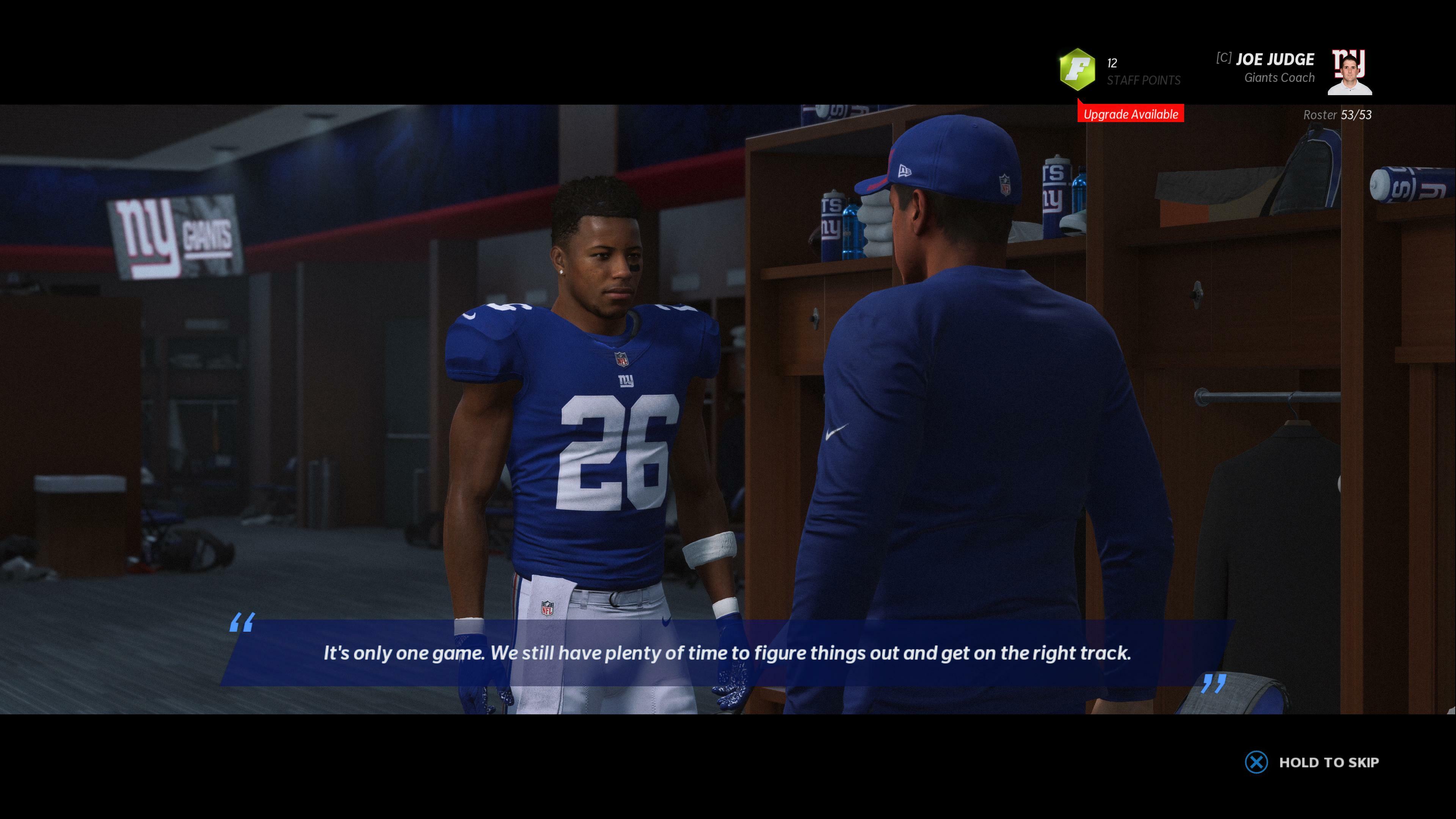
One of Franchise’s other new features can at least mitigate injuries to some extent. Your head coach, offensive coordinator, defensive coordinator, and player personnel all have their own RPG-style skill trees. By meeting gameday and longer-term goals, you’ll unlock Staff Points that can be spent on improving your staff in multiple areas, such as decreasing injury recovery time. Improving your staff results in better development of your players, giving Franchise a rewarding loop as better players means you’re more likely to complete goals to in turn improve your coaches again. Each of these new and revised systems gives Madden 22 greater strategic depth beyond simple roster construction. No two games are the same, and Franchise manages to strike a sweet spot where what you do off the field has a rewarding impact on what you do on it, to the point where it has fundamentally changed how you’re expected to approach each match-up.

If you’re playing as a head coach, Franchise also introduces storylines over the course of each season to reflect the ups and downs a team must endure. These scenarios add faint narrative elements to the game, but mostly it’s another way to improve players by setting them dynamic goals. If a player performs well during pre-season, you might talk to them about having a big game to start the regular season. This will give you a game day goal to continue their breakout, earning more Staff Points if you’re successful. Scouting, on the other hand, is unchanged at the moment, but Tiburon expects to launch a new scouting system for free in September. This will allow you to assign national and regional scouts to find the best college prospects and accrue more information ahead of draft day. This all sounds good, but obviously it’s impossible to know for sure until the free update is released.

Ultimate Team and The Yard also return, but are mostly untouched from last year. The latter–a unique six vs. six backyard football experience–adds new fields, including Hawaii, and a new ranked mode so you can test your skills against other players. Progression in The Yard is also unified across Face of the Franchise: United We Rise, so all player progress, rewards, and gear are shared between the two modes. Face of the Franchise is also similar to last year, only now you’re able to play as either a quarterback, running back, wide receiver, or linebacker. The story here is cliched and stale, with stilted cutscenes and a lack of chemistry amongst its small cast. Watching a young player go through college before entering the draft is an overused plot at this point, even if Madden 22’s version focuses on the relationship between a player and his agent as opposed to something like a teammate rivalry. There just isn’t enough here to warrant playing Face of the Franchise over the regular Franchise mode. The addition of a new class-based system that defines your play style is a nice touch, giving you specific X-Factor abilities to work towards unlocking. But unless you like taking a created character through an NFL season, there’s isn’t enough depth nor incentive to devote time to Face of the Franchise.

No Caption Provided

Gallery

It’s not without its fair share of glitches either. The subtitles during cutscenes often disappear, music will sometimes overpower dialogue, and your created character’s face has a tendency to completely change at random. Madden 22 also has a habit of crashing throughout all modes, giving the impression that it’s not quite ready to launch yet. You can pick back up where you left off after most of these crashes, but occasionally it will freeze at the end of a game and wipe all of your progress. Leaving a game in progress and returning to it later will also reset your game day goals, even if you’ve also completed them, and sometimes a win will count as a loss in Franchise.

These technical issues put a damper on Madden 22, particularly since it finally addresses Franchise with a number of meaningful additions. Hopefully these glitches, and particularly the crashes, can be ironed out soon.

When everything’s working as intended, Madden 22 marks a recent high point for the series. The gameplay doesn’t move the needle much mechanically, but changes to the AI make for a more interesting and varied challenge, while Gameday Atmosphere and Momentum brings every team’s fans to life to palpable effect. With Franchise making the moments between these games more engaging, it’s relatively easy to sink hours into building a team to challenge for the Super Bowl. It’s just unfortunate that this comes with the caveat that technical problems might prove to be the biggest obstacle standing in your way.

Annette Review

Annette hit theaters in a limited release on Aug. 6 and is now streaming on Amazon Prime Video.

Glam rock meets surrealism in Annette, a dreamlike musical that combines the lunatic flair of director Leos Carax with the art pop stylings of Sparks — brothers Ron and Russell Mael — who both wrote and composed the film. Creatively, it’s a match made in heaven, telling the story of a Hollywood couple who starts out similarly well-matched before being consumed by celebrity pitfalls. It’s a tale of passion front-loaded with enrapturing imagery, one that soon slips into a lurid saga of ego and exploitation that, while far less visually dazzling, is no less strange and melancholy. The story might have warranted comparisons to the many versions of A Star is Born, were it not for its peculiarities — chief among them, the couple’s exceptionally gifted newborn, Annette, who happens to be played by a puppet.

Adam Driver plays Henry McHenry, a tortured comedian whose stage act is as avant-garde as the film itself. His set, which walks an uncomfortable line between reality and fiction, is most often about death, a constant anxiety throughout the film, which also manifests in the many stage performances delivered by his wife, Ann Defrasnoux, a famous actress played by Marion Cotillard. Both performers frequently die on stage, but off it, they attempt to live life to the fullest. Theirs is both a high-profile romance, which they perform for the paparazzi, and a sensuous one behind closed doors, resulting in both intimate playfulness, and some incredibly inventive and intoxicating musical sex scenes, in which writhing naked bodies become increasingly entwined with both the rhythm and with each other.

Annette is not a traditional musical with choreographed dance. However, it features thoughtful choreography between the camera and its subjects, with Carax and cinematographer Caroline Champetier turning even mundane interactions into out-of-this-world musical interludes, the kind that would feel poetic even on mute. The film often frames Henry and Ann in relation to the public, whether by capturing their locked gaze across a sea of photographers, or by making their respective stage audiences a key part of the musical segments. The characters’ perspectives on the public are just as important as the public’s perspective on them, whether told through brief, tongue-in-cheek celebrity news broadcasts, or unbroken wide shots that capture Henry traipsing across the stage, as seen from the eyes in the balcony. The camera also has a particular affinity for the film’s only major supporting character (the only one who isn’t a puppet, anyway), a music conductor played by Simon Helberg, who seems hung up on Ann, and whose sincerity clashes with the ugliness underlying her tale of stardom. As he directs his orchestra, the camera often spins around him in close-up, swaying in tandem with the music. While Helberg features only in a handful of scenes, his performance stands out in the way it harbours a deep, unrequited longing.

Movement and music are just as key to Annette as stillness; the viewer is often kept at an arm’s length from Henry during his act, which is punctuated by eerie silence. This creates a sense of mystery about him. Before he steps on stage in his unkempt green robe — part of his disheveled stage persona — he shadow-boxes with his hood up, like a prize fighter about to step out beneath arena lights. There’s an enormity to his performances, scenes of which are interrupted only by brief, dreamy, jittery shots of Ann on a stage of her own, her bright red hair clashing with the blue pillars of the sets around her. She’s never far from Henry’s thoughts. When they step in and out of each other’s orbits, the film captures this transition through its lighting and set design; the sickly, green world of musical stage comedy is Henry’s realm, while Ann resides in the more polished, bright blue world of highbrow opera.

The clash between lowbrow and highbrow lies at the heart of Sparks’ entire campy repertoire. Their lyrics for the film are repetitive and often thuddingly literal, but each composition creates a winding musical path that turns the words into texture. Songs like the simple love ballad “We Love Each Other So Much,” in which the title is repeated ad nauseam, begin to feel like a chant or an echoing promise (there are plenty of similar earworms to be found, especially when Ann and Henry sing to or about Annette). It also helps that Cotillard and Driver are tremendous actors, who inject each aria with physical and emotional desire, even though Driver isn’t the most effective singer. Western musicals tend to have an aversion to playback singing — a common element in Indian cinema, where characters’ singing voices are dubbed by professional singers — and since the number of Hollywood musicals has declined in recent decades, a good singing voice is no longer a prerequisite to stardom. Annette, while a co-production between France, Germany, and Belgium, remains at the mercy of this backdrop (warts and all), given its Hollywood cast and setting. Driver’s singing voice is average, and only sounds like nails on a chalkboard during one specific number which requires emotional belting. But for the most part, he and Helberg are saddled with songs that require them to speak or whisper. They excel during more conversational numbers, while allowing Cotillard to impress both as Ann, the opera actress, and as the voice of Annette, the supernaturally gifted puppet.

Annette is a stunning creation, a marionette that appears to move independently and is designed with wide-eyed emotions in mind. She has her mother’s voice and dyed red hair, and her name, Ann-ette, even suggests that she’s a little version of Ann (coincidentally, the fact that she’s a marionette also makes her a little version of Marion Cotillard). However, while Annette might seem like an opportunity for endless puns — her name may even be a shortened version of “marionette” — her presence is far more thoughtfully conceived. She embodies not only Ann’s hopes and dreams through the traits they share, but Henry’s fears of artificiality and his controlling nature, especially as his success begins to be overshadowed by Ann’s. However, what ultimately sells Annette as a living, breathing character is undoubtedly Driver and Cotillard’s commitment to the bit. Both actors, even though they’re more than adept at emoting through speech, shine most when they react, and think, and consider, as if the way they ponder their feelings (about Annette, and about each other) is what helps those feelings radiate outwards. Once again, the words feel secondary.

Cotillard and Driver are tremendous actors.

Stages appear frequently in the story, but the film isn’t trying to adapt the medium of stage musicals for the screen (as movie musicals often do). Rather, it seeks to adapt the screen, as a fabric, to the medium of music, as if to blend the two together. On occasion, the brightness of the frame shifts with the beat, while sonic distortions manifest as choppy images fading into one another. For every literal, single-minded lyric, Carax introduces a multitude of overlapping visual ideas, and he ties sound and picture inexorably together. Even the editing, by Nelly Quettier, follows suit. Rather than simply cutting on the beat, like a modern pop music video, the film holds on long, unbroken takes, and it cuts only in order to shift between ideas. One choice in particular feels emblematic of this approach, a transition from soothing classical music to thrashing electric guitar, marked by a hard cut from a stroll through the woods to a leather-clad bike ride, all within the same song and all while maintaining the same romantic mood. The film’s more serious second half doesn’t feature as many of these flourishes — it’s comparatively restrained — though one can hardly call it conventional.

The film, while certainly fresh in approach, calls back to earlier works by Carax. Its opening scene in particular — the number “So May We Start,” in which Sparks, Carax and the cast appear as themselves and ask for permission to perform — evokes the accordion interlude from Carax’s hyper-energetic masterpiece Holy Motors. In both cases, the music builds as an ever-growing parade of performers marches towards the camera in an unbroken, momentous take. Meanwhile, Ann’s introduction in the film, in which she wears a skincare facemask, bears a sly resemblance to the late actress Édith Scob — not only her masked appearance in Holy Motors, but in the 1960 Scob classic that it called back to in the first place, Eyes Without a Face. Carax, who fills Annette with charming, old-world special effects, like obviously-fake rear projections, embeds Annette into the history of cinema, and in the process, embeds Sparks within that history too. Carax has been making films since the 1980s, but Annette, which began as a concept album, is Sparks’ first film project to see the light of day, after failed productions with Jaques Tati in the 1970s and Tim Burton in the 1990s. That Sparks are among the first people to appear in the film feels like a well-earned victory lap, in which they rightfully stake their claim as long-time admirers of postmodern and avant-garde cinema, whose acts have always felt like they were on the peripheries of the medium, just waiting to break in. It turns out Tinseltown is big enough for the both of them.

An oblique, ethereal musical that runs the visual gamut, Annette captures the enormity of love through gentle silhouettes, and the corrosive power of jealousy through devastating storms.

Oscar Isaac Explains Why He Joined the Metal Gear Solid Movie, and His Love for the Game

Oscar Isaac has explained his love for Metal Gear Solid led him to accept the role as Solid Snake in an upcoming movie adaptation, saying that its “psychedelic military horror” and anti-war message are a big part of his affections.

Following the news that Oscar Isaac is set to play Solid Snake in the upcoming Metal Gear Solid movie from director Jordan Vogt-Roberts, the actor has explained to Total Film why he joined the film.

“I just loved the game,” Isaac said. “I love the feeling that the game would give me every time I’d play. It’s just a strangely isolated, mournful, lonely game to play that has these incredible moments of violence and terror, with these weird, psychedelic concepts and villains. But, yes, it’s kind of like psychedelic military horror things that happen.”

Isaac spoke further about the themes behind Metal Gear Solid and his hopes for the series’ adaptation onto the big screen. “The truth is, underneath the whole thing, it’s an anti-war story. So I think those are the elements I really love,” he explained. “And, like I said, I love the feel of playing it, and the big question of: can something like that be transferred – or can you explore those themes in a really interesting way – on film?”

Isaac has long since been known to be a fan of the role. During an interview with IGN for Netflix’s Triple Frontier, the actor stated his desire to play the role of Solid Snake in a movie adaptation. “Metal Gear Solid, that’s the one,” Isaac said at the time. “I’m throwing my hat in for that one.”

Following the interview, Vogt-Roberts seemed keen for Isaac to portray the film’s lead even before casting had started. The director commissioned artist Bosslogic to create a mock-up of the actor as Snake which you can see in the tweet below.

Very little is known about the movie at this point with neither the film’s release date nor production date having been announced. With Isaac’s incredibly busy schedule, fans will hope that the film is able to move forward sooner rather than later.

In addition to being cast in Metal Gear Solid, the actor has been working on a number of other projects including Marvel’s Moon Knight where he is set to play the show’s titular character, Marc Spector. The actor will be joined on Moon Knight by Ethan Hawke, who recently revealed what it took for Isaac to convince him to join the Disney Plus series. Meanwhile, Dune – Isaac’s next major sci-fi theatrical release – is set to release on October 22. Isaac will portray House Atreides’ leader Duke Leto in the film adaptation of Frank Herbert’s novel.

Jared Moore is a freelance writer for IGN. You can follow him on Twitter.

Mike Richards Steps Down As Jeopardy Host

Mike Richards has stepped down as the new daily host of Jeopardy. Richards had been the center of controversy ever since he was announced as host last week.

The announcement that Richards will no longer present the new season of the classic game show follows the backlash to a series of sexist, racist, and homophobic comments that he made on a podcast between 2013 and 2014. Richards is also Jeopardy’s executive producer, and in a statement, he said that didn’t want his past behavior to overshadow the show, which started production again this week. Read the full statement below, via writer Claire McNear:

It was McNear who broke the story about the comments that Richards made on the podcast The Randumb Show, in an article for Ringer. Richards issued an initial apology on Wednesday this week, stating, “It is humbling to confront a terribly embarrassing moment of misjudgment, thoughtlessness, and insensitivity from nearly a decade ago.” However, the controversy was showing little signs of going away.

Even before the Ringer article, there were questions being asked about both the selection process to find a new host for Jeopardy. The series went through a series of guest hosts, including LeVar Burton and Aaron Rodgers, with the expectation that the new host would be chosen from these. However, on August 11, it was announced that Richards himself would be the regular host, with Big Bang Theory star Mayim Bialik set to host special episodes and prime-time tournaments.

In addition, Richards had previously settled two lawsuits that dated back to his time as executive producer on The Price is Right in the early 2010s. The lawsuits were brought by former models on the show, who alleged that Richards discriminated against them because of pregnancies, and also made insensitive statements. Richards denied any wrongdoing, stating, “I want you all to know that the way in which my comments and actions have been characterized in these complaints does not reflect the reality of who I am or how we worked together on The Price is Right.”

The search for a new Jeopardy host followed the death of Alex Trebek, who had hosted the show since 1984 but died in November last year. As Richards’ statement indicates, the show will now go back to guests hosts until a new full-time host can be appointed.

Saints Row Could Be Getting a Reboot at Gamescom 2021

A new tease appears to confirm that a Saints Row reboot/new entry will be revealed next week at Gamescom 2021.

The Game Awards and Gamescom Opening Night Live’s Geoff Keighley shared this tease on Twitter, confirming that the team behind the show is “‘Bossing’ it with our announcements this year.”

Speaking of the show, Gamescom Opening Night Live will take place on Wednesday, August 25 at 11am PT/2pm ET/7pm BST.

As if there was any doubt that this was for Saints Row, the Tweet also includes a link to bit.ly/BossIt that takes users to SaintsRow.com, which has been updated to include the same “Rebooting” image.

Rumors and hints of a new Saints Row, which may or may not be titled Saints Row 5, have been appearing for quite some time now, especially considering Saints Row 4 was released all the way back in 2013. THQ Nordic confirmed that a full Saints Row game was “deep in development” back in 2019, and Koch Media said the official announcement of the game would take place in 2020.

Due to the COVID-19 pandemic or other unknown reasons, this reveal has yet to happen, but Gamescom 2021 sure seems where fans of the franchise will finally learn what’s next for the series.

For more, check out our look as to whether Saints Row 4 is the best sandbox of all time, and check out our reviews of both Saints Row 4: Re-Elected and Saints Row 3 Remastered.

Have a tip for us? Want to discuss a possible story? Please send an email to [email protected].

Adam Bankhurst is a news writer for IGN. You can follow him on Twitter @AdamBankhurst and on Twitch.

Soulja Boy Doesn’t Own Atari, Despite What He Told ‘Em

Soujla Boy told ’em, but it wasn’t the truth. Atari has set the record straight that rapper and cheap electronics reseller Soulja Boy is not actually the new owner of Atari, despite the claims he has made over the last few days.

“I am now the owner of Atari. I own the video game company Atari,” Soulja Boy (real name DeAndre Cortez Way) said in a video posted on YouTube. If that sounded too good to be true, it’s because none of it is true, despite Soulja Boy wearing an Atari shirt and hat in the video. He claimed Atari was “proud” of him for his work on the Soujla Game console, which was very clearly a repackaged and marked-up knockoff system that included some legally nebulous elements.

In a message spotted by Game Informer, the Atari Twitter account didn’t directly mention Soulja Boy but very clearly referred to him:

The SouljaBoyGame Twitter account said back in June that you’d be able to play its handheld system using Xbox and PS5 controllers. The console itself is based on another system–big surprise–and is sure to be sold for many times what the original system would cost.

Atari has its hands full already with the recent launch of the Atari VCS system, which doesn’t seem to be making all that big of a splash so far. Reviews have been limited, though IGN’s Seth Macy was unimpressed with its attempts to blend console and PC elements together, as well as its very high price tag.

Demonic Review

Exorcism meets virtual reality in Neill Blomkamp’s Demonic, a film that boasts several weird and interesting ideas but barely skims their surface. It’s bold and unique in the way it captures spiritual fears in a technological landscape, but this exploration is frustratingly cast aside in favor of by-the-numbers horror that hardly commits to its own ridiculous premise.

Demonic follows Carly (Carly Pope), a middle-aged woman who’s talked into communicating with her estranged, comatose mother Angela (Nathalie Boltt) through a new form of virtual reality — however, we quickly learn that they’re not alone in this digital dreamscape. The film is at its most interesting, thematically and aesthetically, during Carly’s multiple trips to see her mother. The space she inhabits is created by Angela’s mind, which, with the help of VR technology, renders it like a video game, bringing doors and passageways into existence right before Carly wanders through them. This world feels uncanny, as if real locations and characters had been coated with a thin layer of digital paint. The camera alternates between sticking close to Carly and taking an “objective” overhead angle. In one moment, it employs a head-on POV, which centers her emotional discovery through close-ups. In the next, it captures a floorplan of the mysterious technological world as Carly carefully explores it.

The frames in this world often jitter as if there’s too much information to process; Blomkamp understands the enormity of turning memory into a digital space. He even uses glitches and impossible physics to denote the bizarre, maybe even supernatural goings-on within Angela’s mind. It’s a haunting image of what a literal ghost in the machine might look like, if one could digitize every element of the human psyche, including its deepest, darkest fears. As Carly emerges into the real world after meeting with her mother, a number of visual flourishes hint at her fractured self-identity. When she’s debriefed and recorded by the executive and doctor who are overseeing the whole ordeal, Michael (Michael J. Rogers) and Daniel (Terry Chen), she’s presented out of focus, and only visible to us on their camera’s monitor. We begin to see her as she sees herself, indirectly, distorted through mirrors and glass, as if her perspective has come unglued.

Somehow, all of this takes up an incredibly tiny portion of the film.

In addition to its haunted digital consciousness, Demonic also features a related, parallel tale of physical haunting, one that proves just how much Blomkamp’s strengths lie in the realm of VFX and the way human beings interact with technology. Carly’s forays into the eerie digital world are often broken up by less interesting real-world segments involving secondary characters like her ex Martin (Chris William Martin), and her best friend Sam (Kandyse McClure). The way she’s framed in isolation certainly piques curiosity, but as the film goes on, she shares more and more scenes with other characters, and the Demonic’s limitations become increasingly apparent. The conversations in Blomkamp’s script are often stilted and unnatural. The movie is lucky to feature a lead actress as naturalistic as Pope to balance it out. Unfortunately, she’s the only cast member who does. It’s practically a superpower in a film like this, in which the protagonist rarely makes active decisions (everything happens either to or around her) and every bit of dialogue, from characters greeting one another to emotional confessions, all feel like exposition first. You can feel Pope struggling to inject her character with some form of lived reality (she’s especially adept at radiating anxiety and discomfort), but the filmmaking does her no favors. The way it frames characters in conversation, with little care for their physical or emotional relationships, comes across as amateurish and rote. It’s as if the goal isn’t to convey a feeling but to establish logistical information.

There’s something almost fascinating about a film that feels totally at ease in the digital world but seems to be on autopilot when dealing with flesh and blood. Almost. For a moment, it seems like this uncanniness during dialogue-heavy scenes might serve a distinct purpose, but whatever twists and turns that appear to be foreshadowed turn out not to pay off. The intrigue is mostly accidental. With Demonic, what you see is what you get, and what you see isn’t very engaging. While its rare moments of VR-specific terror are placed on full display, the movie’s real-world horror segments play out far too mechanically to have any bite. Demonic has the familiar look and design of a typical horror film, with dim, narrow hallways fit for plenty of jump scares. However, the construction of each familiar moment ends up limp and tensionless. It lacks finesse. Each minor miscalculation — when exactly to cut during an intense set-piece, what kind of shot to cut to, or when to play a jarring sound cue — eventually adds up, and so it plays like a hollow imitation of much more effective possession films.

The intrigue is mostly accidental.

At one point, Demonic actually seems like it’s about to introduce an especially kooky wrinkle, with regards to who its exorcists might be and how they navigate the modern world and its modern supernatural problems. The idea is revealed through a line of dialogue that’s so laugh-out-loud ridiculous that it reframes the entire premise, shifting it towards the realm of a self-aware midnight movie. However, this too ends up being a broken promise; it’s largely dealt with off-screen. No idea in Demonic seems to last too far beyond its introduction, save for the occasional concept that might briefly re-emerge to serve a plot function before disappearing once again. It’s quite a shame, considering the film’s potential.

Biomechanical anxieties run throughout Blomkamp’s work. In District 9, Wikus (Sharlto Copley) begins mutating into an alien, which allows him to use DNA-coded extraterrestrial tech. In Elysium, Max (Matt Damon) is surgically fused with a metallic exoskeleton, and has a program coded into his brain. Blomkamp’s shelved Alien project would have seen Ripley (Sigourney Weaver) wear a biomechanical Xenomorph suit. In Chappie, Deon (Dev Patel) is resurrected after his consciousness is stored on a series of PlayStations; it’s a sillier film than the rest, but it asks similar questions about our relationship to machines, and whether the soul can be reconciled with ones and zeroes. Demonic’s virtual reality segments are a natural progression of these ideas. They hint at what could have been Blomkamp’s most intimate exploration of technology, and they’re also more conceptually interesting than what sci-fi anthologies like Black Mirror and Solos have done with VR in recent years, down to the way certain events from Carly’s past manifest both in her dreams as well as her virtual experiences.

As we live more of our lives online, the mind-body connection becomes an understandable fixation in modern sci-fi, but it so often breaks human consciousness down to simple code without digging into the clash between the technological and the spiritual. Few Hollywood films since the Matrix trilogy have even attempted this — which makes Demonic’s sidelining of the concept all the more frustrating. It points towards fascinating questions about how religious beliefs may transform in a digitized, mechanized world, and the ways deep-seated folklore may take hold as we pour cultural fears into online spaces. However, it chooses not to follow those instincts, which might have offered its lead character a much more challenging and complicated emotional journey. Instead, the film reveals its unoriginal demon mythology not only in traditional terms — through snippets of analog historical research — but in a way that circumvents the chilling sensation of discovering something horrifying. The information is simply presented to Carly in pre-assembled form, like someone leaning over to you in the theater and whispering “that’s demonic” when a shapeless figure appears on-screen.

Blomkamp is far more adept at heavy-handed social metaphors than nuanced storytelling, and the lack of the former really hurts him here. The film’s scares are largely traditional too, born of a combination of physical startles and things often explained away in literal terms. Its eventual climax barely features the virtual world at all. For a film with such a new and unique premise, Demonic is awfully quick to bury its ideas beneath ones that have been done to death by dozens of better films.

WarioWare: Get It Together Gets an Unexpected Demo

The upcoming microgames collection WarioWare: Get It Together! has received an unexpected demo that is available for players to try out now on the Nintendo Switch eShop.

News of the demo’s addition to the store was announced on Nintendo of America’s Twitter account and this free trial version of WarioWare: Get It Together! will allow players to access a select range of quirky minigames and characters before the full game’s official release on September 10, 2021.

WarioWare: Get It Together’s full release will allow fans to control Wario and his crew as they navigate across 200 fast-paced minigames. The game’s story mode can either be played solo or with a friend in two-player local co-op whilst an alternative Variety Pack party game mode supports up to four players on the same system. WarioWare: Get It Together will also feature an online game mode called the Wario Cup where players can compete in rotating weekly challenges to earn trophies and in-game currency.

This isn’t the first time this year that Nintendo has announced a demo on short notice. Earlier this year the studio quickly released a demo for Mario Golf: Super Rush following the game’s reveal at the February 2021 Nintendo Direct. Whilst in October 2020, the company released a surprise Cloud version of Control for the handheld. Although WarioWare: Get It Together was announced back in June, the addition of the game’s demo to the eShop similarly came with little warning.

The last WarioWare game to debut for Nintendo was WarioWare Gold which launched in 2018 for 3DS. We felt that the franchise’s previous installment did a good job in providing “short attention span shenanigans” for newcomers, but repeated too much of previous games to really impress long-term fans of the franchise. WarioWare veterans will likely be hoping that Get it Together brings some innovative and substantial new additions to the series.

Jared Moore is a freelance writer for IGN. You can follow him on Twitter.

The Navy Stopped Tom Cruise from Flying an Actual Jet in Top Gun: Maverick

Tom Cruise was barred by the Navy from flying an actual F-18 Super Hornet jet in Top Gun: Maverick, even though he pilots several other aircrafts in the sequel.

According to USA Today, Jerry Bruckheimer, who co-produced the original Top Gun, spoke to Empire Magazine about the long-awaited sequel. He hinted that fans can expect plenty of thrilling action sequences in the movie, as glimpsed in the trailers, with Cruise piloting a P-51 and various other helicopters and aircrafts — bar Maverick’s F-18 jet.

Apparently, Cruise put in a request to fly the Super Hornet but he was denied clearance by the Navy. Instead, IMAX cameras were installed inside the F-18 cockpits to shoot certain scenes while skilled Navy pilots took care of the actual flying, which Bruckheimer assures will give the experience of “what it’s like to be in an F-18 in that cockpit with those pilots.”

“When you’re pulling heavy Gs, it compresses your spine, your skull. It makes some people delirious. Some people can’t handle it,” said Cruise, who, as a producer on the film, signed his co-stars up for intense training and aerial boot camp. “So I had to get them up to be able to sustain high Gs. Because they have to act in the plane. I can’t have them sick the whole time.”

Tron: Legacy and Oblivion’s Joseph Kosinski directs the decades-later sequel, which sees Cruise reprising his role as Pete “Maverick” Mitchell. Now a flight instructor, Maverick must head back into the danger zone and confront his past while training a new squad of graduates for a perilous mission that demands the ultimate sacrifice.

Top Gun: Maverick will finally arrive in cinemas on November 19. Val Kilmer will be returning as Tom “Iceman” Kazansky alongside franchise newcomers Ed Harris, Jon Hamm, Jennifer Connelly, Glen Powell, and Miles Teller in a lead role. Notably absent from the cast is Kelly McGillis who played Maverick’s love interest, Charlie Blackwood, in the original film.

Adele Ankers is a freelance writer for IGN. Follow her on Twitter.