Psyonix is currently “actively working on” moving Rocket League to Unreal Engine 5, but it cautions that this will be a “long-term project” that will take some time.
“The marketing department continues to build out its team in order to maintain and expand its ability to support Rocket League’s ongoing initiatives, as well future Psyonix projects including Rocket League: Sideswipe and Rocket League’s move to UE5.” The job posting read.
It appears that line about Unreal Engine 5 has since been removed in the job posting, but Rocket League senior community manager Devin Connors replied to u/goldfish5’s Reddit thread to confirm this move was in the works.
“Upgrading the technology that powers Rocket League, including a move to UE5, is something we are actively working on. This is a long-term project for us, and we’ll share more details when we’re ready to show our players what’s coming next,” Connors wrote.
Ghost of Tsushima had a few nice little nods to the PlayStation games of old, especially toward the end of the original campaign. But with the Iki Island expansion that’s part of Ghost of Tsushima Director’s Cut for PlayStation 4 and PlayStation 5, developer Sucker Punch Productions has left a few very big Easter eggs for PlayStation fans to find, and several come complete with their own puzzles and rewards.
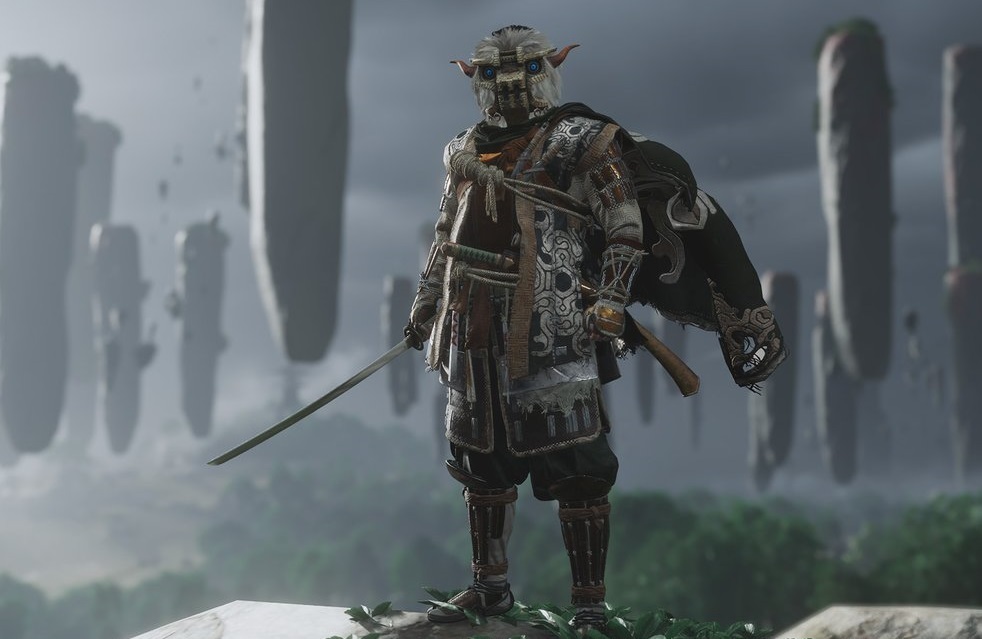
The three biggest Easter eggs reference some classic PlayStation exclusives: Shadow of the Colossus, Bloodborne, and 2018’s God of War. Each has its own dedicated shrine you can find as you explore Iki Island, and each will reward you a cosmetic suit of armor that was previously only available in the Ghost of Tsushima’s Legends mode, if you’re willing to solve some puzzles (or look up their solutions).
Here’s a quick look at the Easter eggs you can find and the rewards you’ll unlock if you manage to solve their puzzles. If you want to figure them out on your own, stop reading now.
Ghost Of Tsushima’s Iki Island Wind Shrines
There are three “forgotten” shrines located on Iki Island, each of which references the game worlds and stories of a famous PlayStation game. Their names give some hints as to what you’ll find in each one: the Blood-Stained Shrine recalls the hunt of Bloodborne; the Shrine in Shadow gives the feel of the central temple in Shadow of the Colossus; and the Shrine of Ash is the home of birch trees like those that grow around the home of Kratos and Atreus in God of War.
Each shrine also includes a poem referencing its game, which provides clues to the puzzle you can solve within.
The Blood-Stained Shrine
Located on the west side of the island, the Blood-Stained Shrine is full of loud, irritating crows and their feathers, with a mural that depicts Yarnham’s orange moon and the Moon Presence it hides.
Blood Stained-Shrine
Venture into the shrine and you’ll discover a scroll that includes a poem referencing the story of the game.
“The first green of spring
sickens to black, decaying,
plagued by blood and beast.
Hunter, reject death’s allure.
Prepare to duel man’s frailty.”
Complete the shrine and you’ll earn the Yarnham Helm and Yarnham Vestments armor cosmetic, both of which recall the armor of Eileen the Crow, one of the Hunters you can meet in Yarnham during your journey.
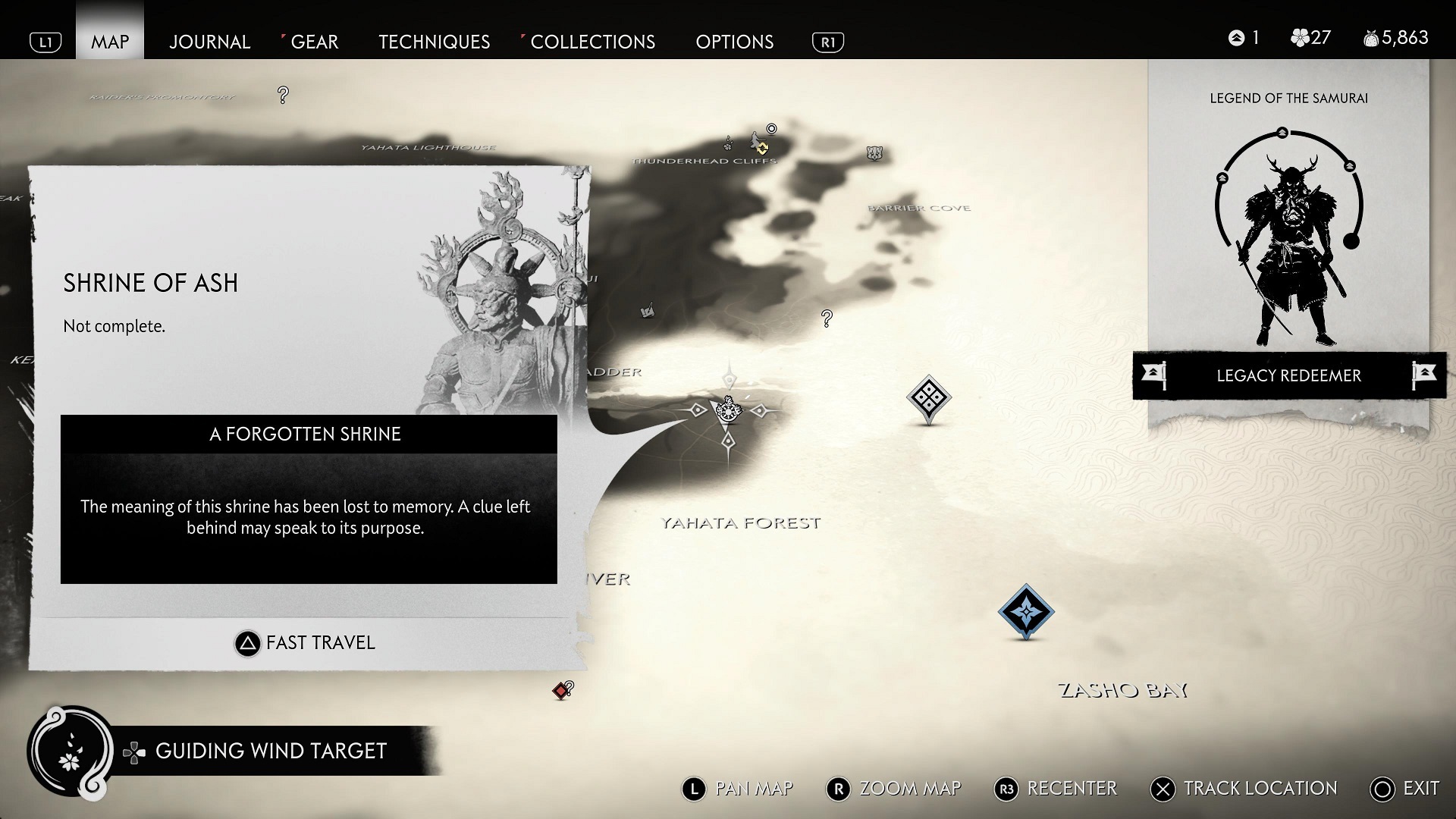
You’ll find the Shrine of Ash on the east side of the island. The shrine is littered with chains, a reference to our man Kratos and his Blades of Chaos. The birch trees present are those found surrounding Kratos’ home at the start of the game, and near the center of the shrine, you’ll find one with a glowing orange handprint–just like those marked by Freya in God of War. There’s also an axe embedded in the tree, recalling Kratos’s work felling a few of them at the start of the game. It’s just a regular working axe, though, and not the super-cool, magical Leviathan axe Kratos wields in the game.
The Shrine of Ash
The shrine’s poem is all about Kratos and Atreus’ relationship, while also feeling a bit relevant to Jin’s story. His journey to Iki Island is all about Jin dealing with the memories of his father, who died during a military campaign on the island, an event that has left Jin feeling guilt and shame for years.
“In fall, a tree fruits
which grows from seed to sapling,
a stranger and son.
Boy, honor your father’s fight.
Show him the strength of your blade.”
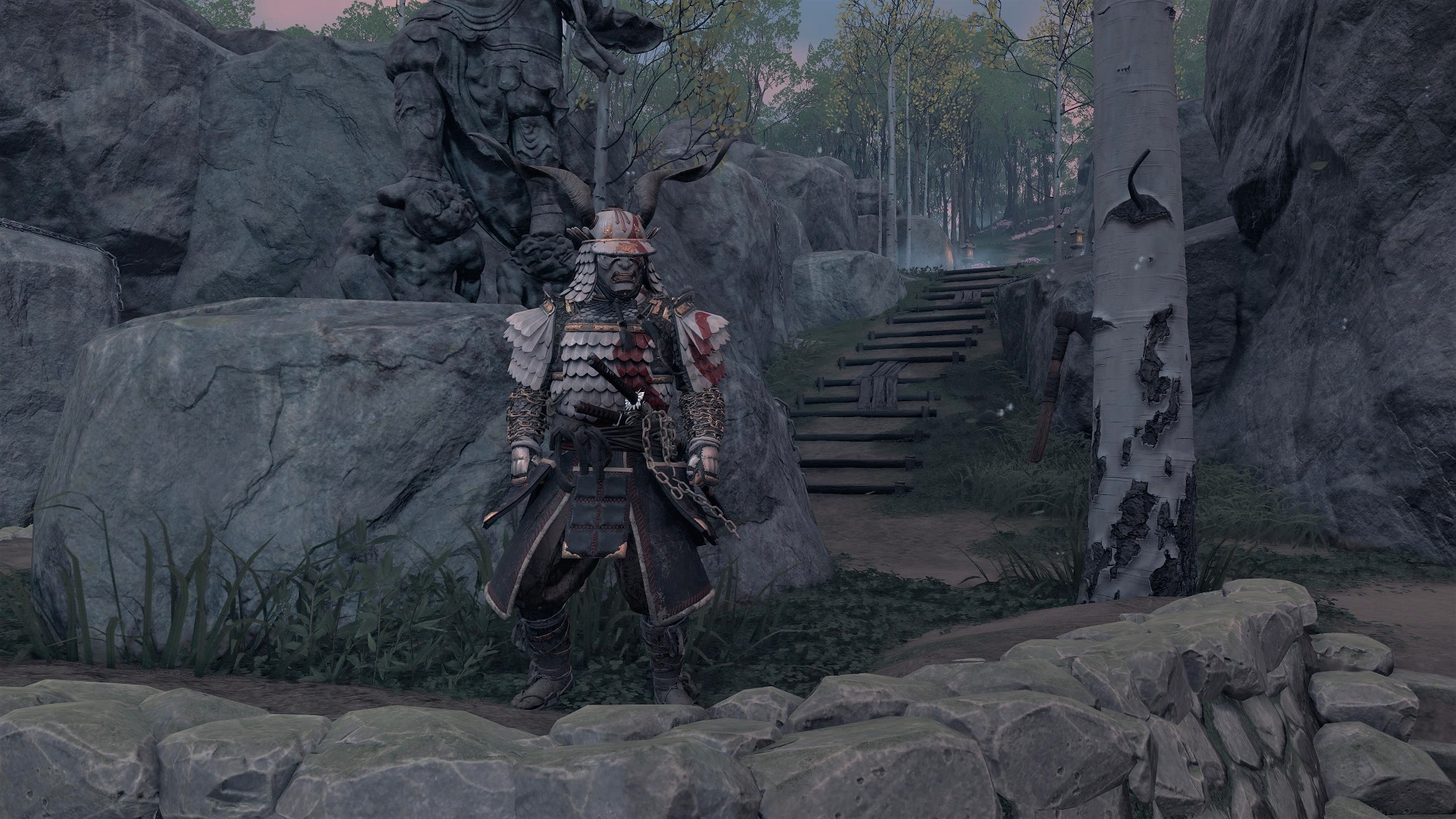
If you solve the shrine’s puzzle, you’ll get the Helm of War, Spartan face mask, and Ghost of Sparta armor cosmetic for your trouble, allowing you to cosplay as Kratos as you adventure across Tsushima.
Stag
Our Shrine of Ash guide can help you to find the shrine and solve its puzzle.
The Shrine In Shadow
Located to the south of Iki Island, the Shrine in Shadow is the toughest of the three to reach, much like the land of Shadow of the Colossus itself. Reach it, and you’ll find a huge mural painted on the base of the statue at its center–the symbol that marks the weak points on the huge colossi you battle throughout that game. The base of the statue is also adorned with huge fur pelts, as if they were skinned off the colossi, and fans of the game will remember using those patches of fur to climb the huge beasts in order to administer the killing blows to bring them down.
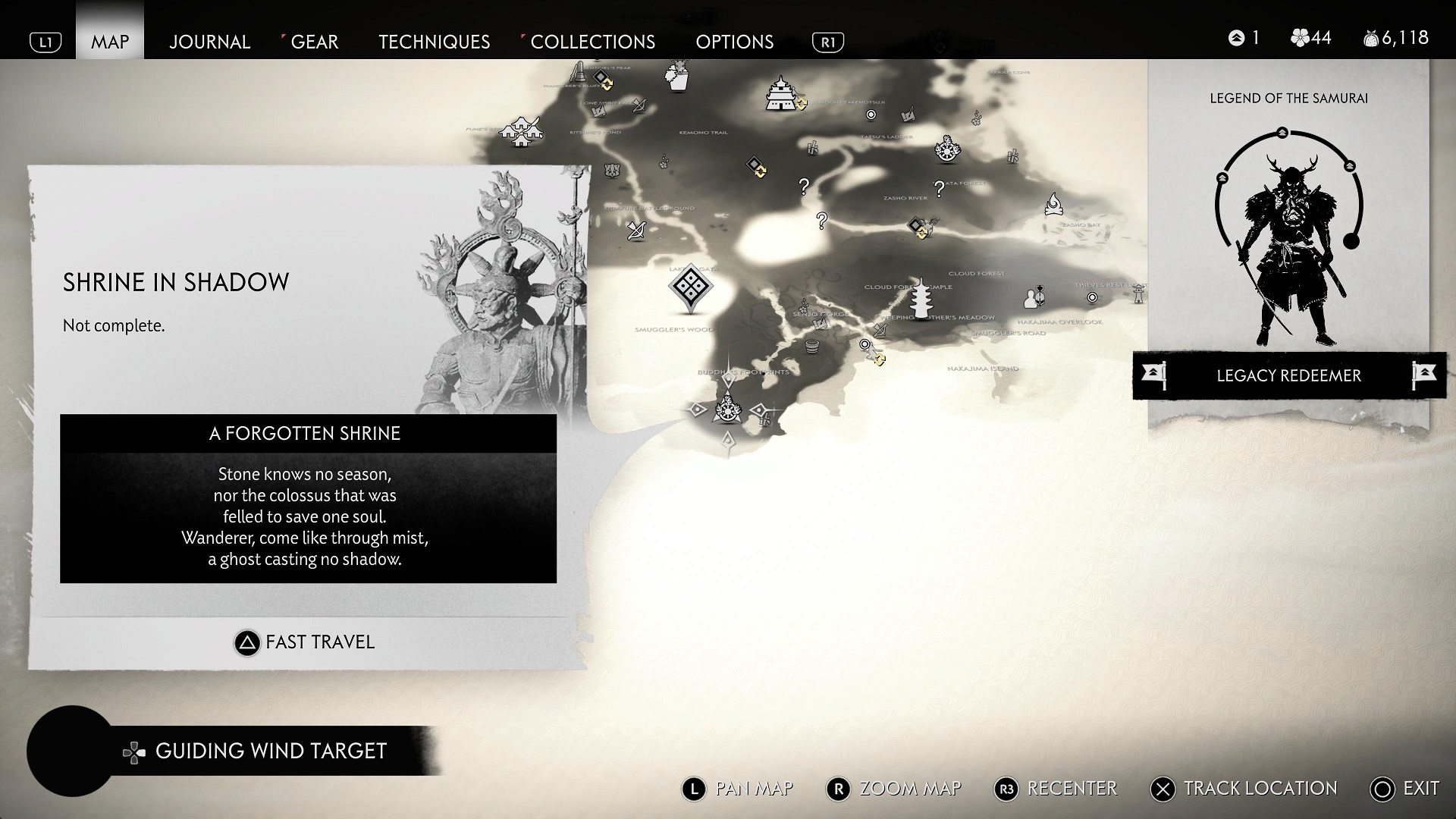
The Shrine in Shadow
The poem is a somber remembrance of Shadow of the Colossus’s story:
“Stone knows no season,
Nor the colossus that was
felled to save one soul.
Wanderer, come like through mist,
a ghost casting no shadow.”
Completing the final shrine’s puzzle gets you the Mask of the Colossus and the Armor of the Colossus cosmetic, which recall both the look of the huge colossi from the game, and the armor and ceremonial robes worn by protagonist Wander and the soldiers and priests who pursue him.
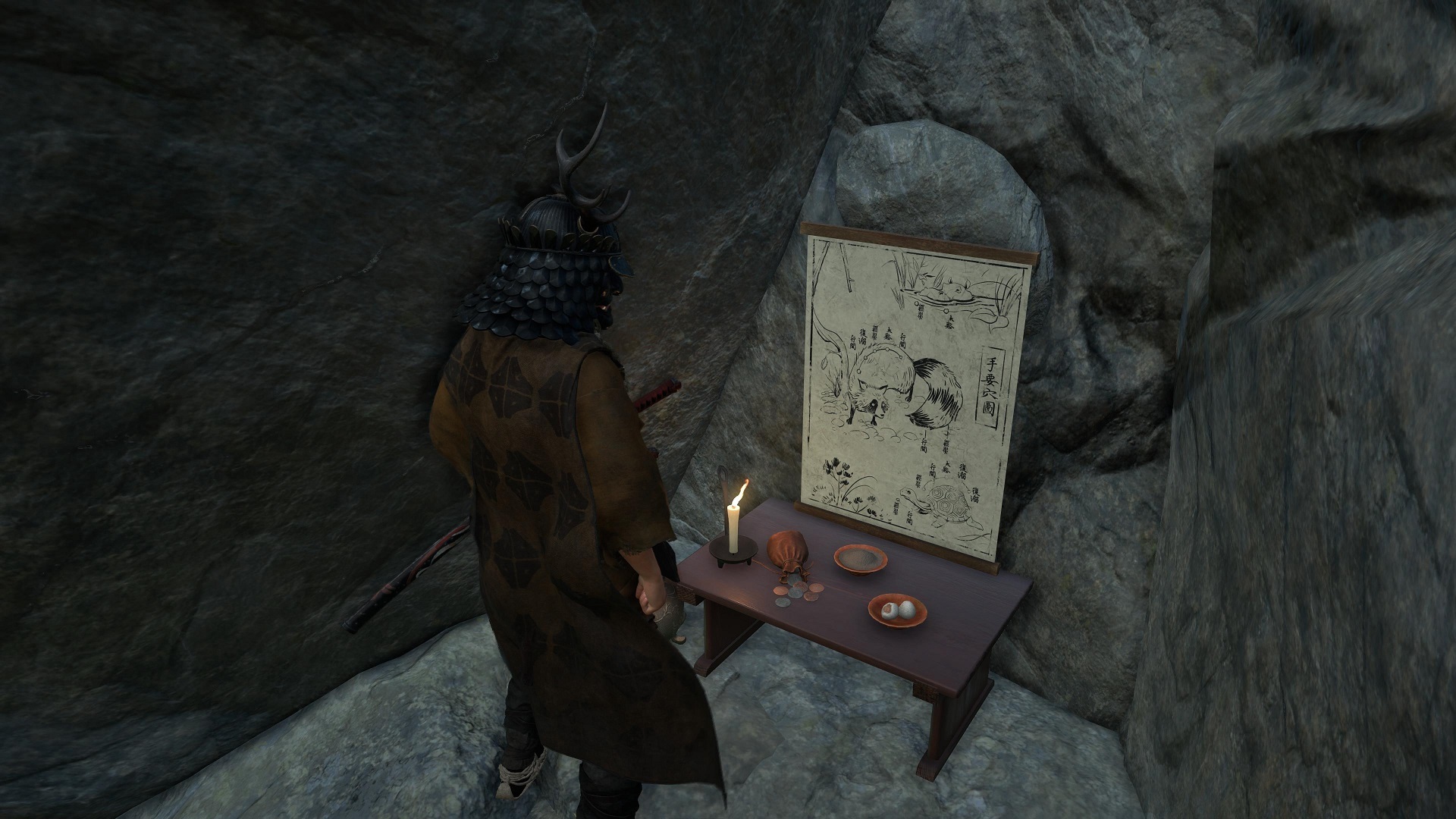
When Ghost of Tsushima came out in 2020, it included pretty involved Sly Cooper and Infamous Easter eggs that triggered a secret Trophy, paying homage to two of Sucker Punch’s other well-loved series. Iki Island gets its own Sly Cooper nod, but this time, it’s hidden in a cave off the beaten path, and you’ll have to be familiar with the series to get it.
A raccoon, a hippo, and a turtle, who may or may not be planning a heist.
Find the particular cave in the Buddha’s Footprints region and you’ll uncover this painting, featuring a raccoon, hippopotamus, and turtle. It’s a reference to Sly (the burglarizing raccoon) and his pals Murray (the hippo) and Bentley (the turtle).
See the resemblance?
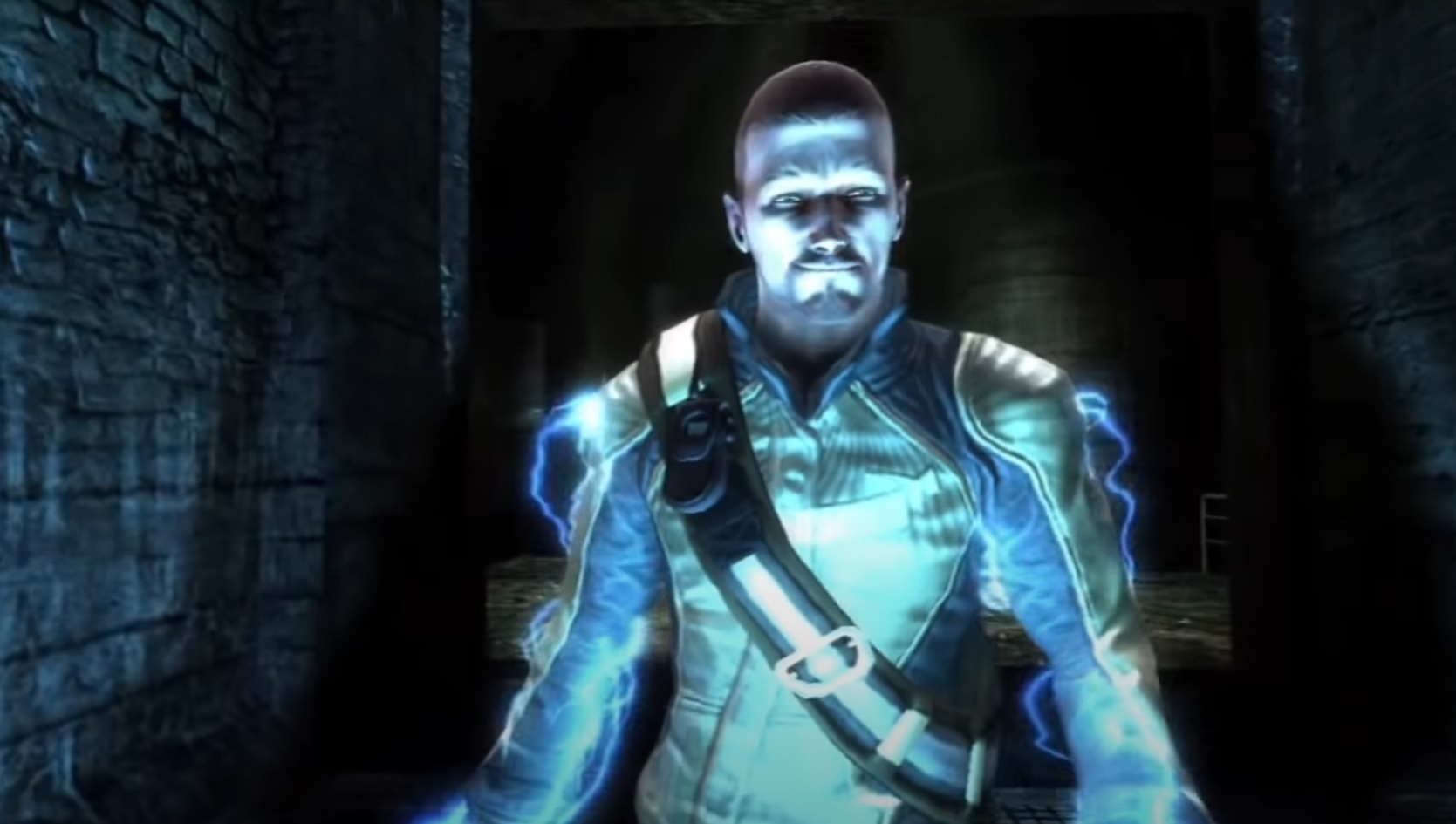
The nod to Infamous is similarly hidden, located on the path up the towering Saruiwa mountain. Find a path where you can climb down from the trail that leads toward the summit, and you’ll find a mural depicting a samurai version of Infamous protagonist Cole MacGrath.
Scour Saruiwa mountain and you might find this mural, an homage to Sucker Punch’s Infamous.
The samurai version of Cole even depicts him with his signature weapon, the Amp, and arcing electricity.
The PS3 version of Cole doesn’t look quite as good as Ghost of Tsushima on PS5, but you get the idea.
Where could WarioWare go after Gold? The 2018 3DS game acted as a sort of grand culmination for the series, combining the best microgames from across its many installments with a handful of new challenges and a plethora of extras. Rather than retread that same ground, the series’ upcoming Switch installment, WarioWare: Get It Together, introduces a few interesting twists to the classic formula, making it more of a party experience.
We recently got a chance to see more of WarioWare: Get It Together via a virtual preview event. Like previous entries, the title is comprised of more than 200 microgames–bite-sized challenges that are thrown at you in rapid-fire succession. These games run the gamut from silly to outright bizarre. One moment, you’ll be shaking apples from a tree; the next, you’ll be plucking hairs from a Greek god’s underarms. This oddball humor has become one of the series’ hallmarks, and even from our brief preview, it’s clear that it’s on full display in Get It Together. But while the microgames are all classic WarioWare fare, they offer a different experience here, thanks to the new focus on actually playing as the title characters.
Unlike past games, you directly control Wario and company during microgames, using their abilities to clear the objective. Each character has a unique playstyle; Ashley the witch, for instance, can fly around on her broom and conjure spells from her wand, while Mona throws a boomerang that you guide around the screen using the control stick. You select three characters at the start of a round, with the game randomly cycling between them as you clear microgames. This adds a new dynamic to the games, as their challenge will depend on which character you’re currently controlling. Ashley can make quick work of the aforementioned apple tree microgame by firing spells directly at the apples, for example, while someone like 9-Volt–who can only skate along the ground and flick his yo-yo vertically–will need to shake the tree’s branches from beneath to dislodge the fruits.
Click To Unmute
WarioWare: Get It Together! First Look | Nintendo E3 2021
Size:
Want us to remember this setting for all your devices?
Multiplayer adds yet another wrinkle. Although previous entries in the series have featured some multiplayer games and activities, Get It Together places a much heavier emphasis on them. Nearly every microgame here supports multiple players locally, and it looks like a riot. While the ability to play with another person should theoretically make the microgames easier to clear, that seems far from the case in practice. You’ll inadvertently get in each other’s way while trying to clear the microgames, turning already-frenetic tasks into pure chaos.
In addition to the story mode microgames, Get It Together features a party mode called Variety Pack, which boasts a handful of more traditional-style cooperative and competitive minigames for multiple players on the same system. One of the games that Nintendo highlighted, Daily Grind, plays out like a sidescroller. Here you must work your way through stages en route to the office, picking up contracts and defeating coworkers. Further complicating that goal, the stage layouts become progressively more challenging as you progress, and they feature power-ups that transform you into other characters, constantly shaking things up.
Another Variety Pack game, Puck ‘er Up, is an air hockey-style competition. The objective here is to knock the puck into the goal. The player who manages to score will then get to play a microgame, with a star as their reward if they can successfully clear it. The other player, however, has a chance to interfere, be it by shaking the screen or trying to obscure the view with a leaf. If the person playing the microgame fails, the star will be awarded to the other player. It’s a clever way of turning microgames into a head-to-head contest, and it looks like one of the highlights of the package.
Beyond that, Get It Together features a handful of other modes, including one called Wario Cup. While we didn’t get to witness it during our preview session, we did learn some details. Nintendo described it as an “online weekly rotating challenge” where you’ll try to clear a specific objective. While you can use any character, the more ill-suited they are to that objective, the better your score will be if you manage to clear it. Wario Cup also features a ranked mode that lets you upload your score and see how it stacks up against players from around the world. That, however, requires a Nintendo Switch Online subscription.
WarioWare: Get It Together launches for Nintendo Switch on September 10. The game retails for $50 USD and is available to preorder now from the eShop and various retailers. Nintendo has also released a free WarioWare demo on the eShop that lets you sample a handful of microgames as well as several playable characters.
The Walking Dead Season 11 premieres this Sunday, August 22, and ahead of that, AMC has released the opening five minutes of the first episode. This is the final season of the show.
The sequence shows a group of survivors, including Carol, Daryl, and Maggie, attempting to lift some bags from a room of sleeping zombies–known as Lurkers. Inevitably it goes wrong, and soon the undead are waking up all around our heroes. This kicks off a desperate battle to reach their helicopter while fighting off dozens of hungry walkers. Check it out below:
This clip follows the Season 11 trailer, that was released during Comic-Con@Home last month. The season will be the longest one of The Walking Dead’s history, with 24 episodes set to air across 2021 and 2022 in three separate blocks.
Even though the main show is ending, there’s plenty more Walking Dead on the way. Both Fear the Walking Dead and The Walking Dead: World’s Beyond return later this year for their seventh and second seasons respectively. Beyond that, Norman Reedus and Melissa McBride will reprise their long-running roles Daryl and Carol for a spin-off series, which is scheduled to release in 2023.
There’s also the long-promised Rick Grimes movies, which according to Walking Dead creator Robert Kirkman are still happening, despite the slow pace of pre-production.
Deathloop’s game director says that the upcoming immersive sim-shooter’s PvP multiplayer wasn’t built with competitive play in mind. Instead, the driving force behind the mode was to create an ‘anecdote generator’.
In a QuakeCon special on Deathloop, Dinga Bakaba discussed his hopes for Deathloop’s PvP mode and what he would like players to get from it: “What drove us to add [PvP] to the game was not the competitive aspect of it really, that’s why there’s no leaderboard, nothing like that, it was really the fact that it is an anecdote generator.
“Two elements of chaos in a simulated world definitely creates some interesting moments, those moments of ‘I really didn’t plan for it to go that way but that was so awesome,’ and you will hit record on your PS5 and save that clip and then send it to the other player in case they didn’t save it and maybe add them as a friend. It’s nice to be surprised by a game. What players can add to the mix, be it something very random, very chaotic [or] on the contrary, something that is a perfectly executed plan where you will think ‘Oh that other person is a mastermind.'”
“In a more developer-centric approach, it’s an opportunity for us to interact with the player and the community in a different way.” he continued. “The way we generally interact with them is asynchronously. We build the game, and then they play the game, and then we watch on Twitch and YouTube and this interaction doesn’t really happen, but now that we get the chance to invade players or get invaded by players, we can share those moments with you all and that’s also exciting for us.”
Deathloop’s PvP mode centers around two characters: the game’s protagonist, Colt, and his rival assassin, Julianna Blake. As the game’s antagonist, Julianna can enter the world randomly as an AI-controlled character during single-player gameplay – but the real fun, it seems, is in entering another player’s campaign as Julianna and causing havoc.
The two characters look to be well-balanced and a good match for one another in the game. Both assassins have access to the same weapons and power-up traits – except for Colt’s signature power Reprise, which allows the player to reverse time within a playthrough and come back to life.
Whilst Julianna only has one life, players opting to enter the field as the antagonist will be able to customize a number of options about the character, including weapon builds and power-ups, before setting out to hunt their target. Bakaba said that the disparity between the two characters’ fragility makes for interesting gameplay. “Colt is able to take a bit more risk,” he said, “which generally encourages Julianna players to be a bit more careful, a bit more devious, and use things like traps, deception, and misdirection.” With the game due out on September 14, we’ve not long to wait before players are able to jump in as Julianna and test out their stealthy pursuits.
Players controlling Colt don’t have to face Julianna should they wish to avoid an encounter. Colt can hide and extract from the map in certain situations to avoid the deadly assassin. However, the rewards for taking her down certainly look enticing. Successfully taking on the challenge will reward Colt with loot that includes power-trait upgrades, top-tier weapons, and Residium – an in-game resource that allows players to maintain their weapons across loops.
Alongside the release of Ghost of Tsushima: Director’s Cut on comes the Iki Island expansion on PS5 and PS4. Like all post-release content, there’s a specific way to gain access to it. Below we detail what you need to do to start playing the next chapter of Jin’s journey.
For the uninitiated, the Iki Island expansion takes Jin to its titular location, where he must confront the demons of his past. The content gives you an entirely new region to explore, packed with new Tales to complete, collectibles to grab, and enemies to fight.
Click To Unmute
Size:
Want us to remember this setting for all your devices?
Now Playing: Ghost of Tsushima Iki Island Expansion Review
1. You Need To Progress Through To Act 2
If you no longer have any backup saves and have nothing but your new game or new game plus save to fall back onto, then you’ll be fortunate to know that you only need to get to Act 2 (Toyotoma Region) to access the Iki Island expansion. Otherwise, read on if you already have access to a late-game save.
2. A New Tale Will Pop Up Called “Journey Into The Past”
Once you’ve met the aforementioned conditions, a new Tale will show up on the map called “Journey Into The Past.” It’s located in the Toyotoma Region at the Drowned Man’s Shore; if it doesn’t appear in your Journal, head to Drowned Man’s Shore and it should appear on your map. Tag it and then follow the guiding wind to the location.
3. Start The Questline To Travel To Iki Island
When you arrive, you’ll find something fishy: an abandoned Mongol ship has made it to shore. Investigate, and you’ll soon find yourself entangled in a surprise battle against the Mongols. You’ll also be introduced to the expansion’s new enemy type: Shamans. Eliminate the invaders and then make your way to the ship that’ll take you to Iki Island.
Before you go, heed the warning given to you by the game.ou won’t be able to return to Tsushima for quite some time after you embark, so make sure you have your affairs in order. You won’t be able to come back until after completing several story quests on Iki Island. We recommend earning the Ghost armor, Kenshi armor, and Sakai Clan armor before leaving for Iki Island.
For more about Ghost of Tsushima’s Iki Island expansion, be sure to read our full review. Otherwise, be sure to check out our other Iki Island guides and our guides for the first game.
The most memorable Minnesota Vikings game I ever attended was when I stood on the sideline and watched Daunte Culpepper dive in for the game-winning touchdown from 20 feet away; an exciting capper to an afternoon spent squinting up at the Metrodome’s tiny jumbotron trying to see what was happening. The Dome is long gone, but its spirit lives on in Madden NFL 22 – though not necessarily in the way EA intends. This year’s version seeks to capture the earsplitting crowd noise that was once the Metrodome’s calling card with new homefield mechanics, and it succeeds… sort of. But while it’s a functional way to experience football, it’s also charmless and frequently strange – the video game equivalent of navigating a concrete concourse under a dirty teflon roof.
After planting its flag last year with “Next-Gen Stats” – a system that uses on-field cameras to produce more refined if not always noticeable improvements to the animation – Madden NFL 22 takes the same slow and steady approach that has characterized the pace of improvements to the franchise over the past decade. Visually, it does not appear to be a large step up from the version of Madden 21 that ran on the PS4 Pro or Xbox One X, though it is noticeably smoother when running in the 60fps Performance Mode (or 120fps on Xbox Series X). It’s familiar enough that, after my first few hours with Madden NFL 22, my immediate reaction was to say, “Yep, it’s definitely Madden” – which is to say that the odd glitches, clunky interface, and slightly robotic animation continue to be very much in play.
This has been the Madden experience in a nutshell for many years now. It’s a grab bag of experiences and ideas, some of them decent, many of them undermined by poor execution and a lack of polish. It’s hard to pick any one area where this year’s version truly excels; almost every one of its best features is done better by one of its major competitors like 2K or Konami. Its biggest success over the past five years is probably the X-Factor system, an arcadey but fun way to differentiate certain superstars by granting them certain special abilities, which is likely the biggest reason that Madden NFL 22 is dredging up NCAA Football’s old homefield advantage mechanics and calling them “M-Factors.”
I’ve been arguing that Madden should add homefield advantage for years now.
Homefield advantage is Madden NFL 22’s most notable new feature, impacting virtually every one of its modes in one way or another. It seeks to shake up the in-game atmosphere, which has been lackluster for years, and add an additional layer of strategy to boot. It’s not a bad idea on the face of it; yes, it’s a feature arguably being recycled from a series that’s almost a decade old now, and you can goof on the notion of homefield advantage when many teams in the NFL has long since priced out their most dogged fans, but the truth is that homefield advantage is still very much a factor in cities like Seattle and Green Bay – a factor that has never really been reflected in Madden. Frankly, I’ve been arguing that Madden should add homefield advantage for years now, so I’m glad to see it finally here.
As for whether it works… I’m not entirely sure yet. The idea is that a little momentum meter will tick up whenever a team makes a big play, unlocking perks like stamina boosts while potentially scrambling your opponent’s playart and causing the screen to shake. Away teams can even flip the script by silencing fans and unlocking perks of their own. It’s all fine in theory, but the momentum doesn’t quite ring true to me. In one game playing as the Browns, I unleashed a bomb to Odell Beckham, scoring a touchdown and taking the lead. A clear momentum swing, right? Cleveland’s fans would be going out of their mind. But the best I managed was to reset the momentum back to neutral.
Momentum doesn’t quite ring true to me.
It’s clear to me that there’s still some tinkering to be done with the balance of the M-Factors, and the development team seems to know it too – due to balance issues, only a handful of them are available in Madden Ultimate Team. The spotty execution is likewise in evidence in the remastered gameday audio, which will cut out whenever the camera cuts to an exterior stadium shot, and the new presentation, which is frankly… not good. Putting aside that it looks nothing like an actual TV broadcast, it tinges much of the graphics in a sickly shade of green, which for whatever reason I found very off-putting.
Other ways in which Madden almost comes together but doesn’t quite manage it are evident throughout. The interface is actually a step back this year, cramming together information in a mess of text and overlapping menus that somehow manage to be more confusing than ever. This, in turn, hampers its player avatar – a decent idea that feels more confusing than it should owing to how opaque even basic functions like character progression can be. Elsewhere, Madden NFL 22 has effectively thrown up an “under construction” sign, acknowledging that the much-needed scouting overhaul for career mode won’t be available until after launch.
Madden NFL 22 has effectively thrown up an “under construction” sign.
Its most thoughtful updates tend to be the ones that pass unnoticed by fans. For instance, Madden NFL 22 introduces halftime adjustments, a small but significant new feature that has a notable impact on in-game strategy. If your opponent is burning you deep with Tyreek Hill, you can choose the “Defend Deep Pass” option at the expense of giving up shorter passes. Or if you’re in the lead, you can choose to focus on running the ball. Simple. I wish Madden’s features were always this straightforward.
This is where I reveal that I’m mainly a sim player, with the bulk of my playtime being devoted to my long-running online league – a sports genre rarity that I appreciate a little more with each passing year. Most Madden fans will tell you that Franchise mode has been disappointing over the past decade or so, with EA only relenting and committing to substantial updates to the modes after heavy backlash on social media. This is the first year that we get to see the fruits of EA’s labor, and the results are decent, if a bit mixed. Playing as the Buffalo Bills, I was pleased to see a short in-game cutscene acknowledging the magnitude of an upcoming playoff game with the New England Patriots. Such story moments have been sorely lacking from Madden’s franchise mode over the years, and they go a long way toward imbuing each season with a sense of narrative.
I was pleased to see a short in-game cutscene acknowledging the magnitude of an upcoming playoff game.
Still, Madden’s franchise mode has a ways to go before it catches up with the competition. Its version of the salary cap bears little resemblance to the real-life NFL, with no ability to restructure contracts or convert money into bonuses. Special teams are an afterthought – a shame, given that undrafted players who eventually develop into stars, such as Vikings receiver Adam Thielen, frequently come from the ranks of special teamers. And even the meaningful additions – like the ability to hire and fire coordinators who confer buffs to different parts of your team – have a brutalist feel to them thanks to the ramshackle nature of the interface.
I think at least some of my problems with the mode can be summed up in a recent conversation where I asked a producer why it wasn’t possible to include legends like Randy Moss in the fantasy draft, wondering if it was an NFLPA issue, and they admitted that it simply hadn’t been considered. This is a feature, I should mention, that has been in both NBA 2K and MLB The Show for years now. Madden’s franchise mode lacks that joyful sense of wish fulfillment that accompanies the best career modes, its rigidity betraying Madden’s overall lack of verve and creativity.
Whatever sense of joy Madden might have seems to be reserved for its resident arcade modes.
Whatever sense of joy Madden might have seems to be reserved for its resident arcade modes, which are, for the most part, a cut above the core simulation modes. Launching The Yard or Superstar KO is a bit like stepping into a different game entirely, with the stadiums, menus, and even the color palette shifting into a brighter, more hyperactive mood meant to elucidate the chaos of backyard football. These modes tie in much more firmly into the player avatar who sits front and center on the main menu screen, with progress in The Yard applying to Face of the Franchise, and vice versa.
It seems clear that Madden NFL 22 is trying to establish a centralized experience akin to its competitors, with progress in one mode unlocking global rewards like cosmetics in others. It’s not quite there yet, though, and much of the blame can be laid at the feet of the interface, which consistently hides its rewards behind one too many button presses. It doesn’t help that none of the rewards apply to the core career modes, which means we’re being funneled toward arcade modes like The Yard and the ever-present Madden Ultimate Team so we can climb on to the neverending game-as-a-service treadmill. MLB The Show works because it offers balanced rewards for all of its modes; in Madden, the modes still feel too siloed away from one another, which makes the global awards it does offer feel ultimately underwhelming for anyone who isn’t heavily invested in The Yard.
Face of the Franchise is short, pointless, and ugly.
Of course, even if EA does refine its interface and improve on its global rewards, none of it will matter much if it doesn’t fix Face of the Franchise, arguably a symbol of everything that ails the series. Ostensibly Madden’s flagship story mode, Face of the Franchise is short, pointless, and ugly. It takes a good idea – letting us live out the dream of getting drafted into the NFL and playing out a career – and utterly fails to execute on it.
Face of the Franchise once again casts your customized character as a young star on the rise, with a story built around a series of challenges and story moments en route to the NFL Draft. College football games return in a neat bit of set dressing, but are hardly integrated into the overall story and quickly forgotten. The handful of choices you make – whether to attend a Nike event or take the team out to dinner, for example – are almost always a strictly mechanical means of boosting your stats or earning more currency for purchasing in-game items, with little impact on the story. The impact of the story choices you do get to make, such as when you talk to scouts before the Draft, are hazy at best. And when the second season of your NFL career rolls around, your character is still referred to as a rookie, as if Roger Goodell hit some cosmic reset button.
As with everything else in Madden, an extra layer of polish would do Face of the Franchise a world of good.
This is Face of the Franchise’s third year, and it’s hard to get a read on EA’s intentions for the mode. Is it story-driven wish fulfillment? A glorified tutorial? All of the above? I have a sneaking suspicion it’s that last option, which is why it feels so messy and unfocused. As with everything else in Madden, an extra layer of polish would do Face of the Franchise a world of good – a character progression system that isn’t needlessly obscured, a better sense of how rewards can be spent across the various modes, and a finale that doesn’t consist of a handful of NFL players offering congratulations in hastily recorded cellphone videos. Madden’s biggest problem seems to be that it’s trying to be all things to all football fans. It wants to be an in-depth sim and a silly arcade game and a competitive multiplayer game, and it wants to do all of it with roughly 10 months of development time per year.
With the new console generation fully underway, I get the impression that Madden would like to be perceived in the same light as SoFi Stadium or Allegiant Stadium – a glittering showcase arena for football. But it’s still much closer to the multipurpose stadiums of old; the big concrete bowls that would host baseball on Saturday, football on Sunday, and monster truck rallies on Monday. The NFL long ago abandoned multipurpose stadiums like the Metrodome, recognizing that their dedication to utility meant that they could provide a gameday experience that was at best functional. As Madden looks to the future, it might want to consider how it can learn from the NFL’s example.
There’s an incredible introductory offer right now for new PlayStation Plus users, £25 for 12-Months. This is 50% off the regular list price for the PlayStation online service, and definitely worth checking out if you haven’t already got a PS Plus subscription with your new PS5.
Other deals to check out today include Zack Snyder’s Justice League, now down to just £17.99 in 4K, and £11.99 on Blu-ray. Call of Duty: Vanguard has also been revealed and is now available to preorder. All preorders will grant early access to the Vanguard Open Beta later this year.
TL;DR – Best Deals of the Day
12-Months of PS Plus for £25 (Save 50%)
Call of Duty Vanguard Now Available to Preorder
The Snyder Cut on 4K Blu-ray Now £17.99 at Amazon (Save £7)
Note: This article contains spoilers for the Shrine of Ash on Iki Island. If you’d rather solve its puzzles yourself, read no further.
Scattered across Iki Island in Ghost of Tsushima Director’s Cut are three Wind Shrines that contain some of the coolest cosmetic rewards in the game. Each reward is themed on a major PlayStation exclusive game, and each lets you do a little cosplay in Tsushima as you fight the Mongols. However, to unlock the three armor sets, you’ll have to find the three shrines–and solve some confusing riddles along the way.
Note that to complete this shrine, you’ll need theSakai Clan Armor.
How To Find The Shrine Of Ash
Head to the eastern coast of Iki, east of Tatsu’s Ladder and north of Yahata Forest, to find the shrine.
You’ll find the Shrine of Ash near the eastern coast of Iki Island, just south of the river delta near Tatsu’s Ladder. Look for the shrine set into a hill, which you can approach from the west to find stairs leading down. It’s marked by white birch trees, which make it stand out from the surrounding forest.
How To Solve The Shrine Of Ash Riddle
Fans of God of War will immediately pick up on why the aforementioned birch trees are important to this shrine. To the left of the statue, you’ll see one of the birch trees marked with a handprint. In God of War, that handprint belonged to Freya, Kratos’s wife and the mother of Atreus, Kratos’s son. Also buried in the birch tree is an axe, recalling both Kratos’s actions at the start of the game to chop down those special trees, and the Leviathan axe that is his central weapon in the game. This one’s quite a bit simpler, however.
That’s not the Leviathan axe in the Shrine of Ash, unfortunately.
In the center of the shrine is a scroll with a poem that recalls the story of God of War and gives you the clues you need to unlock the shrine:
In fall, a tree fruits which grows from seed to sapling, a stranger and son. Boy, honor your father’s fight. Show him the strength of your blade.”
The meaningful parts of the poem for our purposes are the last two lines. They tell you to “honor your father’s fight” and “show him the strength of your blade.” Those are the clues we need to solve the Shrine of Ash.
Each shrine is solved by wearing a specific set of armor and performing a specific action. For this one, you’ll need the Sakai Clan Armor found during Act 2 of Ghost of Tsushima. That armor belonged to Jin’s father, Kasumasa Sakai, and he was wearing it when he died fighting raiders on Iki–so to “honor your father’s fight,” you’ll need to wear his armor.
Next, the poem says to “show him the strength of your blade.” This one is pretty simple, actually–just swipe to the right on your controller’s touchpad to draw your sword while standing in the shrine.
The God of War armor is a cosmetic you can unlock for the Sakai Clan armor, complete with Kratos-themed helmet and face mask.
If you’ve got the Sakai armor on, you’ll trigger a cutscene and earn your rewards: the Helm of War, Spartan face mask, and Ghost of Sparta cosmetic for the Sakai Clan Armor.
Note: This article contains spoilers for the Shrine in Shadow on Iki Island. If you’d rather solve its puzzles yourself, read no further.
Ghost of Tsushima‘s new Iki Island expansion includes three major Easter eggs referencing other major PlayStation-exclusive games: Shadow of the Colossus, Bloodborne, and God of War. To locate these Easter eggs and unlock some of the coolest rewards in the game, you need to locate Iki Island’s three Wind Shrines and solve their riddles. Each packs a cosmetic armor set previously only available in the Legends mode. To unlock the Shadow of the Colossus armor hidden on Iki, you’ll need to track down the Shrine in Shadow.
Note that to complete this shrine, you’ll need theGhost Armor.
Where To Find The Shrine In Shadow
Look for the Shrine in Shadow near the southern coast of Iki Island.
Head to the southern coast of Iki Island, almost dead center in the middle of the map, to find the Shrine In Shadow. It’s situated up in the cliffs of Buddha’s Footprints and can be tough to reach. Approach it from the east side and try to find a spot marked with a mat and a candle where you can jump across to reach the shrine’s entrance. Be careful, though–one of the handholds will break free, and you’ll need to catch the one below it to keep yourself from a painful fall to the rocks below.
How To Solve The Shrine In Shadow Riddle
Once you enter the shrine, you’ll quickly see its references to Shadow of the Colossus. The mark painted on the base of the statue at the shrine’s center is also the mark that adorns that games’ colossi, marking where you can stab them and inflict damage. The base of the statue is also covered in fur pelts, mimicking the fur of the colossi that protagonist Wander uses to climb the huge beasts in order to destroy them.
The shrine is marked with the symbol you’d find on a colossus, the sword protagonist Wander uses to slay them, and the inky darkness that bleeds from their wounds.
In the center of the shrine is a scroll containing a poem that recalls Shadow of the Colossus’s story, while also giving you hints about how to solve the shrine:
Stone knows no season, Nor the colossus that was felled to save one soul. Wanderer, come like through mist, a ghost casting no shadow.
The last two lines of the poem contain the clues, addressing you as Wanderer and telling you to “come like through mist, a ghost casting no shadow.”
Since the poem tells you to act like a ghost, you might have already guessed that you’ll need to wear the Ghost Armor to complete the puzzle. The second part is a little more confusing, where you’re told to “come like through mist.” While there’s a song for your flute that will change the weather to create mist, that’s not what the riddle is looking for.
The Armor of the Colossus is a cosmetic applied to the Ghost armor.
Instead, stand in the middle of the shrine wearing the Ghost Armor and throw a smoke bomb to fulfill the requirements of the poem. That’ll trigger a cutscene, and you’ll receive your Shadow of the Colossus-themed rewards: the Mask of the Colossus and the Armor of the Colossus, a cosmetic for the Ghost Armor.