Roccat Gaming Keyboards See Lowest Price Ever In Best Buy Deal Of The Day

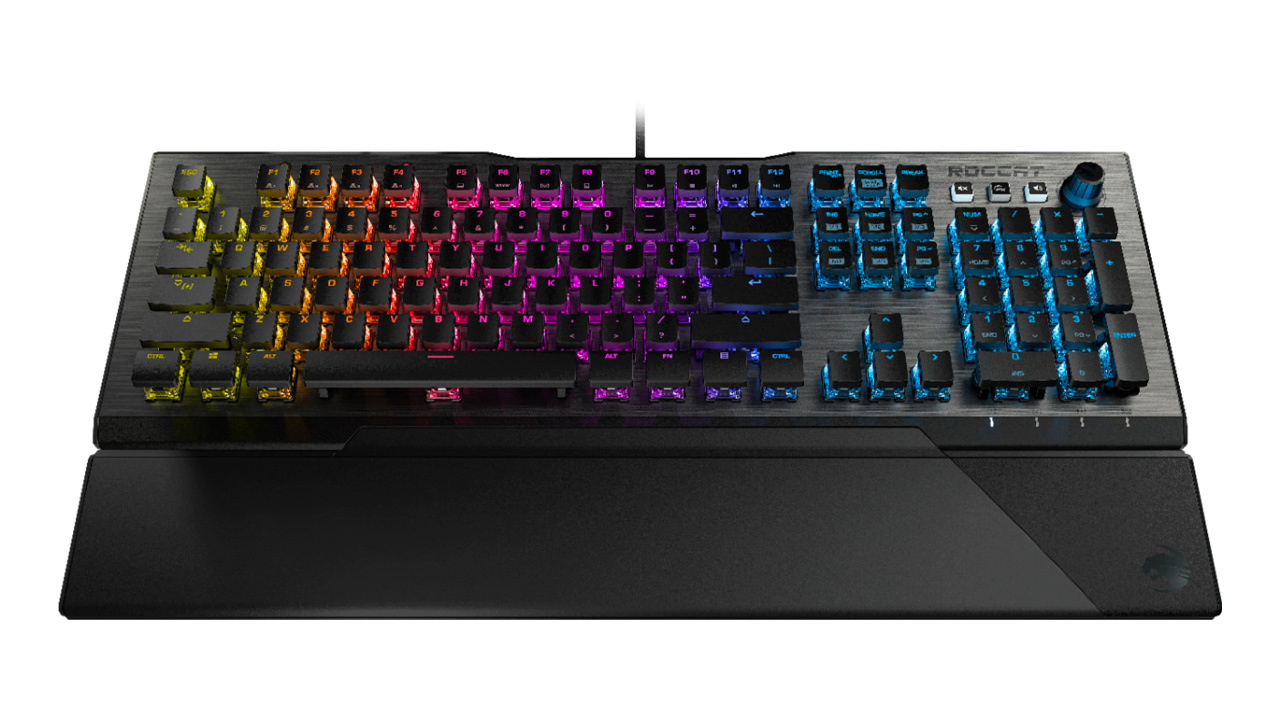
Best Buy’s Deals of the Day for Thursday include a particularly nice couple of deals on Roccat gaming keyboards, with both the Vulcan 120 and the Vulcan 121 mechanical keyboards on sale for $105 each. That marks their lowest price ever, though we’ll note that Amazon is price-matching this deal as well. The Deals of the Day are available only through the rest of today; after that, they’ll return to their $160 list price.

The Vulcan 120 and 121 keyboards are basically the same in terms of build and features. The 120 is silver, while the 121 comes in a darker black; both feature AIMO illumination for RGB backlighting and LED effects. The 120 comes with Roccat’s tactile and crisp Titan switches, while the 121 has linear switches for extremely fast keystrokes and consistency. Both include wrist rests that are magnetically detachable along with programmable macro keys and full n-key rollover so every keystroke is registered.

If you’d rather pick one up from Amazon, you can check out the deals on the Vulcan 120 and Vulcan 121 available there, with both brown and red switches available for the Vulcan 121 deal.

Roccat Vulcan 120 mechanical gaming keyboard

In other Deals of the Day, Best Buy is slashing prices on the Logitech GMX518 optical gaming mouse ($20), the MSI GF63 15.6-inch gaming laptop ($630), and a very sturdy-looking Walker Edison computer desk ($363).

Blizzard Reportedly Took Warcraft 3: Reforged Pre-Orders While Knowing It Wouldn’t Be Ready for Release

Blizzard reportedly took pre-orders and refused to delay Warcraft 3: Reforged, despite knowing that the game wouldn’t be sufficiently ready for release.

In a new report from Bloomberg, sources claim that Blizzard chose to release Reforged – which launched to widespread fan complaints about low quality and false advertising – because it had already accepted pre-orders, and didn’t want to risk those sales by delaying.

Bloomberg also reports that it has seen an internal Blizzard postmortem document saying, “We took pre-orders when we knew the game wasn’t ready yet” and that the company should, in future, “resist the urge to ship an unfinished product because of financial pressure.”

The project was allegedly hamstrung by a low budget, and was apparently seen as a low priority by parent company Activision because of its unlikeliness to become a ‘billion-dollar product’. The report says that the game was then rescoped, leading to it launching without features present in the original Warcraft 3, and without reworked cutscenes announced before launch. Altered scripts and re-recordings of dialogue were allegedly also ditched.

[ignvideo url=”https://www.ign.com/videos/2020/02/07/blizzard-its-been-a-bit-of-a-hard-week-with-warcraft-3-reforged-ign-news”]

The problems on the project reportedly caused low morale, with the internal postmortem reading: “We have developers who have dealt with exhaustion, anxiety, depression and more for a year now. Many have lost trust in the team and this company. Many players have also lost trust, and the launch certainly didn’t help an already rough year for Blizzard’s image.”

Several sources pin the blame on leadership in both the Reforged team, and within the wider Blizzard organisation. The postmortem reportedly adds: “Senior voices in the department warned leadership about the impending disaster of Warcraft on several occasions over the last year or so, but were ignored.”

Blizzard subsequently changed its refund policy to allow for more returns of the game, but some missing features have not yet materialised, more than a year after release. A Blizzard spokesperson told Bloomberg that despite the closure of the Classic Games team that made it, a new team is, “dedicated to updating Warcraft III: Reforged with improvements. In these efforts, we realize our work and actions will speak louder than our words.”

Earlier this year, we published a special report on the exodus of talent from Blizzard. Yesterday, Activision Blizzard as a whole was sued by the California Department of Fair Employment and Housing for an alleged “frat boy” culture in which female employees are allegedly subjected to unequal pay and sexual harassment.

[poilib element=”accentDivider”]

Joe Skrebels is IGN’s Executive Editor of News. Follow him on Twitter. Have a tip for us? Want to discuss a possible story? Please send an email to [email protected].

Snake Eyes: G.I. Joe Origins Review

Snake Eyes: G.I. Joe Origins hits theaters on July 23.

[poilib element=”accentDivider”]

Snake Eyes: G.I. Joe Origins marks Paramount’s third attempt to spin franchise gold out of Hasbro’s legendary action figure line, and in distancing itself from the overheated, effects-heavy bombast of the prior two attempts (2009’s G.I. Joe: The Rise of Cobra, and 2013’s G.I. Joe: Retaliation), it may be the strongest go yet. Armed with a gritty, street-level aesthetic in service of its world-building, Snake Eyes –– directed by Robert Schwentke and starring Henry Golding in the title role –– feels as indebted to Christopher Nolan’s Batman Begins as it does the 1980s G.I. Joe Marvel Comics run written by Larry Hama.

Snake Eyes has been a key part of the “Real American Hero” team since its introduction in 1982. Though he remained an enigmatic figure in the iconic 1980s animated series, Snake Eyes was given an origin in issues #26 and #27 of the Marvel Comics series in 1984, which is what this project uses as a jump-off point, albeit loosely. Yes, Snake Eyes tips its cap to the source material (not so much the animated show, however), but it also freely forges its own path in a way that feels both familiar and fresh. The essential ingredient is an air of encroaching destiny as the various threads intersect with Snake Eyes (Golding), Tommy Arashikage (Andrew Koji), and the other members of the Arashikage clan. By film’s close, friendships have been forged, allegiances have been flipped, and the way forward is clear for further Joe escapades (or even further Origins movies) should the desire arise.

[poilib element=”poll” parameters=”id=ff4b8b07-30c3-42dc-9b84-8c0d8e8361c1″]

In terms of the cast, Golding makes a solid entrance as an action leading man in what could have been a thankless part. This is a far cry from when Ray Park played Snake Eyes with his face entirely hidden behind a mask and visor, speaking no dialogue for the duration of his two-movie tenure. Hiding his face clearly wasn’t going to be an option once the Crazy Rich Asians heartthrob was cast, but he does a good job imbuing Snake Eyes with requisite pathos while adding enough of an edge so his true motivations are never entirely clear. It’s a swerve from prior depictions, but it feels like there’s room to grow yet in his journey before becoming the iconic Snake Eyes familiar to longtime fans.

Meanwhile, Koji (who previously impressed on the Cinemax series Warrior) is quite charismatic as the Man Who Will Be Storm Shadow. Like 2011’s X-Men: First Class and its depiction of the early bromance between Professor X and Magneto, Snake Eyes makes us care enough about the forged-in-fire friendship between Snake Eyes and Tommy that there’s a twinge of sadness when the needs of the extant mythology take over, like fate has its own plans no matter what we may wish. Speaking of extant mythology, both Samara Weaving (as Scarlett, representing the elite G.I. Joe task force) and Úrsula Corberó (who’s fronting Cobra as the Baroness) effortlessly embody their alter egos, and although their screen time is limited, their presence offers a tantalizing tease of the unfolding “fight for freedom” happening just outside the frames of this film.

[widget path=”global/article/imagegallery” parameters=”slug=snake-eyes-gi-joe-origins-exclusive-posters&captions=true”]

In the previous G.I. Joe movie, Retaliation (directed by Golding’s Crazy Rich Asians filmmaker Jon M. Chu), there’s a scene where the evil Cobra Commander literally bombs London out of existence and it barely elicits a reaction from the characters — or us. By contrast, the stakes are dialed down substantially here: It’s not about saving the world, but saving a family and a friendship (and I say all that as someone who loudly, proudly enjoyed every bonkers minute of G.I. Joe: Retaliation).

Unfortunately, there are some failings in Schwentke’s approach to the action; under-lit and over-reliant on shaky-cam. As a result, instead of luxuriating in spectacular martial arts sequences, the fight scenes have a tendency to be confusing or disorienting. There’s also a narrative leap in the third act into hard fantasy/mysticism that, while it doesn’t pull you out, does feel somewhat incongruous when compared with the relatively grounded first two-thirds. Nonetheless, because of strong character work throughout, these end up as minor qualms. 

[poilib element=”quoteBox” parameters=”excerpt=There%20are%20some%20failings%20in%20Schwentke%E2%80%99s%20approach%20to%20the%20action.”]

Get a 144Hz Gaming Monitor From LG on Sale Right Now

If you’re in the market for a new gaming monitor, have I got some great news for you. The LG 27GN800 display is on sale right now, and I can personally attest to its quality, since I bought one earlier in the year for full price like an idiot.

144Hz 1440p Gaming Monitor Deal

[poilib element=”commerceDeal” parameters=”slug=lg-27gn800-b-27-gaming-monitor-deal”]

I feel like 27″ in the sweet-spot for desktop displays, and 1440p at 144Hz gives you a real nice picture, too. I like mine a lot, although it did require some fiddling with the settings both in Windows and the monitor itself to lock in the best color. If you want to take it a step further and calibrate it, knock yourself out. At this price, it’s a stupendous bargain.

The on-screen menu is pretty slick and there’s a program you can download to run the settings directly from Windows rather than through the OSD. For gaming, I have no complaints. The 1ms response time is nice, since my last monitor had that turbo-mode nonsense that only pretends to be 1ms, and was really smear-y when gaming mode was turned on. Not so with this LG. If it isn’t true 1ms, I couldn’t tell.

For the full breakdown of this display, you can check out our LG UltraGear 27″ monitor review. I didn’t write it, but I agree with pretty much the whole thing.

[poilib element=”accentDivider”]

Seth Macy is IGN’s Executive Editor, IGN Commerce, and just wants to be your friend.

A New Investment Scheme Lets You Buy Shares of a Nintendo World Championships Cartridge

The Nintendo World Championships 1990 cartridge is viewed as the rarest and most valuable NES games ever released, and now you can own a piece of one of the iconic cartridges.

A new investment scheme has launched via Otis that allows people to buy shares of the 8.5 Wata (a grading score used for video game collecting) Nintendo World Championships Grey Cartridge for $10. The shares will fluctuate in value just like stock, with shareholders waiting for their prices to increase before potentially considering to trade them in, hopefully for a sizeable profit.

[ignvideo url=”https://www.ign.com/videos/2019/08/08/holy-grail-of-nes-games-traded-into-seattle-game-shop”]

Otis is an investment platform that specializes in cultural assets, and it is the first fractionalized platform to offer the prized Nintendo game, valued at $211,300. The cartridge is considered by many to be the holy grail of video game collecting, and a lower grade Wata 8.0 copy of the game sold for $180,000 earlier this month.

The cartridges were given to winners of the Nintendo World Championships in 1990, a touring event that had players compete in popular games. The cartridge itself was used in competition and features a remix of Rad Racer, Super Mario Bros., and Tetris for a single high score. More copies went to the winners of a Nintendo Power magazine contest.

Given the limited number of Nintendo World Championships cartridges that are out in the wild, collectors and game fans alike are often on the lookout for them. That’s why it was particularly surprising when one turned up in a box of traded-in NES games at a used game store in Seattle, Washington back in 2019.

[widget path=”global/article/imagegallery” parameters=”slug=nintendo-world-championship-1990-cartridge-302&captions=true”]

The store paid $13,000 for the Nintendo World Championship 1990 cartridge after judging the condition of the item and conducting some research. It was reported at the time that the seller happily accepted the offer, though the resale price and the identity of the second buyer were both kept secret.

[poilib element=”accentDivider”]

Adele Ankers is a freelance writer for IGN. Follow her on Twitter.

HP Omen 15 Review

You don’t have to spend several grand on a gaming laptop to get an enjoyable gaming experience. Need proof? The HP Omen laptop I’ve been testing for the last few weeks should suffice. There’s nothing extra special or fancy about the look of the Omen, but for a $1,250 laptop, there doesn’t need to be. 

Instead, you’re getting a respectable – and portable – gaming rig for just a little more than a MacBook Air. Heck, it even has an RTX 3060 GPU to keep up with your gaming needs. 

[widget path=”global/article/imagegallery” parameters=”slug=hp-omen-15-gaming-laptop&captions=true”]

I always try to enter testing a new laptop without any bias based on specs or price, but I’d be lying if I didn’t admit that I expected mediocre performance from the Omen. That is until I started using it. 

Specs

Here are the specifications of the HP Omen I’ve been testing: 

  • Model: HP Omen (15t-ek100)
  • Display: 15.6-inch FHD 144Hz (1920 x 1080)
  • Processor: 10th Gen Intel Core i5-10300H 2.5GHz (8M cache, 4.5GHz Max Turbo)
  • Graphics: Nvidia GeForce RTX 3060 GPU with 6GB GDDR6 memory
  • Memory: 16GB DDR4 2933MHz
  • OS: Windows 10 Home
  • Storage: 512GB PCIe NVMe SSD
  • Webcam: 720p
  • Ports: 1 x Thunderbolt 4 USB-C, 1 x miniDisplayPort 1.4, 3 x USB SuperSpeed Type-A ports, 1 x HDMI, 1 x 3.5mm audio jack, 1 x SD Card Reader, 1 x Ethernet
  • Connectivity: WiFi 6 802.11ax, Bluetooth 5
  • Dimensions: 14.09 x 9.44 x 0.9-inches (WxDxH)
  • Weight: 5.4-pounds
  • Price: $1,249.99

There are a couple of build options you can customize, if, for example, an Intel Core i5 isn’t exactly screaming your name. For another $330 you can bump up the CPU to an Intel Core i7-10870H and the GPU up to an RTX 3070, putting you just over the $1,500 mark all-in. Of course, you can add more to the build by doubling the memory, upgrading to Windows 10 Pro, upgrading to a QHD display or adding more storage. 

Instead of sending me a high-end review sample with all of the bells and whistles, HP did something I respect: Send me the entry-level build, save for 16GB of memory over the base 8GB. It’s a $50 upgrade, taking the build from $1,199 to $1,249 and something I’d imagine most are willing to invest in. 

HP Omen 15 – Design

As I said at the start, there’s nothing noteworthy about the overall look of the Omen. It’s a black laptop with a shiny Omen logo on the lid. The only other splash of color, beyond the Intel and Nvidia stickers, is the red ink used on the keyboard’s keys. Actually, the entire keyboard lights up red thanks to the single-zone backlight. 

The 15.6-inch display is surrounded by slim bezels on both sides, with a slightly thicker trim on the top to make room for the 720p camera. As is the case with most laptop webcams, the Omen’s camera is good enough to get the job done. In other words, you’re not going to get compliments on the quality of your video calls. 

There are plenty of ports that line either side of the laptop’s deck. On the right side is a Thunderbolt 4 USB-C port, a miniDisplayPort 1.4, and two USB 3.1 Gen 1 ports. On the opposite side is where a full-size SD card reader is found, along with a 3.5mm headphone jack, an HDMI port, another USB 3.1 Gen 1 port, and, finally, a gigabit Ethernet port. 

The full-size keyboard doesn’t span the entire width of the housing. Instead, there’s a small space to the right of the keyboard where you’ll find dedicated arrow keys, along with a 9-key cluster, including common keys like Page Up/Down but also adding a shortcut key to the calculator app. 

I enjoyed typing on the Omen’s keyboard. There’s very little movement in the keys, and they aren’t overly loud, so it’s unlikely you’ll annoy your roommates or partner while they’re working (or trying to sleep) in the room around the corner. 

I do want to call out one aspect of the keyboard that I feel reflects the thought that HP put into the Omen as a gaming laptop. I can’t recall if I’ve ever noticed it before, but not only did HP put small bumps on the F and J keys to help your fingers find your place, but they also added a small bump to the W key. I’ve found gaming on chiclet-style keyboards often leads to misplacing my fingers at times, but with the W key practically calling out to my middle finger, that never occurred during my testing. 

The trackpad is below the keyboard, but it’s not quite centered with either the keyboard or with the Omen’s housing. It’s lined up slightly to the right of the spacebar, which makes it look somewhat centered but also reminds me of those pictures that show a beautiful tile pattern broken up by one tile that’s out of place. 

As for the overall size and weight, the Omen is deceivingly not light. Until I looked at the specifications, I had no clue it weighed over 5 pounds. To be exact, it weighs 5.4-pounds and measures 14.09 x 9.44 x 0.9-inches (WxDxH). It’s not overly heavy, by any means, I just didn’t expect it to weigh that much. 

HP Omen 15 – Performance and gaming

Powering the Omen I tested is an Intel Core i5-10300H, a Nvidia RTX 3060 Laptop GPU, 16GB of 2933Mhz memory, and 512GB of SSD storage. The 144Hz screen looks clear, and colors aren’t overly saturated. Instead, they’re more life-like, and one could even argue, muted. 

As I’ve already hinted at a few times, performance on the Omen is surprisingly good. Benchmarks don’t tell the full story, but they are part of the story, so here’s a quick look at how the Omen compares to the Acer Predator Triton 300 SE and the Asus TUF Dash F15

As you can see in the chart, the Omen stayed in lockstep with both comparisons. Keep in mind, they both had an Intel Core i7 processor, while the Omen I tested is using an i5. 

As for actually spending some time behind the screen and keyboard gaming, the Omen kept up with Battlefield V at Max Fidelity settings, averaging 105 fps. I’ve become slightly obsessed with Knockout City (thanks Xbox Game Pass), and maxed out the display’s refresh rate with an average of 144 fps while playing. 

Finally, when cruising the streets in Need for Speed, the Omen averaged 101 fps. All three of those scores are impressive, and while Knockout City isn’t the most resource-intensive game, the other two are – and the Omen handled both of them just fine. You could easily get to the display’s 144Hz refresh rate if you spend some time adjusting the graphics settings for each game. I’d rather max out the graphics and play at a slightly lower refresh rate, but you do you. 

It makes sense to double the memory to 16GB, as HP did with the unit it sent me, and it also makes sense to double the amount of storage. The base 512GB of storage is enough for a game or two, but if you’re using this for everyday tasks, video or photo editing, and gaming, you’ll find that the SSD fills up pretty fast. 

HP Omen 15 – Battery life

If there’s one negative about the HP Omen, it would be battery life. Using PCMark 10’s battery life benchmark, the Omen lasted 2 hours and 17 minutes before powering down. That’s enough to watch a movie on a flight, but don’t expect to get through a workday on a single charge. 

For reference, the Acer Predator Triton 300 SE and Asus TUF Dash F15 powered through 6:30 and 9:10, respectively. 

One feature the Omen has that I grew to appreciate during my time testing is fast charging. Using the included power adapter you can charge the battery from zero to 50% in 30 minutes, but with the catch that the laptop has to be powered down. Even with that requirement, the battery does top-off at a steady pace when it’s powered on. 

HP Omen 15 – Software

The Omen comes with Windows 10 Home, or you can customize the build and get Windows 10 Pro. Outside of the default extras that Microsoft installs, there’s not a terrible amount of added software. You will have to deal with McAfee’s LiveSafe software, which is annoying and constantly reminds you that you need to pay for a subscription. It’s easily uninstalled, however, and frankly, at $1,200 I’m willing to give the Omen a small pass on installing bloatware like McAfee. 

As for gaming-specific software, HP’s Omen Gaming Hub comes preinstalled. It’s the app you’ll use to do things like view device stats, underplot the CPU to decrease power use without impacting performance, or force the Omen to use only the RTX 3060 GPU instead of letting Windows automatically switch between Intel’s UHD graphics and the RTX 3060. 

Outside of a few helpful areas in the app, it feels much more like HP’s own App Store, or, well, actually a coupon store that’s constantly marketing some sort of game or program. I haven’t experienced any push alerts from the app, so it has that going for it.

Horizon Zero Dawn’s Aloy Is Headed to Genshin Impact

Guerrilla Games and MiHoYo have announced that Aloy, the lead character in Horizon Zero Dawn and the upcoming Horizon Forbidden West, will join the roster of open world RPG Genshin Impact.

Announced on Twitter (below), we got a look at how Aloy will be translated into Genshin Impact’s anime-inflected visual style, and learned that she will only be available in the game for “a limited time”. She will be a five-star character, with unique combo skills, cryo elemental abilities, and animations.

In a press release, MiHoYo explained that all PlayStation players will unlock Aloy simply by logging into the PS4 or PS5 version of the game once the game’s upcoming 2.1 version is unlocked. She will be availble to unlock from your in-game mailbox (and, once you’ve done so, she can be played in any version of the game thanks to cross-save). Players will also unlock a special 4-star bow for Aloy during this time, but no details have been added as to how.

When the game moves to version 2.2, all players above adventure rank 20 on any platform will be able to claim Aloy and the bow. While more details are yet to be revealed, it seems Aloy will only be available in Genshin Impact until version 2.2 comes to an end.

It’s not the first time Aloy’s made it into games other than her own – we also saw the character become a part of Monster Hunter World and its expansion, Iceborne, not to mention Fortnite.

Genshin Impact launched its huge 2.0 Inazuma update yesterday, adding a new city, cross-save, new PS5 features, and more.

[widget path=”global/article/imagegallery” parameters=”slug=genshin-impact-version-20&captions=true”][poilib element=”accentDivider”]

Arkane Studios: The Story So Far

Arkane Studios is developing two of the most fascinating upcoming video games: the time-looping assassin sim, Deathloop, and the co-op vampire slaying adventure, Redfall. Though each has the potential to be a unique experience, they both fit comfortably in the 20-year history of development studio Arkane, which has evolved and refined a deep, multi-layered approach to game design throughout its history.

The studio is best known for creating “immersive sims,” a genre characterised by its combination of RPG elements, first-person action, and interlocking gameplay systems. But Arkane takes that one step further, crafting intricate, freeform levels that offer thrilling and impactful choices at every turn. Each successive Arkane game introduces new ideas while reinforcing and refining the studio’s established formula, which has resulted in a library of memorable genre hybrids. And with Deathloop and Redfall signalling the company’s next evolutionary change, it’s the perfect time to reflect on two decades of creation.

This is the story of Arkane Studios, so far.

[ignvideo url=”https://www.ign.com/videos/2020/08/10/arkane-20th-anniversary-collection-trailer”]

Start With a Sequel

Arkane Studios was founded in 1999 in France – the city of Lyon, to be specific – by Raphaël Colantonio. The studio was born from Colantonio’s disinterest in the games his former employer, EA, had begun to focus on. He’d previously worked at EA’s French quality assurance office, tracking bugs in Origin Systems games like System Shock. But soon, EA began to shift its focus away from the games he enjoyed.

“This machine called PS1 came out and that was the beginning of a big, big shift,” said Colantonio in an interview with Polygon. “Suddenly EA didn’t like Origin. All they liked were sports games and that’s the new thing for EA — consoles, sports. ‘Don’t like it? Sorry.'”

So, with some financial help from his uncle, Colantonio set up Arkane Studios. His original ambition for the studio was to create a new sequel to 1992’s Ultima Underworld, a fantasy RPG notable for the non-linear, freeform exploration it offered players at the time. However, he was unable to secure the rights from EA without agreeing to terms that compromised his vision. So Colantonio and the small team at Arkane pivoted, breaking away from any agreement with EA and instead made Arx Fatalis.

[poilib element=”quoteBox” parameters=”excerpt=The%20original%20ambition%20for%20the%20studio%20was%20to%20create%20a%20new%20sequel%20to%201992%E2%80%99s%20Ultima%20Underworld.”]

“I would say Arx is the game that we’ve always wanted to play here at Arkane Studios,” said Colantonio in an interview with IGN in 2000. “A first person dungeon crawler / fantasy RPG combining a real adventure, puzzle solving, lots of object and NPC interactions, immersive fights and magic.” In short, Arx Fatalis was essentially an Ultima Underworld sequel in all but name.

Like its inspiration, Arx Fatalis’ labyrinthine level design encouraged non-linear exploration, with opportunities to fight or adopt a stealthy approach. Clever use of its toolkit – consisting of medieval fantasy weapons and an elaborate rune-based magic system – could help create fun and unusual solutions to problems. These elements will likely be familiar to any player of Arkane’s library of work, but if you’ve never visited Dunwall or walked aboard Talos I, all you need to know is these core mechanics would become cornerstones of Arkane’s future portfolio, remoulded for each new project to fit unique, original worlds.

Adapt and Survive

Arkane released Arx Fatalis in 2002. It did not sell many copies, but it was well received by critics, including IGN. We praised its atmosphere and spellcasting, awarding it 8/10. Importantly, Arx Fatalis’ high quality opened a door for the then-independent Arkane to collaborate with Valve. Arkane began to craft a sequel to Arx Fatalis built in the Source engine, the technology that powered Half-Life 2, but struggled to find a publisher. A lifeline came via Ubisoft, which convinced Arkane to set the game in its Might and Magic fantasy universe. And so Arx Fatalis 2 became Dark Messiah of Might and Magic.

[ignvideo url=”https://www.ign.com/videos/2006/10/04/dark-messiah-of-might-and-magic-pc-dark-messiah-source-video”]

Dark Messiah, released in 2006, stripped back the role-playing stats and interconnected world of the original Arx Fatalis, and instead honed in on clever combat mechanics. The Source engine’s physics system gave each attack weight; sword strikes would cleave enemies in two and send their corpse halves ragdolling across the room, while a satisfying kick could boot orcs into spike pits or off cliff edges.

Despite leaning more heavily on combat, Arkane still wanted to imbue Arx Fatalis’ level of player choice into Dark Messiah. “The main focus of the game is freedom of expression for the player,” explained Dark Messiah senior producer, Romain De Waubert De Genlis in an interview with IGN. “We really want to make sure that players don’t feel like they’re playing in a game that’s been set up by a designer and they don’t have a choice.”

That sentiment is clear in Dark Messiah, which would set the stage for Arkane’s future games. The RPG intricacies of Arx Fatalis faded in favour of greater environmental depth; what if you dropped a chandelier on those enemies, or cast an ice spell on the ground to make it slippy? It may have been a design choice that moved away from the more traditional RPG roots of the studio, but Dark Messiah showcased Arkane yet again making decisions that would define it as the immersive sim studio it is today.

[poilib element=”quoteBox” parameters=”excerpt=Dark%20Messiah%20showcased%20Arkane%20making%20decisions%20that%20would%20define%20it%20as%20the%20immersive%20sim%20studio%20it%20is%20today.”]

But Arkane’s evolution would, unfortunately, face a series of setbacks over the next six years. After releasing Dark Messiah, Arkane worked on three cancelled projects. The studio’s relationship with Valve led to a Half-Life game – Return to Ravelhom – but the project was eventually called off due to financial costs. Arkane then shifted to a project of its own, a first-person shooter called The Crossing in which other players could invade your solo campaign, but it struggled to find a publisher. The Crossing’s production eventually dwindled so Arkane could work with EA on a collaboration with Steven Spielberg. But that project, a road trip game called LMNO, was also eventually cancelled due to the impact of the 2008 global financial crash, leaving Arkane in a tight spot. During these tough years, the studio resorted to work-for-hire jobs on games like Call of Duty: World at War and Bioshock 2 to keep cash flowing.

With a slate of disheartening project cancellations behind them, and no project of its own in development, Arkane faced financial struggles. By this point, Arkane was made up of two studios, the original Lyon office and one in Austin, Texas, and something needed to be done to support the costs associated with both teams. Thankfully, in 2010, Bethesda Softworks approached Arkane with an idea for a stealth game set in feudal Japan. Despite being nothing more than a broad idea, it already had a name: Dishonored.

[ignvideo url=”https://www.ign.com/videos/2018/02/18/dishonored-33-minute-speedrun”]

The Modern Immersive Sim

Bethesda acquired Arkane in August 2010, and provided the funding needed to create Dishonored, which eventually moved from Japan to a fictional Victorian London-inspired setting called Dunwall. There, players would take on the role of a supernatural bodyguard/assassin named Corvo, who is framed for the murder of an Empress.

The player-choice formula dating back to Arx Fatalis and the visceral fighting from Dark Messiah returned, but with an increased emphasis on stealth. This came through Corvo’s equipment – made up of weapons, gadgets, and supernatural powers – which offered players flexibility in how they approached each mission.

“Each of the powers is kind of ambivalent, in a sense,” explained Dishonored’s executive producer, Julien Roby, in an interview with Games.on.net. “You can use Bend Time in combat to take advantage of characters, or can use Bend Time to sneak around and get placed unnoticed. So the powers can be used in both ways. Even if you buy a power for stealth it actually has lots of applications in combat.”

[poilib element=”quoteBox” parameters=”excerpt=Every%20target%20in%20Dishonored%20could%20be%20assassinated%2C%20but%20they%20could%20also%20be%20non-lethally%20dispatched%20in%20increasingly%20grim%20ways.”]

That versatility was a key component of what players could do as Corvo, but every weapon and power afforded so many opportunities in part because of Dishonored’s carefully crafted levels. Notable for their verticality, these environments allowed players to climb to vantage points to scope out locations and meticulously plan their approach. A teleport skill called Blink was introduced to allow creative navigation of Dunwall’s spaces, as well as engage in hit-and-run tactics against enemies.

Dishonored also placed greater emphasis on story than previous Arkane games; player choice was not just about gameplay opportunities, but also the impact on Corvo’s story, and the tale of Dunwall itself. Every target in Dishonored could be assassinated, but they could also be non-lethally dispatched in increasingly grim ways. These moral choices fed directly back into the gameplay systems; the more players killed, the more the plague infecting the city of Dunwall spread, causing zombie-like creatures called Weepers to populate the streets.

Dishonored was released in October 2012 and exceeded Bethesda’s sales expectations. NPD reported 460,000 sales in its first month in the US, and it has gone on to sell over 3 million copies on PC alone. Naturally, with success in gaming comes the possibility for a franchise, and so Arkane set to work on creating a sequel. Dishonored 2’s creative director, Harvey Smith, said during an interview with Noclip that the team “wanted to refine all the stuff that we had done in Dishonored 1. We wanted a chance to make it bigger and richer, deeper.” And so, fundamentally, Dishonored 2 was more of the same. But Arkane found ways to offer new possibilities while still using the same template.

[ignvideo url=”https://www.ign.com/videos/2016/09/29/24-minutes-of-dishonored-2-clockwork-mansion-gameplay”]

Dishonored 2 is arguably Arkane’s most ambitious game, the culmination so far of the studio’s specific approach to level and combat design. That ethos is on full display in the sequel’s two stand-out levels: the Clockwork Mansion and A Crack in the Slab. The former is a huge estate patrolled by menacing clockwork soldiers, through which you must navigate and seek out your target. The mansion itself shifts and changes around you; entire segments folding away to reconfigure rooms and provide new pathways and opportunities, turning the level itself into a puzzle. A Crack in the Slab, meanwhile, takes place in a location that can be explored across different time periods, as the player instantly switches between eras at the press of a button. Vitally, beyond their flashy presentation, these levels are all about player choice, the ultimate key tenet of Arkane’s design. A Crack in the Slab allows you to use time as a navigation tool, weaving in between eras as you would rooms, while the Clockwork Mansion’s adjusting walls are entirely player controlled, and can even be subverted by slipping behind the mechanical curtains and into the metal guts of the house itself.

Dishonored 2 launched in 2016 to critical acclaim. But it struggled to replicate the original game’s success, with launch sales in the UK almost 40% lower than its predecessor according to Chart-Track. It’s a situation that Arkane continually finds itself in; critically beloved, but commercially stunted. Despite this, Arkane soldiered on. Just one year later it released Dishonored: Death of the Outsider, which, at least for now, concluded the story of the series. As a piece of DLC that eventually grew into its own game, Death of the Outsider played much like Dishonored 2, albeit with another set of bespoke supernatural powers for its protagonist, Billie Lurk. While its level design never reached the highs of Dishonored 2, its focus on fascinating, new twists to the studio’s penchant for stealth mechanics – such as the ability to disguise yourself as an NPC – provided the standalone expansion with its own identity.

[poilib element=”quoteBox” parameters=”excerpt=It%E2%80%99s%20a%20situation%20that%20Arkane%20continually%20finds%20itself%20in%3B%20critically%20beloved%2C%20but%20commercially%20stunted.”]

This era was a busy one for Arkane’s two studios, as 2017 also saw the release of Prey, a sci-fi game developed by Arkane’s team in Austin. Like with Dark Messiah and Dishonored, Arkane looked back to Arx Fatalis for inspiration, but in a very different way than with those projects.

Prey’s lead designer, Ricardo Bare, explained to PCGamesN that Arkane “wanted to do something that was sort of similar to Arx Fatalis. [Arx Fatalis] was a totally different setting, it was a fantasy game, but the structure is very similar to Prey. It was sort of an open structured game, not a mission-based game.”

Prey doubled down on exploration over combat, with a world design that also drew from System Shock, the game Colantonio had worked QA on back in the 1990s. And so Arx Fatalis’ sprawling subterranean dungeon became an abandoned, infected space station. Its interconnected levels created a genuine sense of functioning space that not only made its layout believable but also one that would be interesting for players; its many routes looped back and around on themselves in a manner akin to the Metroid games.

[ignvideo url=”https://www.ign.com/videos/2017/05/10/prey-review”]

Exploration is certainly at the heart of Prey’s design but Arkane also imbued its unique blend of player choice into how players interacted with its world. Like with Dishonored, the player had a toolkit filled with items to be used in combination with the environment in a number of creative ways. The GLOO gun, for example, could encase enemies in hardening foam but also create a staircase up to an out-of-reach platform. And like the give-and-take of Dishonored’s lethal vs. nonlethal approaches, Prey’s Neuromods system enforced long-term consequences. These brain injections granted players supernatural abilities by splicing their DNA with that of the aliens infecting the space station. But should the player become too alien, the station’s defences would identify them as an enemy and open fire. This created a balancing act between unrestrained experimentation and careful decision making.

The following year Prey received an expansion, Mooncrash, which revisited many of the key ideas of the original, but transferred Arkane’s design into a different genre: the roguelite. With death resetting all progress, exploring the interconnected locations of Mooncrash’s space base had a real sense of risk, but each new attempt at playing Mooncrash unlocked permanent upgrades and new tools. Newly unlocked playable characters allowed you to start from different locations. Over time you’d (hopefully) learn smart routes and clever uses of your tools, which would allow you to achieve Mooncrash’s ultimate goal: evacuate all five of its characters from the moon base in a single run.

The Past Informs The Future

Mooncrash’s DNA is evident in Arkane’s next game, Deathloop. While not a roguelite, its time-looping structure does embrace many of the live, die, repeat ideas seen in Mooncrash. Importantly, each run of Deathloop is designed to teach players new elements of its world and characters, while also unlocking new systemic opportunities to approach your main mission, which should ultimately make each loop different, and perhaps more fun, than the one before it.

Your ultimate goal in Deathloop is to eliminate eight targets in a single time loop, similar to Mooncrash’s evacuation goal. The execution of this objective, however, has more in common with Dishonored; one that, again, Arkane is imbuing with a mix of supernatural powers and inventive weapons to allow players to approach their victims in whatever manner they choose. It also includes a PvP invasion mechanic, in which a second player can drop into someone’s campaign and hunt them down, an idea dating all the way back to Arkane’s work on The Crossing. Deathloop may very well be the culmination of every lesson the studio has learnt so far, in both its published and cancelled games, though we’ll know for certain when Deathloop hits PS5 and PC in September.

[ignvideo url=”https://www.ign.com/videos/2021/06/13/redfall-reveal-trailer”]

But Arkane has even more on the horizon: the Xbox and PC co-op adventure Redfall, the vampire-slaying game announced at E3 2021. So far, all we know is that it’s an open world co-op shooter, which at a high concept level is already treading some brand new ground for Arkane. But the studio promises its “signature gameplay” to return in Redfall, which likely means the developers are drawing on the design philosophies that date all the way back to Arx Fatalis and have been refined over the company’s last few projects.

Deathloop and Redfall may be bringing new ideas to the table, but there’s a clear lineage of Arkane’s design sensibilities and trademarks in what we know of both upcoming games. It’s a lineage that goes right back to the studio’s original inspirations; for 20 years Arkane has kept the spirit of 1990s immersive sims alive. The freedom of approach found in the likes of Ultima Underworld, System Shock, and Thief can be seen in all of Akane’s games. The studio has spent years refining the design pillars first found in those old PC games, becoming the main name in AAA development keeping those ideas alive and evolving. Arkane continually finds new ways to bring choice in combat, exploration, and story to the forefront like few other studios can. And though every new game may try new things, they all share a dedication to player expression, deep level design, and intertwined gameplay systems. That’s the Arkane way. And that’s the studio’s story so far.

[poilib element=”accentDivider”]

Matt Purslow is IGN’s UK News and Entertainment Writer, and Arkane aficionado.
You Can Pay $75 To Ask Reggie Fils-Aimé A Question

If you’d like to pick the brains of former Nintendo of America boss Reggie Fils-Aimé, you can make it happen for just $75. The Zoom meeting with the games industry legend is being organized as a fundraiser by non-profit New York Videogame Critics Circle.

The event is due to take place virtually on August 3, with a donation of $50 getting you in to watch, and a contribution of $75 guaranteeing you the chance to ask Reggie a question of your own choosing. Places are limited, with only 100 slots available for the event, likely due to the limitations of Zoom’s hosting. You can donate here to guarantee yourself a spot at the event.

Reggie has collaborated with the New York Videogame Critics Circle (NYVGCC) before, having hosted the podcast Talking Games with Reggie and Harold as a fundraiser for the non-profit with NYVGCC founder Harold Goldberg. The podcast featured numerous high-profile guests in the industry, and concluded last year with seven total episodes.

Since leaving Nintendo of America, Reggie served on the board of GameStop, though departed that role earlier this year. He has kept up his involvement in the industry, continuing to comment on issues such as representation and diversity in gaming.

Epic Games Has Bought Another Company

Epic has continued the expansion of its “metaverse” with the acquisition of Sketchfab, a platform used by creators to buy, sell, edit, and discover 3D models. Epic has bought a number of other companies in recent years, including both game studios and companies whose products are designed to support or improve game development.

“By joining forces, Epic and Sketchfab will be able to make 3D, AR and VR content more accessible and grow the creator ecosystem, which are critical to an open and interconnected Metaverse,” Epic’s statement on the acquisition reads. It’s not the first time Epic has referred to its lofty “metaverse” ambitions, with the concept coming up during the purchase of Fall Guys developer Mediatonic as well.

Now Playing: Epic Vs Apple Explained

At this point, the Sketchfab acquisition looks like good news for existing users of the site, with Epic’s involvement pushing down the prices of the platform’s services. Sketchfab has reduced its store fees for sellers to 12%, while the site’s premium account tiers have also received a shake-up. The lowest paid tier, Sketchfab Plus, is now free for all users, while existing Plus subscribers will be upgraded to Sketchfab Pro at no extra cost. Sketchfab has also now merged its business plan with its enterprise plan, with those upgrades also incurring no extra cost.

Epic Games has acquired a number of companies in recent years, with the names now under its belt including Fall Guys developer Mediatonic, Rocket League studio Psyonix, and tech companies such as photogrammetry developer Capturing Reality and Houseparty developers Life On Air.