Stranger Things Season 4 Trailer Teases More of Eleven’s Backstory

Netflix has released a teaser trailer for Stranger Things Season 4, which seems to suggest that the upcoming episodes will reveal more about Eleven’s backstory.

The minute-long teaser appears to be set in the laboratory in which Eleven was experimented on. Numerous children can be seen playing with toys as they are observed by a scientist through a camera. All are dressed in gowns similar to the one worn by Eleven back in Season 1.

Not among the children is Milly Bobby Brown’s Eleven, but panicked breathing from behind a door marked ‘11’ suggests we’ll be taking a closer look at the horrors she went through. “Eleven, are you listening?” asks an unseen voice.

The story of Eleven’s supernatural origin has been an ongoing one across the whole of Stranger Things, but clearly there are still more stories to tell. The name ‘Eleven’ always suggested that there were more children experimented on than just her, and it seems like season four will at the very least show us some of the other subjects.

[ignvideo url=”https://www.ign.com/videos/2019/07/04/netflixs-stranger-things-season-3-review”]

Netflix left Stranger Things on a high point with a fantastic third season back in 2019. With a huge cliff-hanger at the end of that season, fans have been eagerly waiting for the fourth season. No release date has been announced for Season 4, but creators the Duffer brothers have said that this will not be the final season for the show.

[poilib element=”accentDivider”]

Matt Purslow is IGN’s UK News and Entertainment Writer. 

E3 2021: Games From Square Enix, Sega, Gearbox and More Confirmed

The ESA has confirmed that games from a number of prominent developers and publishers will be part of E3 2021, in addition to previously announced partners.

Square Enix, Sega, Bandai Namco, and Gearbox Entertainment are all confirmed to have games to show at E3’s all-virtual event for 2021. They are also joined by XSEED Games/Marvelous USA, Inc, Freedom Games, Devious Eye Entertainment, Turtle Beach, Verizon, and Binge.com.

[ignvideo url=”https://www.ign.com/videos/2021/04/08/what-to-expect-from-nintendos-e3-2021-nvc-555″]

These companies join E3’s previously confirmed partners: Nintendo, Xbox, Capcom, Ubisoft, Take-Two Interactive, and Warner Bros. Games. For more information, check out the game publishers at E3 2021. You can also start planning with our E3 2021 schedule, which will be continually updated as E3 announces new streams.

E3 2021 will take place from Saturday, June 12 to Tuesday, June 15 as an all-digital event for the very first time. You’ll be able to watch it on IGN as part of our Summer of Gaming event.

[poilib element=”accentDivider”]

Matt Purslow is IGN’s UK News and Entertainment Writer. 

Devolver Digital Teases its E3 Plans, Says Nothing Else

Devolver Digital has announced that it has teased its E3 plans. The company simply just tweeted, “E3 plans have been made”, and left it at that. No other specific details about what kind of games or announcements have been mentioned. This tweet falls in line with Devolver Digital’s sarcastic tone and style, but hopefully, we’ll have more news about the company’s plans for the showcase as the date gets nearer.

When E3 was canceled last year, Devolver Digital, among several other companies, took it upon themselves to create their own digital showcases. The publisher called its own show the Devolver Direct. Either another Devolver Direct show could happen but with E3’s branding this time around, or Devolver Digital could simply integrate its own announcements with whatever E3 has planned.

Some of the Devolver Digital titles we’re aware of so far this year are Shadow Warrior 3, Weird West, and Boomerang X. Some other titles that the publisher released earlier this year include Loop Hero and Olijia.

E3 2021 is an all-digital event set to be held June 12-15. Several companies have signed on to showcase there, such as Capcom, Nintendo, Ubisoft, and Xbox. Konami was originally signed on as well, but recently announced that it would be pulling out as it is in “deep development on a number of key projects.”

How Diablo 2 Is Changing on Its Path to Resurrection… While Staying True to Its Roots

Playing the recent Diablo II: Resurrected technical alpha was like a glimpse of a different time and place, filtered through a modern lens. The action-RPG classic still feels great to play, but it’s interesting to return to such a measured pace of combat, and to feel the weight of choices in inventory management and character progression once again. It’s very much the same game, but at the same time, the team is modernising it. The game’s impressive visual and aural makeover is perhaps the most obvious, but beyond that are some carefully evaluated quality of life changes to reduce friction while maintaining the core gameplay.

I caught up with the team to ask about the response to the alpha, as well as how they’re ensuring that they stay true to such a classic piece of game design.

[ignvideo url=”https://www.ign.com/videos/2021/02/19/diablo-2-resurrected-reveal-trailer”]

On the Technical Alpha

“We wanted people to feel how it plays, and to make sure that it felt like they remember,” says Rob Gallerani, Principal Designer on Diablo II: Resurrected of the recent alpha. “And you can’t communicate that unless people play it.” For the team having Resurrected feel like Diablo II was the priority, and that filters through to the new visuals, the remastered score, the shot-for-shot remake treatment the cinematic sequences are getting, and of course, the gameplay.

The team also wanted to gauge the fanbase’s reaction to some of the small quality of life changes that had been implemented, such as automatic gold pick-up. “For the most part people really liked them,” Gallerani says. “In fact they want to see more. The game is still a work in progress – this was a tech alpha – so even from the design side we have a lot of thoughts about [additional] quality of life updates and ways we can make them better.”

“A lot of the feedback has been specific, low level, little things across the board,” Gallerani continues. “The community has been amazing, we have sites of people putting together surveys and PowerPoints for us. It’s awesome to see them share how they feel about it.”

“We can’t promise that we can or will change everything,” Lead Artist Chris Amaral adds. “But when there are things we agree with, we can push them a little further.”

“We do prioritise things though,” Gallerani continues. “If something isn’t communicating how to play the game, that needs to be fixed. The next thing would be if it’s betraying something, if something doesn’t feel like Diablo, that’s important. If it’s ‘hey, here’s my personal preference’ well let’s make sure we go through the bugs and other things first. The fact that we have this huge list is awesome.”

[ignvideo url=”https://www.ign.com/videos/2021/04/13/diablo-2-resurrected-alpha-an-impressive-update-performance-preview”]

Going From 2D to 3D

Diablo II’s visuals have been recreated using a new 3D engine, and it’s extremely impressive, increasing the detail seen in everything from a puddle to the way lightning arcs around a space. The mood, the dark tone, the atmosphere, the lighting and animation; it’s all ramped up significantly with the new look, yet still feels every bit like a modern version of the same classic game. The original is still under the covers, incidentally – you can switch back to it at the press of a key – and that, in particular, really helps reinforce the idea that Diablo II Resurrected is still the same game.

It also gives players a way to quickly cross reference what they remember with this updated incarnation. As an example, in the original, monsters that have been slowed or frozen turn bright blue to really make their status effect obvious. In the alpha, however, that blue seemed a little muted by comparison. Was this intended? Was it about establishing a darker atmosphere? “We want everything to feel moody, but still within the realm of what Diablo II is,” Lead Artist Chris Amaral responds. “We don’t want things to be too dark, we want it to be appropriately dark and match the original game. That frozen effect, that’s actually something we’re currently adjusting. In fact, we adjusted it a day or two ago. Again it’s all very much a work in progress, but in going through the feedback that specific example has come up.”

[widget path=”global/article/imagegallery” parameters=”albumSlug=diablo-2-resurrected-comparison-screenshots&captions=true”]

“What’s great is that the community has been super specific like that,” Rob Gallerani adds. “The fact that you can have a game that has a worldwide audience and get a specific bit of feedback like, ‘The hue of this one effect doesn’t look right’. Well, that’s actionable. If it was a crowd of people simply saying the effects stink or something like that, there’s not much we can do. What’s even better is we have systems in place to tweak these things.”

“The inspiration really is the original game,” Amaral explains. “We want you to feel more immersed in this universe and feel like you’re actually living this rather than being a thousand feet above it.” This intent extends to all aspects of the presentation. The audio has been remastered, bringing new life to Matt Uelmen’s evocative score, and new ambient elements have been added to the sound design, like enhanced echoes inside a cave or the sound of dripping water. The goal is to double down on what makes Diablo II feel like Diablo II, and heighten the immersion in the process.

Coming back to visuals, the process of recreating the game’s classes in 3D was a lot more involved than simply updating or reinterpreting 2D sprites. The level of detail in modern games means that what were once vague characteristics become highly detailed elements – facial features, armour that has visibly seen a battle or two, and all sorts of other grit.

“A lot of it comes from the original, not only the original sprites but the original Maya files,” Amaral says, alluding to the widely used 3D modelling program. “Also, the reference images that were used to inspire the original art. My whole approach was that it’s 70/30. 70% we’re simply making sure it’s classic in terms of look, and then 30% is adding extra embellishments to make things feel more believable. We’re researching Celtic and Slavic imagery for the Barbarian, we’re referencing Roman armoury for the Amazon.”

“With that we’re trying to make things feel functional both in construction and use,” Amaral continues. “We believe that it reinforces the storytelling. When you see those extra details, you feel like this character equipped this armour rather than having things like floating shoulder pads. We love that little bit of realistic context where it makes every character feel like they’re a little bit battle worn. That they’ve been living in this universe.”

This extends to every aspect of the game. Every single icon that can exist in the player’s inventory has also been updated. It’s a mammoth task for a loot-driven game like this, but along the way the team discovered something of an unexpected roadmap to help them on their way. The original documentation by artists at Blizzard North for all Diablo II’s inventory art cited real-world references for every object. Yes, actual items the Resurrected team could draw upon to create new high-resolution art. Real-world history was the foundation that the game’s dark fantasy of monsters and giant beasts spilling out into Sanctuary from the Seven Hells was built upon.[poilib element=”quoteBox” parameters=”excerpt=The%20original%20documentation%20by%20artists%20at%20Blizzard%20North%20for%20all%20Diablo%20II%E2%80%99s%20inventory%20art%20cited%20real-world%20references%20for%20every%20object.”]

“We went through every piece of sprite art and re-concepted them using that 70/30 rule – so every piece of concept art we made updated an existing piece of imagery,” Chris Amaral tells me.

The team is also adding in extra objects within the game’s environments to give them more distinct details “The original game has a very particular ‘nav mesh’ [navigation mesh],” Amaral says. “You have a building and there’s a ‘nav mesh’ that determines collision and where the player can and can’t go. Meaning you can’t really run up to the wall exactly, there is a little bit of a gap. And where that extra gap is, we’re placing all the new props because it doesn’t interfere with the original collision. As far as storytelling goes, adding these extra details, we have a very limited area. Also, we don’t want to impede gameplay or the overall readability.”

There’s a tipping point at which too much detail becomes messy. Imagine an overly active physics and particle system animating thousands of fallen leaves through a foggy and dense swamp. The action can easily become too hard to read. With that in mind, even with the “nav mesh” limitation the team employs what it calls “noise filters” to determine, well, how noisy or how much detail exists on any given path.

“We’re constantly evaluating areas and going back and forth, trying to work out what’s too much and pushing down those colour maps to make sure the value is compressed,” Chris Amaral explains. “It’s Diablo so when an item drops, you need to be able to easily read where it is on the ground.”

[ignvideo url=”https://www.ign.com/videos/2021/04/09/diablo-2-vs-diablo-2-resurrected-graphics-comparison-short”]

Quality of Life and The Controller Paradox

When it came to the optional but on-by-default auto gold pick-up in Resurrected, the team felt comfortable in making that adjustment. Creating a shared stash was similar, as the change would alleviate the original’s cumbersome system for transferring items from one character to another. Remaining faithful to the original drives development, but ultimately there’s still room for quality of life improvements.

“The line is simple in that we don’t want to make the game easier,” Rob Gallerani says. “We want to remain faithful, so there’s a difference between making the game easier and making the game easier to play. With some feedback and requests coming in it’s easy for us to not do a thing because that will make the game easier. When people say, ‘We don’t want to worry about arrows anymore, give us infinite arrows’, or more broadly, ‘I want a giant inventory’. Stuff like that removes important choices; do I pick this item up or do I leave it behind? Do I go back to town now? Making the inventory bigger means more charms in your bag and that starts to change what the game is.”

With Diablo II: Resurrected coming to consoles in addition to PC later this year, the team was faced with one update that, well, didn’t really fit within the rules it set. And that was the addition of controller support.

“It was a lot of work,” Gallerani recalls. “Diablo is played out on a grid and underneath the hood the grid is still there. Play with the keyboard and mouse, when you click somewhere and tell your character to go there, the game pathfinds for you. It is going to figure out how to get there. When we took that away, via adding controller support, we were saying that the player is the one doing the pathfinding. What happened was that we realised just how much collision there was in the original game. A puddle, a rock, the corner of a building, stuff you never really noticed before because the game walked around it all for you.”

The team felt that making any alterations to the original collision — to let your character walk directly over a puddle, for instance — might be too fundamental a change, so a compromise was made. “We’ve gone in and added technology to smooth you around corners, and that’s still a work in progress,” Gallerani says. “We also added the ability to end movement in-between squares, so if you push the stick a little you walk a little. We had to add that in conjunction with stamina because there’s still a walk and run mode.”

[widget path=”global/article/imagegallery” parameters=”albumSlug=diablo-2-resurrected-technical-alpha-screenshots&captions=true”]

Controller support really does make Diablo II: Resurrection feel very different from the original point-and-click presentation, and for the most part it works brilliantly. Using a stick lets you move between incoming projectiles with the sort of ease usually associated with a third-person adventure game, while with abilities and skills mapped to face buttons, and potions to the four corners of a d-pad, the critical actions are all at your fingertips.

That accessibility has led to many people asking for an ability bar for the traditional keyboard and mouse input too. “Something like that would change what you’re used to from Diablo II.” Rob Gallerani comments. “Would that make it not feel like D2 anymore? Would it feel more like Diablo III? Which is a great game, but a different game. We’ve been having and continue to have these sorts of discussions a lot. But, we’re happy that when the feedback came back, people said that it felt like D2. In a sense we’re on the other side of that hill, a place where people are talking about things we could add or change. It’s a much better place to be than, ‘it doesn’t feel like D2 anymore’.”

[poilib element=”accentDivider”]

Kosta Andreadis is an Australian musician and freelancer who wrote this longform Diablo retrospectiveCheck out his tunes and follow him on Twitter.

Epic Vs Apple Explained

Fortnite

First Released Dec 31, 2015

released

  • Android
  • iOS (iPhone/iPad)
  • Nintendo Switch
  • PC
  • PlayStation 4
  • PlayStation 5
  • Xbox One
  • Xbox Series X

In Fortnite, players and their friends lead a group of Heroes to reclaim and rebuild a homeland that has been left empty by a mysterious darkness only known as “the Storm.”

Xbox Is Celebrating Asian American And Pacific Islander Heritage Month

Xbox has announced plans to celebrate Asian American and Pacific Islander Heritage Month with a series of initiatives meant to highlight the culture and contributions of AAPI community. Alongside a donation match program, Xbox is including a curated list of AAPI games and movies on the Xbox and Microsoft stores, adding a weekly showcase of games featuring AAPI creators and characters to the Xbox Community Game Club, and promoting AAPI streamers and creators on both Twitch and in the Xbox Ambassadors community.

This year marks the first that Xbox has celebrated AAPI Heritage Month, a fact Xbox addressed in its statement. The company said this is due to its deepened efforts to support and celebrate the community during this period of “frightening and reprehensible” attacks and “COVID-19-related hate crimes against members of the AAPI community.”

One of the key ways it intends to do this is by allowing Microsoft Rewards Members to earn and donate points to two AAPI-focused charities, Asian American Advancing Justice | AAJC and Asian Pacific Policy and Planning Council (A3PCON), which will be matched by Microsoft. Minecraft’s Mojang studios will be promoting this feature, and has already donated $100,000 USD to AAJC as a part of this initiative.

Over on Xbox’s Twitch channel, a schedule has been assembled that focuses on highlighting AAPI creators, developers, and streamers. The schedule is as follows:

  • Week of May 3 – AAPI Community Appreciation Week, “Let’s play and watch games with the AAPI community at the forefront”
  • Week of May 10 – AAPI Community Takeover Week, “Meet new & familiar faces in the AAPI gaming community”
  • Week of May 24 – AAPI Community Appreciation Week, “Let’s play and watch games with the AAPI community at the forefront”

Creators and players will also be showcased on the Xbox Community Game Club and Xbox Ambassadors community. Over at the Xbox Community Game Club, Xbox is featuring games created by AAPI individuals. In the Xbox Ambassadors community, Xbox has asked various AAPI identifying members “how games with diverse representation have impacted them” and about “their stories about being a member of a gaming community.” Their stories have been collected and posted on the site’s blog.

Lastly, Xbox fans can find curated lists of AAPI created games and movies listed on both the Xbox and Microsoft stores. A few highlights of the games list include Outer Wilds, created by Japanese American Mobius Digital founder Masi Oka, and Marvel’s Avengers, which features a campaign centered around Marvel’s Kamala Khan, a Pakistan American woman. Some of the recommended films include Minari, Crazy Rich Asians, and Moana. After May 31, visitors can find these lists by searching for “AAPI Heritage Month” on the respective sites.

Biomutant Preview: Customizing Your Way Through A Post-Apocalyptic World

In just 40 or so minutes of a hands-off gameplay demo of Biomutant, I’d watched its protagonist ride a jetski through polluted gooey waters, mount some kind of cat-looking horse thing, operate their own ramshackle mech suit, and hop aboard a flying bat creature. Oh, and there’s a flying suitcase, too.

Traversing the world in these many ways is indicative of the level of customization at play in Biomutant. In the final hands-off preview before the game’s release, developer Experiment 101 showed a fair amount of new footage that gave a sense of your ability to explore the game world, engage in combat, create your character, and build your own weapons. That freedom seems to be a central tenet of the Biomutant’s open-world–you can look how you want, fight how you want, wear what you want, and use the weapons that you want.

The freedom to determine your character in the world of Biomutant begins with character creation, where you make your own mutant animal critter to travel the wastes of the game’s post-human world. You can do a lot to create a creature you like to look at, but character creation goes well beyond just having spiffy fur patterns.

As creative director Stefan Ljungqvist explained, character creation has you making a bunch of important RPG decisions as well. You’ll determine your species, as well as your core attributes like strength and intellect, and those determine how your character looks as well as its capabilities. You’ll also fine-tune your ability to resist environmental issues, like radiation, heat, and cold–which will help determine what places you can easily explore, and how dangerous they become.

There are six species to choose from and six tribes out in the world, Ljungqvist said. While he was cagey about the tribes, it sounds like they might be divided by species–and it sounds like your choice of animal might affect how you interact with them.

That’s another running theme of Biomutant’s customization: Your choices will influence how other characters deal with you. As you deal with other characters and make dialogue choices, it’ll affect your “aura,” which can range from light to dark and various shades in between. “Light and dark” doesn’t necessarily mean “good or evil,” though–it sounds like choices won’t be quite so cut and dried. What’s more important is that the shade of your aura affects how you interact with other people based on their distinct auras. If you have a similar alignment, you might find people easier to connect with and influence; drastic differences will make for more strained communication.

And, of course, customization plays a big role in combat. The core of Biomutant is a fast-paced, Devil May Cry-like combination of gunplay and melee combat, filled with combos and special abilities. When you build your character, you also define your class, which Ljungqvist described as being more like a loadout than a set of hard-and-fast rules about your character’s abilities. You can do things like lean into being more of a commando-style fighter or a precision shooter, or maybe prioritize psionic abilities, but picking a certain class doesn’t lock you out from other possibilities when it comes to your abilities and weapons. What it does do is give you lots of options on the battlefield to hit enemies with big area-of-effect psionic attacks, or to slow down time to make sure you land a ton of shots for precision damage.

No Caption Provided

Gallery

Combat is also influenced by the weapons you bring to the fight, which is where crafting plays a huge role. It seems like the crafting system in Biomutant is extremely deep; this is a loot-based RPG where you’ll be finding all kinds of gear of various rarity and quality levels, and you’ll be able to cobble it together to build new things.

For instance, Ljungqvist showed one possibility in which he crafted a mace made out of a cane and the door of a safe, imbued with freezing powers–which came to be called the Cane Stronkbox. Later, he assembled a new gun from a ton of different pieces, each of which determined how it would handle. Setting the stock and trigger meant it would be a two-handed weapon instead of one-handed; choosing a magazine determined how many shots it could handle; picking a certain barrel switched it from a rifle to a shotgun. As Ljungqvist explained, your crafting choices determine not only how the gun will work and what kind of damage it’ll do, but even how it handles and how it sounds.

Crafting extends to your armor, too, where you can sometimes add additional components that give you different benefits. You’ll be thinking about this, in particular, because armors can have resistances just like the ones you determine for your character at the start of the game. Having the right armor with the right resistance is how you’ll survive in some areas of Biomutant. While other places might be gated, for the most part, you’ll be able to go anywhere you want in Biomutant right off the bat, Ljungqvist said; you’ll just need to find the right armor to survive in some of the more harsh environments.

And that’s what seemed most remarkable about our quick, final look at Biomutant–it seems like a vast world with a ton of freedom in how you’ll play it. There’s a story pulling you along (something about protecting the Tree of Life from Worldeaters and maybe the end of the world), but how you engage with that story and the 8-by-8-kilometer game world is up to you. We’ll have to see how that freedom translates into actually playing Biomutant when it finally releases on May 25 for PS4, Xbox One, and PC.

Now Playing: Biomutant – The Final Preview

Opinion: In Letting Go Of Sons Of Anarchy, Mayans MC Has Finally Surpassed It

When Mayans MC first debuted on FX, the idea of a continuation of the world of Sons of Anarchy was exciting. Still, the original series left some massive shoes to fill. While its quality may have fallen off in the last couple of seasons, it was a groundbreaking show that told a compelling story and featured a group of characters you were dying to root for. How could a sequel series with an all-new cast stack up?

Yet here we are, nearing the end of Mayans MC’s third and best season. Not only has it measured up to the original series, but it’s also toppled it. It took some work to get there, though. After all, while all three seasons of Mayans MC are worthwhile, it’s not until the current run of episodes that the show did the smartest thing it could: It buried the past and moved forward.

Co-created by Elgin James and Sons of Anarchy creator Kurt Sutter, the first two seasons of Mayans MC introduced a very relevant story. Unlike Sons of Anarchy’s predominantly white motorcycle gang in a small Northern California town, Mayans is made up of a primarily Latinx cast of actors in a tale set on the border between the United States and Mexico. It couldn’t be a more timely narrative.

Yet still, with so many intricate stories to weave, the first two seasons–in which James and Sutter served as showrunners together–could not untie the knots that bound it to Sons of Anarchy. While this story of the Latinx existence in such a dangerous place at such a dangerous time was the primary plot, all too often the series relied on callbacks to Sons of Anarchy, as if it were afraid of telling a story independent of the original show. It began with the pilot and continued right on through the Season 2 finale, in which a member of the Sons club was mistakenly gunned down.

Then, something important happened. At the premiere of Mayans MC Season 2, Sutter took the stage and announced he would be handing sole control of the series over to James. “It’s time for the white man to leave the building,” he said at the time. A few months later, the Sons of Anarchy creator was fired by FX, reportedly due to “multiple complaints” about his behavior on the show.

No Caption Provided

In a way, that departure allowed Mayans to be creatively reborn into the show it should have been since the beginning. With the debut of Season 3, the Sons of Anarchy influence decreased, while the series was refocused on an inter-gang rivalry between different charters of the Mayans club. With the advent of this civil war, the new season has gone to great lengths to confront members outlaws who they have become as a club and made them grapple with how far they are willing to go to protect their own interests–even if that means killing their fellow members.

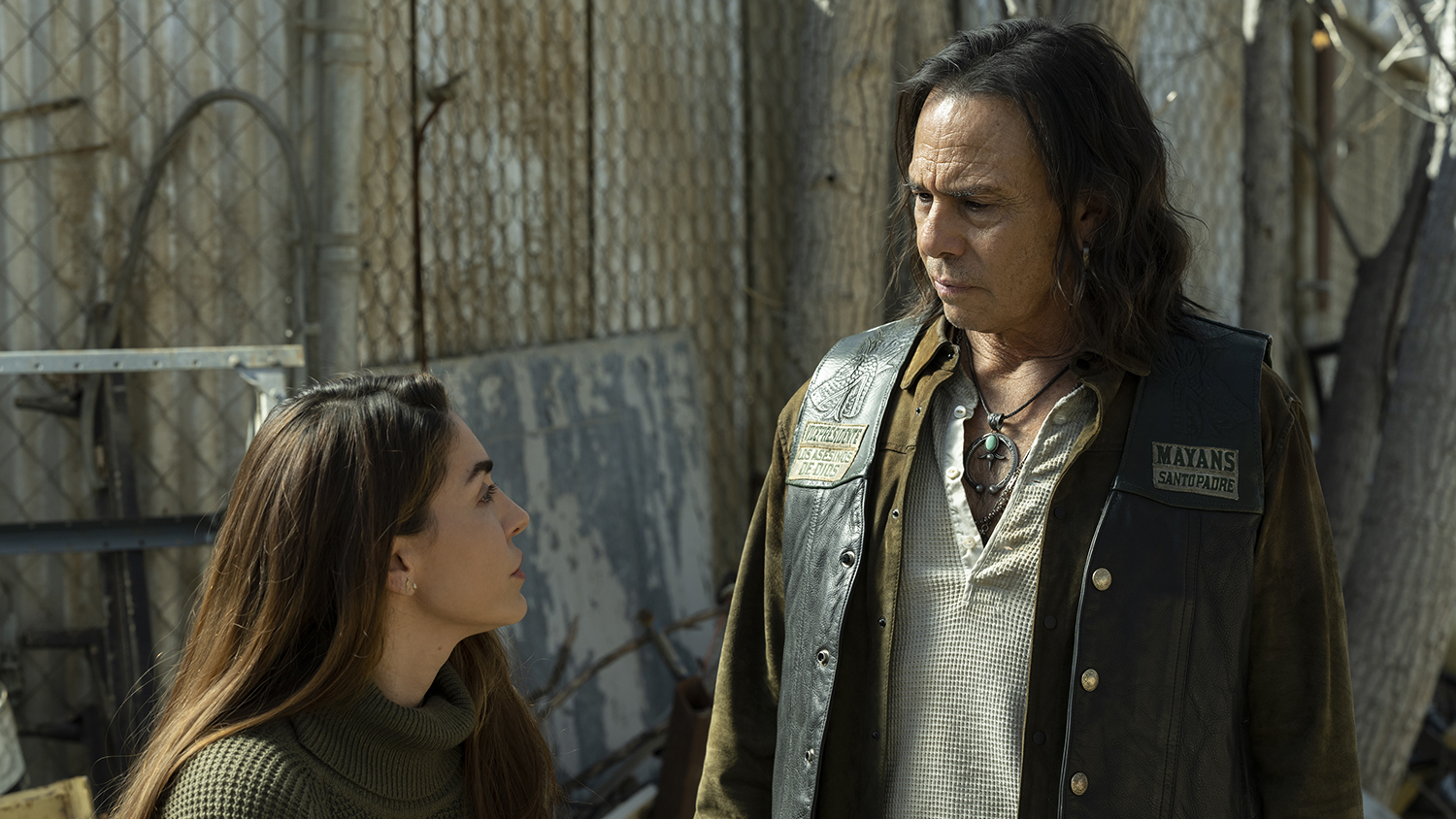
What’s more, a refocused Mayans MC allowed certain characters that had been stuck largely on the sidelines to shine bright, whether it’s Coco’s (Richard Cabral) struggle with heroin addiction and the haunting and violent upbringing he had–in which Cabral is giving the performance of his career–or the tragic story of Taza (Raoul Trujillo).

It was revealed this season that Taza, the vice president of the Santo Padre Mayans MC charter, is bisexual–something that’s frowned on in this world of outlaw bikers. Viewers came to learn that his past misdeeds against the club were done to not only protect that secret but to seek vengeance on the person who killed the man he loved.

No Caption Provided

Coco and Taza’s stories are by far some of the most riveting on Mayans MC this season and had the show not pulled back on the Sons of Anarchy influence, it’s possible viewers wouldn’t have seen them come to light. At the very least, they likely wouldn’t be given as much time to bloom as they have in Season 3.

In the end, Sons of Anarchy had its time. It ran for seven seasons on FX, telling the full tale of Jax Teller’s (Charlie Hunnam) rise and fall as the king of his MC world. That story, however, is over. Mayans MC has proved this season that it can more than hold its own without having to also fill in the gaps in Sons of Anarchy’s history. As much as we, as fans, would all love to know what’s happening with SAMCRO since Jax’s death, that is not this show’s responsibility–and it never should have been.

Instead, Mayans MC needs to tell its own story, explore its own characters in more depth, and make the audience care about them independent of their relationships with characters from another show that stop by from time to time. And it’s done that.

No Caption Provided

Moreover, it has surpassed Sons of Anarchy. The stories unfolding, including Coco’s addiction and Taza’s bisexuality, are being given the time to breathe and grow naturally. These are the types of stories we never got on Sons of Anarchy. That show was always honest about what it was. Sons of Anarchy was about the club, first and foremost. Everything, ultimately, was in service to the story of SAMCRO. While that’s not a bad thing, it can certainly be limiting.

Mayans, on the other hand, has shown that it’s more interested in the people that make up the club–and not just one of two main characters, but as many as possible. It is looking at how they function as individuals, and how that impacts the club. That’s the kind of story we need to see in this vicious, blood-soaked world. Thankfully, we’ll get to see more of it in Season 4.

Now Playing: Mayans M.C. Season 1: The Best Sons of Anarchy Easter Eggs

Trailer For Netflix Thriller Awake Will Keep You Up At Night

You know the drill: there’s a worldwide catastrophe, and all our creature comforts are suddenly worthless. Society disintegrates, and one adorable child is our last hope for survival. That’s the premise behind Netflix’s upcoming thriller, Awake, starring Gina Rodriguez and you can watch the first trailer right now.

In Netflix‘s Awake, “global hysteria ensues after a mysterious catastrophe wipes out all electronics and takes away humanity’s ability to sleep,” according to the official synopsis. “Scientists race against the clock to find a cure for the unexplained insomnia before its fatal effects eliminate the human race. When Jill, a former soldier, discovers her young daughter may be the key to salvation, she must decide: protect her children at all costs or sacrifice everything to save the world.”

Along with Gina Rodriguez (Jane the Virgin, Annihilation), Awake stars Arianna Greenblatt (Love and Monsters) as the daughter, as well as Finn Jones (Iron Fist, Game of Thrones) and Jennifer Jason Leigh (Annihilation, Single White Female). Awake is directed by Mark Raso, and written by Mark and Joseph Raso based on a story by Gregory Poirier.

The basic premise sounds a lot like Children of Men, A Quiet Place, Logan, The Last of Us, and so many other stories about children in apocalyptic situations. What seems to set this one apart is how fast-moving the danger is–sleep deprivation takes a toll in days, not weeks or years–and the nature of sleep deprivation makes for some pretty weird shots and situations as the trailer seems to indicate.

You don’t have to wait very long for this one. Awake hits Netflix on June 9, 2021.

An Among Us Collector’s Edition Is Coming From Limited Run Games

There’s nothing sus about this collector’s edition. Limited Run Games, which often brings digital-only titles to a physical format with plenty of extra goodies, is partnering with developer Innersloth for a collector’s edition of Among Us. Customers can start preordering the Among Us Collector’s edition from Limited Run Games’ store on May 11 at 7 AM PT / 10 AM ET. Preorders for the bundle will likewise close on June 27 at 8:59 PM PT / 11:59 PM ET.

This collector’s edition of the hit indie title will cost $80, a steep hike on the game’s usual price of just $5. That being said, customers get a ton of extra Among Us-themed merch for picking up this bundle.

No Caption Provided

The Among Us Collector’s edition includes two copies of the game, although they’re both digital. One copy is specifically for Steam while the other can only be redeemed on the Epic Games Store. Along with a couple of copies of Among Us, customers will also get a working Emergency Button from the game, a CD featuring its ambient music, and an imposter-themed steelbook containing a disc of Among Us concept art and interviews with Innersloth. The collector’s edition also includes a reversible poster.

This is all packed into an emergency button box. The box itself is blue with white sides. On top, it reads “Emergency” and in the middle is a big, shiny red button in a plastic case just asking to be pressed.

If you just want to get your hands on a copy of Among Us, the game is currently on sale for $4 on Steam.

GameSpot may get a commission from retail offers.