While EA Motive has shared a brand-new look at Dead Space Remake’s USG Ishimura, it also revealed that this would be the last update for 2021.
Motive shared the news on Reddit in a post that explained a bit more about what the team is focusing on and how it is taking fans’ feedback to heart.
“Everything we showed was a work in progress which means that we’ll be working on things like Isaac’s suit, the aesthetic and ambiance of the Ishimura,” EA Motive’s CM_Ythisens wrote. “We’re doing work to ensure it has the right level of wear and tear. For example, here is an early work in progress clip showing some of the ways that the team is going to be giving that worn look to the Ishimura.”
They continued to say that the team is going to “be heads down now working on the game, taking some time to review all the thoughts, theories, and suggestions you’ve all shared with us. We look forward to showing you how you’ve helped shape the game next year when we’re further in development!”
The behind-the-scenes look (which you can see here) of the Dead Space Remake is all about the USG Ishimura and how the team is making the ship and main location of the Dead Space Remake into the terrifying place it will end up being. As an added bonus, we get a look at an idle animation of Isaac Clarke!
In Fortnite, players and their friends lead a group of Heroes to reclaim and rebuild a homeland that has been left empty by a mysterious darkness only known as “the Storm.”
2K Sports is constantly striving to make its NBA 2K series the most authentic representation of the professional basketball experience both on and off the court. The developer took this ambition to new heights with NBA 2K22, putting the famous spokesperson Jake from State Farm into the game. Really.
As part of the significant updates to the social hub, The City, 2K Sports added a State Farm insurance store. And none other than Jake from State Farm is there to have a chat. The whole sequence is a treat, so we won’t spoil it. Here’s the video:
As Jake from State Farm says in the encounter, you can also dress like Jake from State Farm after meeting up with the character. Capybaroness, who was among the first to spot Jake from State Farm in NBA 2K22, also posted an image of the clothing, or “drip,” as Jake from State Farm says.
The actor who plays Jake from State Farm, Kevin Miles, reacted to his appearance in NBA 2K22 on social media, retweeting a story about it. Jake from State Farm is one of the most recognizable salespeople in recent years; if you watch TV or online videos, you’ve no doubt seen Jake from State Farm many times.
NBA 2K22 released on September 10 across PS4, Xbox One, and PC, as well as PS5, Xbox Series X|S, and Nintendo Switch.
Scenes From a Marriage premieres on HBO on Sept. 12.
I have a distinct distaste for remakes whose goal is “like the original, but in English this time.” Of course, there are great American remakes of foreign films that put a unique spin on the source material, but too often, Hollywood is happy to plop the same plotline into a U.S. setting, recast its roles with dazzling domestic stars, and call it a day. Now, not even a seminal 1973 Swedish mini-series is safe from this kind of uninspired treatment, as HBO Max has translated Ingmar Bergman’s Scenes From a Marriage into a five-part mini-series that boasts Oscar Isaac and Jessica Chastain in the leads. Though that pairing is promising, these heavy hitters can’t save this show from feeling like a shallow retread.
Scenes From a Marriage centers on a contemporary “successful” married couple in the Boston area. They seem to have it all: great jobs, a big house, a darling daughter, affluence, and a monogamous relationship nearing the decade mark. However, while husband Jonathan (Isaac) monologues about how defying traditional gender norms positively impacts their happiness, his high-powered executive wife Mira (Chastain) twitches like she’s trying to stealthily escape her skin. Something is off. And as smart as Jonathan the college professor is, he will be blindsided when she reveals she’s not happy.
Like the original mini-series, each episode focuses on a chapter of this marriage falling apart. The plotline hews closely to the original, involving disagreements about parenting, a loss of passion, and infidelity, as well as screaming matches and domestic violence. Co-writers Amy Herzog and Hagai Levi (who also directs) even name their episodes after those from Bergman’s show (“Innocence and Panic, “The Vale of Tears, “The Illiterates”). The key difference in this remake is that the roles are gender-swapped. This time around, it is the wife who gets caught up in her professional ambitions and extramarital interests, while the husband is the primary caregiver shocked to learn his contributions have been deemed insufficient by his partner. While Jonathan blathers on about how gender roles have evolved, the show itself treats this switcheroo as little more than a gimmick. Because the show focuses so intently on their household (few other characters will appear on screen), any assertions about gender feel anecdotal at best. When Mira defends one her shocking choices with “Men do this all the time,” it feels a crass misuse of feminist talking points on double standards.
Perhaps if this show were a ’70-set period piece, Levi’s shallow exploration of gender dynamics in heterosexual marriage might have played better. However, since Bergman’s mini-series, a plethora of filmmakers who were inspired by him have mined this battle-of-the-sexes terrain, creating emotionally charged and intellectual films like Robert Benton’s Kramer vs. Kramer, Woody Allen’s Husbands and Wives, Richard Linklater’s Before Midnight,Mike Nichols’ Closer, and Noah Baumbach’s Marriage Story. Walking in the footsteps of a master, Levi fails to define his own path. He offers a barrage of bickering scenes that feel like cliches because they’ve become staples in the wake of Bergman’s work. So, this Scenes From a Marriagefeels less revolutionary and more like a hollow revival.
Perhaps “revival” is a better way to think of this remake. Levi has not mined the original to make some bold new point about marriage, monogamy, or heartbreak. However, he has offered a stage for two of the greatest actors working today to face off in love and war. Reunited for the first time since J.C. Chandor’s A Most Violent Year, Isaac and Chastain are mesmerizing together. Both have dizzying screen presences that bring life to dialogue that feels well worn. Beyond that, they have a natural ease with each other. When the resentments bubble up, it hits harder because the intimacy established feels authentic.
Playing a man repressed by his need to project pleasantness, Isaac delivers a performance that is subtly heartbreaking. His soft tone is always in apology mode. His body quakes in a moment of repressed disappointment. His trembling smile sends shockwaves. In this crouched position of coddling, even the way he packs a suitcase feels tragic. Every quiet scene of desperation builds to a storm, where Isaac will grow from crackling jabs to booming resentments. Meanwhile, Chastain begins with this nervous frenzy, like a caged animal desperate to flee. Her Mira evolves, finding a new confidence that comes off initially cold before blooming to radiant but reckless. Together, their scenes of tenderness are as electrifying as those of catastrophic conflict. Plus, they get an early assist from celebrated actors, Nicole Beharie and Corey Stoll, who play a couple whose tensions explode over an awkward dinner party. Truly, Beharie is so ruthlessly riveting in this sequence that she might well score Emmy or Golden Globe notice for Best Supporting Actress. However, these are great performances despite a lackluster script that offers no memorable dialogue or distinctive moments of pleasure or pain.
Isaac and Chastain are mesmerizing together.
Levi doesn’t have a strong stamp on this material. The words still sound like Bergman’s. The cinematography, made up of gentle drifting and clingy close-ups, offers nothing inspired. A color palette coated in warm golds is pretty, but becomes banal across this tumultuous tale of love and loss. Even the powerful performances can’t keep it from feeling redundant and overlong. Notably, Bergman trimmed down his mini-series into a feature-length film (which is also available on HBO Max). Perhaps Levi should have taken a cue from that recut, then his marriage story wouldn’t be such a slog.
Are you a Final Fantasy XIV fan? Newegg has a deal for you, as you can save $5 on a 60 Day Game Time Card, stack those up a few times and you’ll be set for time well into the Endwalker expansion. Tales of Arise has also released, and you can grab yourself a reduced copy down below on PC, Apple Gift Cards that come with Amazon credit and much more.
The PS4 (and even the PS5 so far) has been defined by its exclusives. While Sony’s PlayStation consoles have had notable exclusive games over the years, a significant number of the very best games on modern PlayStation consoles are exclusives. From sterling action games like God of War and Marvel’s Spider-Man to brilliant RPGs such as Final Fantasy VII Remake and Persona 5 Royal, recent PlayStation exclusives have been mightily impressive. We’ve rounded up the best PlayStation exclusives for PS4 and PS5. While most of these games are playable on both PS4 and PS5, we’ve included a few PS5 exclusives as well.
In the above video, we round up 15 of the best PS4 and PS5 exclusives.
So you’ve begun your journey into Tales of Arise. Liberating the Dahnan people is no small task, and your success will depend entirely on how well you can navigate the game’s world and combat. But fear not, brave freedom fighter–we’ve assembled a list of tips to help you hone your skills for the starting hours of your long journey.
Whether you’re a newcomer to the Tales series or a seasoned veteran, this advice will help you start off your adventure on the right foot. Don’t forget to also check out our Tales of Arise review while you’re at it.
Hoarding Is Good, Actually
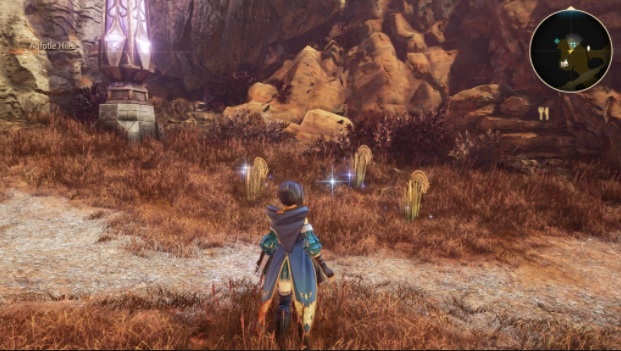
As you wander around the fields and caverns that make up the world of Tales of Arise, you’ll undoubtedly see lots of collectibles, indicated by shining sparkles, purple rock formations, or treasure chests of varying forms. Is it worth your time to go off-path to grab these items? The answer is almost always yes, absolutely!
While amassing a huge amount of wheat, mushrooms, and random rocks might not seem like it’s worth the trouble at first, once cooking and crafting open up, you’ll understand why having a variety of ingredients on-hand at all times is a solid idea. We’ll discuss cooking more in a bit, but with accessory crafting in particular, you’ll want to have lots of cheap, low-rarity ores alongside the top-tier stuff, as the lower-grade ores can be used to unlock the extra skills on each customized accessory. If you’re lucky, you’ll also discover various special herbs that can give characters permanent stat boosts.
There are also a fair few sidequests where folks will request ingredients or items. If you’ve been hoarding items from the field and from fights and already have what they need, you’ll be given an option to hand over the items as soon as they ask for it. This will save you the time and effort of hunting stuff down again and complete the quest immediately. Finally, if you’re ever in desperate need of cash, you can always look through your stash of materials, see what you have a lot of, and offload some of it–though it’s not recommended unless you have a lot of a particular material or you’re really in a bind.
ABC (Always Be Cooking)
Veteran Tales series fans know that collecting recipes and cooking up food is a key element to success, but if Arise is your first Tales adventure, you might not quite grasp what the big deal is at first.
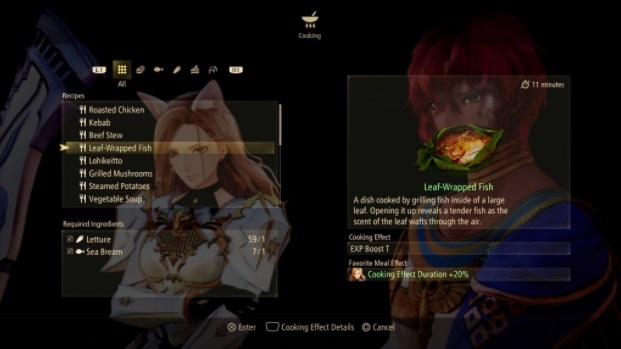
At camps and inns throughout the game, before you rest, you’ll be presented with an option to cook a meal for the party using the ingredients you’ve collected. You can pick from the recipes you’ve learned and collected so far, provided you have the proper ingredients on-hand. Each recipe grants a different effect for a certain amount of time.
There are lots of different effects food can grant you: EXP boosts, attack and defense buffs, increased item drops or ore collection, and so on. You can only have one recipe active at a time, so choosing a meal with a good effect for what you’re going to do next in the game is key. Are you going into a long dungeon? A meal that restores HP after each battle can help you conserve your precious CP. Planning to take on that big monster-hunting subquest? An attack or defense buff can help. Need to farm dropped items from enemies? There’s a meal for that, too. You can keep an eye on the effect’s duration by watching the little silverware icon in the upper right area of the screen. If it’s almost empty, then your meal’s effect is about to be cut short.
Choosing who makes the meal is also important, as they’ll change up the effects slightly. For example, when Law cooks, he’ll reduce the duration of the meal’s effect, but also increase its potency. Eating a new meal also resets the effect time (rather than adding onto it), so if you’re still pretty full and want to keep the current meal effect around, it might not be a good idea to cook again so soon.
What’s Beyond The Wall?
Throughout the game, there will be several spots in fields and dungeons where you can spend CP to clear or create a path. It usually costs a good amount of CP to open up these areas, so you might wonder if it’s worth your while to do so. The overwhelming majority of the time… yes, absolutely!
Usually, if a barrier that requires CP to clear is present, it’s blocking one of three things: a crucial area to progress, an extremely valuable treasure, or a shortcut that allows you to bypass dangerous foes. You’ll obviously need to clear the progress-impeding barriers, but those aren’t quite as common as barriers blocking treasure. Oftentimes, these barriers will be blocking off high-quality weapons and armor, valuable healing items like Gold Gels, Treats, Elixirs, and artifacts that give long-lasting permanent effects. Even if it costs a lot of CP, the reward is usually worth it, so don’t be hesitant to bust down a few barriers to get some top-class loot.
Use Frequent Fast Travel
Tales of Arise has a very robust fast-travel system. You can go almost anywhere from anywhere else in the game: all you need to do is open the map screen, find the area where you want to go, highlight the fast travel waypoint, and hit the confirm button. You’ll be quickly whisked away to wherever you want to go without needing to spend any additional time or resources. The only times you can’t use fast travel are when the story restricts you to certain areas.
This system is a welcome convenience that will save you plenty of time and headaches, especially if you’re planning on doing sidequesting. Need to beat enemies or grab something from a specific area? Just warp on over there, then zip yourself back over to the quest-giver. It also makes returning to previous areas a cinch–which helps when you want to backtrack and see if any new sidequests have opened up, or if you want to take on that big bad Zeugle who was too tough for you a few hours ago but seems more on your level now. (In particular, if you’re diligently hunting for hidden owls, you’ll want to fast travel to the Owl Forest frequently to claim your rewards.)
Hold Onto Your Old Weapons
Money can be scarce at times in Tales of Arise, especially in the earlier parts of the game. Healing items are pricey, and the costs of crafting weapons and armor can really start to add up. But as tempting as it might be to offload your old weaponry once you’ve got your shiny new gear from the blacksmith, don’t do it!
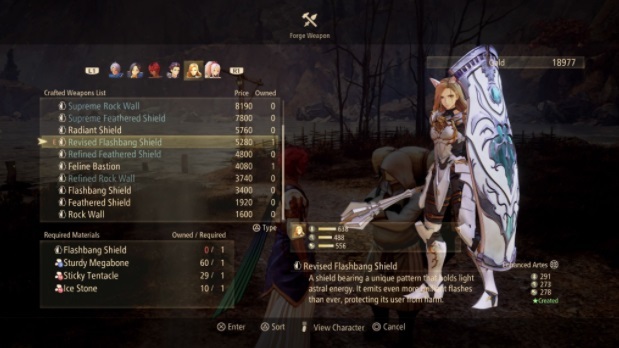
Yes, you can sell your old armor, but weapons? Hold onto those. As you play further into the game, you’ll be given a lot more weapon crafting options–many of which include gradually upgrading your old weaponry. And if you’ve sold all your old weapons, well… you’re going to have to spend time and resources crafting them again just to apply all of those upgrades. And sometimes to do that you’ll need materials that you’ll have to go out of your way to re-obtain. It’s easier just to hold on to your old armaments until you have the opportunity to upgrade them.
There’s also a sidequest for Rinwell where she will be tasked with showing a character the various books she uses as her primary weaponry. If she doesn’t have a specific book, she’ll have to obtain it again–usually through crafting. So why not save yourself the hassle? Hold onto those weapons as long as you can.
Big Game, Big Rewards
From very early on in the game, you’ll notice that there are some Zeugle enemies that are extremely nasty. Did you make the mistake of trying to engage that mantis in Sandinus Ravine with just Alphen and Shionne? Then you know what I’m talking about. These enemies are absolutely brutal, and oftentimes when you see them, it’s not a good idea to take them on right away. (You’ll usually hear your party members comment if you’re really under-leveled before you engage them.)
That doesn’t mean you should just leave them be, however. Many of these big foes have sidequest bounties attached, and will give rewards when you report their deaths to the quest-givers. They also yield a particularly valuable item when defeated: a flower that permanently adds 10 CP to your maximum. More CP is always a crucial good thing to have, so killing these beasts is a worthwhile endeavor in many ways.
But before you take these monsters on, you’ll want to be prepared. Many of them are just as difficult as the game’s story bosses–and sometimes even harder. It’s usually not the best idea to take them on right away unless you are feeling extremely confident–building up a few extra levels before engaging will help out a lot. You’ll also want to eat an appropriate buff-granting meal beforehand to give yourself a leg up.
Add To Your Title Collection
Collecting titles for your characters is another long-running Tales series tradition. In Tales of Arise, titles are especially valuable, as unlocking them will grant one permanent new buff or skill for each character along with four other optional enhancements you can spend SP on. Unlocking all of the skills a title grants also gives a permanent stat boost to that character.
Many titles will be unlocked over the course of the game’s story, but there are many optional titles that you might miss out on if you’re not paying attention. There are many ways titles can be unlocked: completing sidequests, using certain Arte types, crafting weapons and accessories, even by cooking specific meals. If a title is available to unlock, you can go into the Skill Panel to see the requirements needed. Highlight the center of the empty circle, and you’ll see what you need to do in order to activate that title and gain access to the skills contained within.
By checking these requirements regularly, you’ll be able to unlock lots of titles that you may have otherwise missed, making your party members even more formidable.
Jonathan Ferguson, a weapons expert and Keeper of Firearms & Artillery at the Royal Armouries, breaks down the sci-fi arsenal of Aliens: Fireteam Elite, including the legendary Smartgun, the OCAP-91 Volcan flamethrower and, of course, the iconic M4A1 Pulse Rifle.
In this video, DeVante talks about Far Cry 6’s free post-launch DLC plans that include crossover missions with Danny Trejo, Rambo, and Stranger Things. The roadmap also includes free weekly insurgency missions and events called Special Operations.
God of War: Ragnarok’s Tyr shocks fans on social media after his height is revealed and we compare the Asgardian deity to the popular Lady Dimitrescu of Resident Evil Village.
Later in the video, DeVante breaks down the different Call of Duty: Vanguard beta start dates and what you need to do to start playing early.
Warning: Full spoilers follow for Marvel’s What If…? through Episode 5.
When it comes to the Marvel Cinematic Universe’s television shows, What If…? was always the wild card of the line-up. Yes, it’s the first animated MCU offering, each episode so far is relatively self-contained outside of the unifying gimmick of The Watcher’s limited involvement, and it’s a collection of multiverse stories rather than an installment of the mainline universe canon. Those are the obvious answers. But now that we’re several episodes into the first season, a more prevailing theme is becoming clear.
It’s the first Marvel Disney+ show to actually take advantage of being a television show.
Previously, on the MCU…
With WandaVision, The Falcon and the Winter Soldier and the first season of Loki all in the bag, Marvel’s production ethos for their live-action shows has crystallized: They are making six-hour movies. This isn’t even a supposition on my part; Kari Skogland, the director of Falcon and the Winter Soldier, said as such when discussing how she and Marvel Studios President Kevin Feige approached the series: “I approached [it] like a film. From the beginning, as Kevin said, we were making a six-hour film.” It is as plain a statement of creative intent as it’s possible to make, and it’s also indicative of the pitfalls that have held these shows back from being their best selves, because they are actively fighting against the medium they’re in.
Aside from the first couple of black and white installments of WandaVision, it is remarkably difficult to distinguish the various episodes in any of these shows from one another, or to recall what specifically happens in each one. The narratives are segmented into episodes at relatively random intervals and widely differing runtimes, and this general lack of a consistent episode structure makes each one feel vague as an installment in itself. This is a recurring problem with a lot of “paced for the binge” mini-series television production in the last several years, but it’s an openly acknowledged part of the mindset for creating these shows. The episodes of MCU shows are not distinct entities because they are not designed to be. Beyond more readily apparent concerns like sluggish pacing and lack of thematic coherence, what this approach also facilitates is the shows as a whole feeling largely inconsequential.
WandaVision begins with Wanda grieving over the death of Vision, and ends with her… grieving over the death of Vision, but with a new costume and the added loss of their hypothetical children. The Falcon and the Winter Soldier was essentially a prologue to Sam Wilson accepting the mantle of Captain America, something the audience could reasonably be expected to infer happened between films after being given the shield by Steve Rogers in Avengers: Endgame. Loki is basically now in a pocket dimension with the TVA, and although the show is responsible for Kang’s arrival, he will be properly introduced (and, we can assume, adequately explained) in his first film appearance in the upcoming Ant-Man and the Wasp: Quantumania. It is as if these series are designed on purpose to be ignored if the moviegoing audience happens to not have a Disney+ account, and while that’s sound from a business perspective, it’s unsatisfying from a viewer standpoint because the shows are so defined by their MCU connectivity to the point of diluting their own core narratives.
[Episodes] are allowed to be more complete as narratives because they are not beholden to either building off of previous threads or setting up future ones in the larger franchise.
A Universe of Infinite Possibilities
In contrast, What If…? couldn’t be further from its brethren. Despite only having a handful of episodes to its name, What If…? has already cemented itself not just as the best Disney+ Marvel show so far, but the first to firmly coalesce as both a television show and an installment of the wider MCU, and it did so by not really mattering to the wider MCU. Each episode of What If…? is not only a specific entity that are (so far, anyway) only spiritually tied to each other by the show’s multiverse branding, they are also allowed to be more complete as narratives because they are not beholden to either building off of previous threads or setting up future ones in the larger franchise. That the individual episodes can even be judged against each other at all speaks to how much more distinct they are than the episodes from the live-action shows.
While the first episode is not much more than a gender-swapped remake of Captain America: The First Avenger as a way to get the ball rolling, each subsequent one has created more of a unique identity, with the T’Challa-starring second having fresh takes on an array of well-known MCU characters, and the third and fifth embracing wholly new genres as a murder mystery and zombie apocalypse story, respectively.
But none have succeeded so far as much as Episode 4, which takes place in a reality where the death of Christine Palmer was an inextricable part of Doctor Strange’s origin story. This “absolute point,” as the Ancient One calls it, is what Strange seeks to reverse, leading him down a dark path that ultimately results not just in his own moral dissolution, but also the destruction of his entire reality. As a take on the Doctor Strange mythology, it is a sibling to the film instead of a sequel, one that mirrors its live-action counterpart without needing to act as connective tissue to everything it established.
This is clear in the episode’s central conceit, which pumps up Christine Palmer’s importance to a level that doesn’t match the film’s use of the character at all. In the movie Stephen and Christine were distant exes at the time of his fateful car crash, while in the episode their romance had apparently never died out. What If…? builds on Strange’s central traits: his brilliance, his determination, and his ego, but channels them towards an inevitably tragic conclusion.
The same principle applies to Hank Pym’s chance to reconcile with his daughter being ripped away, which turns him into an Avengers serial killer in Episode 3, and Vision’s emotional dependence on Wanda causing him to betray his ideals by feeding people to her zombified form in Episode 5. As for the Doctor Strange story, it ends exactly as the story needs it to: with Strange alone, defeated, his world destroyed in exactly the manner he was told it would. It’s a brave and heartbreaking note that stands in stark opposition to Strange’s formative journey of accepting humility in his origin film.
By being the “least important” show to the wider universe, What If…? has ironically wound up being the one with the most genuine consequence.
Carlos Morales writes novels, articles and Mass Effect essays. You can follow his fixations on Twitter.