After 13 years, it has finally been revealed that Tennis star Andy Roddick was the sperm donor that Jan Levinson used to get pregnant on The Office.
As reported by EW, Jenna Fischer (Pam Beesly) and Angela Kinsey (Angela Martin) shared this behind-the-scenes story on their Office Ladies podcast while discussing the season four finale “Goodbye Toby.”
Image Credit: The Office via Peacock
In the original script for the episode, Kinsey explained how this cut scene would have played out and how Jan would have told Michael Scott that Roddick was the sperm donor and father of Astrid Levinson.
“The tennis player?” Michael asked.
“Well, it’s a little more than that. He’s the sixth-ranked player in the world and he’s won four grand slams,” Jan responds.
‘That’s a lot of grand slams, I guess,” says Michael.
Jan then continues to tell him that “he’s a humanitarian — something with orphans.”
Michael and Jan would have sat in silence for a moment, and then Michael would ask, “can I just sit here for a minute without more things coming into my head?”
The scene unfortunately did not make it past the editing room, and this bit of The Office lore had been hidden away since the episode aired in 2008.
Fischer continued by saying that Roddick was a good friend of Rainn Wilson (Dwight Schrute) and would frequently visit the set during filming.
“I have to imagine that the reason they wrote it as being Andy Roddick’s sperm was a little bit of a nod to Andy, who has an amazing sense of humor. I am so sad for his sake that this did not stay in the episode,” Fischer said.
Welcome to our Saturday deals page, and not a moment too soon, as the Samsung Galaxy Watch 3 is seeing a crazy discount this weekend. Slashed in price by $170, it brings this featured packed accessory into a price range that’s much more appealing than it’s traditional listing. Doordash deals continue this weekend as well, as well as robotic vacuum discounts and even a nice little Oculus Quest 2 purchase bonus should you buy one over at Newegg.
In addition to officially licensed, limited edition apparel, the IGN Store is now stocking collectibles and figures from some of the best animated franchises.
The Xbox Series X and Xbox Series S both support expanded storage for playing next-gen games, but doing so requires a proprietary storage card. Right now, that Seagate Storage Expansion Card for Xbox Series X|S is on sale at Newegg, giving you more than $20 off its regular price so you can install even more games.
To take advantage of the 10% discount, all you have to do is enter the promo code 93XQY65 in the code field during checkout. This will give you the discount, which drops the price down to $198. Though that is still nothing to sneeze at, the card is the only one that supports direct play of Xbox Series X|S games other than the consoles’ own internal storage. Currently, other external drives, including other SSDs, only support storing these games, and they must be transferred to the internal drive to play.
Designed in collaboration with Microsoft to ensure compatibility and performance, the Seagate drive is meant to offer the exact same experience you’d get running a game off the consoles’ internal NVMe SSDs. That means support for Quick Resume and very fast loading times, and with 1 TB of storage, you can put a whole bunch of games on it.
It remains to be seen if any other manufacturers will release their own compatible expansion cards for Xbox Series X|S, but because that hasn’t happened yet, we rarely see price drops on Seagate’s model. If you’re running out of space already and don’t want to delete your favorite games, now’s a great time to buy the drive. That’s especially true if you’re taking advantage of Newegg’s recent Xbox preorder discounts, which have knocked off $10 on upcoming games like Biomutant.
Most notable RPGs from Japan and other countries in modern gaming get official translations for other territories at or soon after launch, but that wasn’t always the case. There’s a long lineage of RPGs whose well-known English translations stem from fans, not developers. From the proto-Persona Shin Megami Tensei: if… to the beloved tactical RPG Bahamut Lagoon, many of the most obscure, yet beloved, foreign-language RPGs of the ’80s and ’90s have been painstakingly translated into English by hard-working amateurs.
The proliferation of this phenomena can be traced back to a handful of teenagers whose disagreements and messy ambition ultimately paved the way for one of the most notable fan-works of the 1990’s: a working English hack of Final Fantasy V. Of the members of RPGe, the group credited with producing the hack, none of them better reflect the heady days of early fan translation than Derrick “Shadow” Sobodash, a lonely high-school student who didn’t let his lack of technical expertise or Japanese knowledge stop him from tackling such a demanding project. His relationship with other members of RPGe, like Myria and SoM2Freak, would lead to disagreements, drama, split partnerships, and more, but their collective work would produce renowned fan translations that are still frequently played to this day.
And on that note, it’s essential to understand that the final version of the famous ’90s FFV English hack you can download on fan websites today is almost entirely the work of three people, known as “Myria,” “Harmony7,” and “SoM2Freak.” However, prior to their involvement – which is well-explored in a 2017 Kotaku article on the topic – Sobodash and several other individuals in the nascent fan translation community were publicly working on a translation for FFV, and their project racked up thousands of views on the primitive internet. Sobodash and his compatriots may not have contributed to the hack itself to the same extent, but their promotion of the concept of English “fanslations” helped to inspire others to pursue their own projects. There was some tears shed and friendships broken along the way, but the impact that RPGe had on the world of fan translations can’t be overstated.
’90s Script Kiddies
Sobodash was part of the first generation of kids who truly grew up online in the mid-to-late ’90s. A self-described “script kiddie” who would use other people’s code to access unauthorized computer systems for fun, Sobodash started using bulletin board systems (BBSes) in his early teenage years. Prior to his interest in hacking Super Nintendo games, Sobodash’s dalliances with tools and malware he found online would occasionally land him in hot water. At one point, he accidentally emailed a copy of the controversial book The Anarchist Cookbook to every email address in his high school from the administrator’s account after obtaining access with a “keylogger,” a tool that records keystrokes made by a user.
Though this stunt earned him a lifetime ban from his school library, Sobodash quickly found a new obsession: untranslated Super Nintendo games. Having already beaten most of the SNES library by sharing rented games with friends, Sobodash became fixated on the possibility of playing these lost games, immersing himself in the vibrant online Square fan community in the process.
But his interest and passion developed into a directive after he stumbled upon an incomplete fan translation of the Japan-only Final Fantasy II by SoM2Freak and another user, “Demi.” Even though the buggy FFII fanslation simply ran out of English text only an hour or two into the JRPG, it forever changed the then-14-year-old Sobodash.
Sobodash clung to the realization that hackers could translate these old games by manipulating their files. That might seem obvious now, but back in 1996, the idea of ROM-hacking was very much in its infancy. Though the Dutch group Oasis pioneered the concept of fan-translation back in the early ’90s with hacks of MSX games like Hideo Kojima’s Snatcher and cult JRPG The Legend of Heroes, the concept had yet to be popularized online. SoM2Freak and Demi never completed their Final Fantasy II translation, but it inspired Sobodash and other would-be hackers to reach out to the duo for tools and advice on how to start their own hacks.
Sobodash didn’t know much about SNES programming and had self-described “pretty terrible” understanding of the Japanese language, but he was determined to translate Final Fantasy V himself. SoM2Freak and Demi’s abandoned translation of Final Fantasy II actually had begun life as an attempt to translate FFV, but the duo soon decided that that goal was too ambitious for a first project. (In fact, that project grew out of yet another FFV translation effort announced by a group called Kowasu Ku, which never produced any meaningful progress.) However, that didn’t stop Sobodash from following in their footsteps.
At the time, Final Fantasy VI (initially Final Fantasy III in English) was the latest and greatest game in the series, which meant that FFV was the next-best thing, and the next object of his ever-growing obsession. From his research, Sobodash also knew that an English translation had been released online in 1996 by a fan named Mark Rosa, which would make the process much easier, given his lack of Japanese skills.
SoM2Freak eventually sent Sobodash some of the rudimentary fan-developed tools they used to translate FFII – a sprite editor and a text editor – but Sobodash quickly concluded that they were too clunky to use and decided to find his own. (One of them crashed every time he alt-tabbed out of it.) After obtaining a superior sprite editor from another fanslator’s Dragon Quest I & II hack and a different hex editor, Sobodash sat down and put himself to work.
Armed with his 380-page paper translation of Final Fantasy V, his hex editor, and printed-out copies of the game’s Japanese font, Sobodash began creating physical flashcards to teach himself which hex code corresponded to each Japanese and English character. While this might seem like a waste of time, the hex editor that Sobodash used was so primitive that it didn’t have a table that would break up and sort the hex code for you. Instead, Sobodash was simply looking at unbroken lines of raw hex for hours at a time, which meant that memorization was important. Needless to say, it was tedious work.
He would even carry a gigantic three-ring binder filled to the brim with hexadecimal tables and the English script to his high school, spending hours during class and lunch breaks transposing the hex code into romanji – Japanese characters rendered in English text. His translation project claimed casualties, too: the sheer amount of paper involved eventually led to the messy demise of his cheap family printer.
While Sobodash admits that this low-tech approach was far from optimal, his teenage enthusiasm carried him through. He knew that the online Square fan community was hungry to play these games in English, and any translation project would draw a lot of attention. Though he had yet to produce much in the way of a usable hack, Sobodash promoted his project by manipulating images from FFV with Photoshop. He removed the Japanese text and replaced it with phrases from the English translation to give the illusion of miraculous progress to others.
And like that, some poorly Photoshopped images led to word of Sobodash’s project travelling fast around the Square fan community. Over the next few months, several fans reached out to the teenage translator to offer help. One of them was a college student who went by “Hooie.” He and Sobodash quickly became friends, talking over the early IM service ICQ several times a week. Unlike many of the other would-be collaborators, Hooie brought substantial technical knowledge as a computer engineering major. He also wasn’t shy about occasionally asking his Japanese instructors at his university to help him translate enemy or item names.
With his help, the duo were able to use hex editing software to actually replace some of the game’s Japanese text with English, and they even released a few patches on the Final Fantasy Mailing List. It was slow, arduous work, and the duo were not plugged into the fledgling emulation community, resulting in many bugs in the few patches they did release. But their progress still attracted a substantial amount of attention from fellow early internet enthusiasts, including rivals in the fan translation scene.
RPGe Lives
In mid-1997, a notable figure in the world of emulation known as “Zophar” accused Sobodash and Hooie of stealing the work of a fellow translator, David Timko, who was also working on his own English patch for FFV. Sobodash chalked the whole ordeal up to a misunderstanding, and Timko and Sobodash eventually buried the hatchet and partnered to produce one patch together. That sense of unity eventually led the group to coin an official name for itself, RPGe, which would be the label that Myria and Harmony7’s completed hack would be released under the following year.
Myria first stumbled on RPGe’s projects while researching her own passion project, a version of Final Fantasy IV that would restore many of the changes localizers made to the English version, particularly the dozens of items deemed too complicated for Western audiences. While Myria’s interest in FFV was relatively low, the challenge of translating an unknown game intrigued her, so she decided to check out the group’s in-progress patches for herself.
Myria quickly concluded that the hex-editing process the RPGe hackers like Sobodash were using to modify the game files would never be able to produce a complete hack.
In simple terms, they were modifying the text of the game directly without modifying the code, she explained. “In FFV, as with many older Japanese games, all of the Japanese characters were the same size. In English, imagine if the letter I and the letter W were the same width. It just looks bad. The Japanese version of the game is limited to 16 characters per line. If you think about Japanese as a language, that’s fine, but it’s way too low for English…It just wasn’t going to work.”
Though RPGe presented a unified front on its webpage, as Myria recalls, the group was beset by internal factionalism even at the best of times. Myria tried to explain the shortcomings of their text-only approach to Sobodash, Timko, and their collaborators, but her arguments failed to convince her fellow hackers.
“I basically just told them that the approach they were taking was completely wrong, and that we needed to modify the game code to make it work,” she said. “Well, they wanted to continue what they were doing, but SoM2Freak agreed with me, so we just went and started our own version of the project.”
Once Myria determined the rest of RPGe didn’t agree with her approach, she and SoM2Freak restarted the hack fresh from there. Over the next few months, Myria used a variety of tools to disassemble FFV’s machine-level code into terms she could understand, and she eventually reverse-engineered the parts of the code that displayed text. She then modified those portions of the game code to better suit the English language. Their version would, of course, go on to be the famous fan translation that is still remembered fondly today.
Meanwhile, as RPGe’s digital presence continued to grow as the group announced more and more ambitious translation projects, the pressure of e-celebrity took its toll on Sobodash. By promoting himself as the public face of the fledgling group, he opened himself up to a flood of hate mail and death threats from anonymous internet denizens desperate to play these unknown titles. Sobodash believed that RPGe was performing a vital service to the Square fan community by translating these lost games, and took the hobby very seriously as a result – perhaps too seriously.
The fact that Myria and SOM2Freak had essentially taken over the FFV project that he helped start did bother him, but that wasn’t necessarily the sole source of his growing anguish. Sobodash saw RPGe as an extension of himself, a group in fierce competition with rival organizations to blaze bold new trails in the fan translating scene. To Sobodash and many others, it was a neverending race to see who could translate the most games in English. It was a lot of pressure, even if somewhat self-imposed, for a teenager to handle.
In early 1998, when fellow hacker Demi published a lengthy parody of Sobodash that painted him as lazy and selfish, Sobodash was absolutely devastated. Though Sobodash disagreed with the characterization, Demi was an influential figure in the community, and his opinions held a lot of sway. Not only was he one of the first fan translators on the scene, he owned one of the most popular rom-hacking forums of the day. Whether true or not, Sobodash felt like all of his online friends were laughing at him, and in his own words, he finally “snapped.” He typed one last message to RPGe and then left the scene entirely.
“I can’t tolerate the number of people who send me flames and death threats, it’s more than I can bear to handle,” his final message reads in part. “I’m going off now to work on my own. Maybe I’ll program, maybe I’ll translate for myself, like I used to when it was fun, I don’t know but please wish me well in whatever I do…I’m not sure who’s going to take charge here, pull RPGe back together, and manage our many members. I hope they can keep the spirit of doing this all for fun alive and well.”
By the time of Sobodash’s exit, all four of RPGe’s co-founders had exited the organization, leaving Harmony7 and another hacker named “MagitekKn” to manage it. Meanwhile, the FFV translation had trouble of its own: when native Japanese speaker Harmony7 took a look at SoM2Freak’s script, he made many corrections to it. According to Myria, SoM2Freak resented the fact that Harmony and Myria made changes to the script and ended up growing upset at them both as a result.
“I think he was pretty mad at me,” Myria recalled. “I honestly feel bad about how we handled it, but we were kids at the time.”
The official release of the FFV patch – the first completed fan translation in English – didn’t come until October 1998, but by that point, Myria wasn’t even involved. She was too busy pouring hundreds of hours into Final Fantasy VII, which had released the previous September.
“It was all Harmony7 at the end,” she says, laughing. “All I did was the programming, and I was done by that point.”
By late 1998, Sobodash had completely exited the online Square fan scene and immersed himself at a job he got at a local pizza joint. He figured out pretty quickly that playing video games with his new friends was preferable to getting yelled at by strangers online. Still, though he dabbled with translations in his spare time as the years passed, he never quite felt the same passion for it than he did back in 1996.
“In 1997, translating games was uncharted territory,” he said. “There were few tools and few documents. None of us knew what we were doing: it was educated guesses, trial and error, and tinkering. I was learning and doing something few other people were able to do, and we were all able to teach each other….In most fields, you have to study and struggle for years to be an expert. However, if you invent a new field, then no matter how limited your knowledge is, you are an expert by default. I think that is what I was most after. I wanted more than anything else to be good at something no one else was.”
Today, it’s difficult to draw firm conclusions about the legacy of RPGe. Much of the group’s online presence has been lost to ever-churning fans of digital progress – the Wayback Machine captured only a handful of ancient pages that mention the group. Sobodash himself says that he doesn’t even have any of the group’s work on his own computer. What’s clear is that Myria’s machine-level reverse-engineering pioneered the approach that an entire generation of fan translators would use on notable English hacks, and it’s still very much part of the basic procedure that hackers use today.
Still, while early hacking groups like RPGe might have fallen apart due to changing tastes and personal differences, they promoted a concept that inspired many JRPG fans to recognize the importance of non-localized games like Mother 3, Trials of Mana (Seiken Densetsu 3), and Ace Attorney Investigations 2. Sobodash might have never lived up to his lofty teenage ambitions, but he and his fellow early hackers made a mark on history just the same.
“Most people have stories of high school sports or funny anecdotes about school life and friends,” he said. “In place of that, I have hundreds of hours of hammering away at [a] screen full of hexadecimal. I cannot say if that should fill me with pride or sadness.”
While they may not be blockbuster-level releases, Nintendo’s obscure Famicom Detective Club games arrive on Switch next week, making this a notable moment for the system. As Nintendo itself has called them, these two games are “deep cuts” from the company’s early years, a pair of previously unlocalized visual novels that originally launched for the Famicom Disk System (hence their namesake) back in the late ’80s. This marks the first time either title is ever being released outside of Japan, and I hope Nintendo continues to bring more of these kinds of curiosities to the West.
If nothing else, the Famicom Detective Club remakes are noteworthy for their historical value. As with Fire Emblem, my own introduction to the series came through Super Smash Bros. Melee. The fighting game featured a number of trophies calling back to Japan-only titles, including one of Famicom Detective Club’s heroine, Ayumi Tachibana. That small Easter egg was a fascinating glimpse at a lesser-known piece of Nintendo’s oeuvre, but I had long assumed the series would remain just that–a footnote in the company’s history. Their release on Switch, however, finally gives players outside of Japan their first official chance to experience the titles, and introduces the forgotten series to a modern audience.
What also makes Famicom Detective Club interesting is the team behind it. The games were originally developed by Nintendo R&D1, the division that produced Kid Icarus and Metroid (among other titles). Many of the developers who worked on those classics had a hand in Famicom Detective Club, including Yoshio Sakamoto. While he is perhaps best known for his work on the Metroid series, Sakamoto was responsible for penning the script for both Famicom Detective Club titles–some of his earliest writing credits on a video game.
Click To Unmute
Famicon Detective Club – Official Announcement Trailer| Nintendo Direct
Size:
Want us to remember this setting for all your devices?
It’s rare to see Nintendo revive these kinds of obscurities, but the company has seemed more willing to open its vaults in recent years. Last December, Nintendo celebrated Fire Emblem’s 30th anniversary by releasing an official localized version of the series’ first installment, Fire Emblem: Shadow Dragon and the Blade of Light–the first time this version was ever available in the West. A couple of years prior, Hamster released an Arcade Archives version of Nintendo’s long-lost arcade game, Sky Skipper. The latter, in particular, is a small miracle of preservation. As Nintendo of America’s Don James explained during a Treehouse Live segment at E3 2018, Sky Skipper never received an official release in the US, and the only extant cabinet is stored in Nintendo’s archives. In order to bring the game to Switch, the company had to remove the ROMs from the cabinet, copy them, and send the copies to Japan.
Even before Switch, Nintendo occasionally dusted off some of its previously unlocalized titles, and each time it did so felt like a special occasion. The unreleased Star Fox 2 was included in the SNES Classic mini console (and later added to Nintendo Switch Online’s SNES library), while the very first Mother game received its official Western release on Wii U–as EarthBound Beginnings–back in 2015. Thanks to the Virtual Console service, other previously unlocalized games like The Mysterious Murasame Castle and the original Sin & Punishment were also made available in the West.
None of these games will likely ever be multi-million sellers on the level of Mario or Animal Crossing, but that’s in part why it’s encouraging to see Nintendo still willing to release them. These historical curiosities are effectively a treat for longtime fans more than anything, and I only hope the company continues to bring more of them to the Switch. I’d personally pounce on an Arcade Archives version of Nintendo’s Popeye game, and many are still clamoring for Mother 3 to be localized (count Terry Crews among them). There’s no guarantee we’ll ever see any of these titles, of course, but releases like Shadow Dragon and Famicom Detective Club help to keep the dream alive, hopefully paving the way for more long-overdue localizations from Nintendo’s deep archives.
The World Ends With You (TWEWY) was a lot of things–an innovative RPG that put the Nintendo DS’s touch screen to good use, a stylish experience that demonstrated youthful expression through fashion and music, and one of the most experimental games in Square Enix’s history. But despite the game’s cult status, TWEWY has not had an official follow up in the 14 years since its release. Until now, that is, with the upcoming NEO: The World Ends With You.
The original TWEWY came back around with the Switch remaster in 2018, dubbed Final Remix, albeit with mixed results from the retooled controls to accommodate the platform change. However, this upcoming sequel, NEO: The World Ends With You, is a sort of rebuild of what made the original special. I recently had a brief interview with its key developers, which included Tetsuya Nomura (creative producer and character art designer), Tatsuya Kondo (series director), Hiroyuki Ito (director), and Tomohiko Hirano (producer). And from talking with them, I have a clearer picture of how TWEWY is being modernized not just in a gameplay sense but also in its attitude.
We covered NEO TWEWY’s character designs and their conception, storytelling and ties to the original game, and how the combat has shifted from touch controls to a fast-paced action-RPG with a dynamic party system. We have a better understanding of what we can expect from this anticipated follow-up, and it seems that bringing the series into a modern era isn’t going to take away from what made TWEWY unique, either. My only regret is not leaving enough time to talk about the soundtrack and eccentric jams that have made the series resonate with so many of us.
NEO: The World Ends With You is slated to launch on July 27, 2021 for PlayStation 4 and Nintendo Switch, and to PC via Epic Games Store shortly after. The following interview was done through a Square Enix translator and edited for clarity and readability.
To start things off, the original TWEWY had a very distinct attitude and style, and maybe a bit dark in some places. What kinds of narrative themes and motifs are you going for in NEO TWEWY?
Kando: This is something that you’ll probably notice when you play the game, but for the elements that we felt represent TWEWY, those are elements we decided to preserve this time around as well.
One thing that I think is quite different is the personality of the protagonist compared to the original game. Neku was a little bit more reserved, he was a little bit more reclusive, whereas this time around it’s more of a team–the protagonist being Rendo with his sidekick Fret and also Nagi. They’ll be moving around as a team, and then we’ve tried to incorporate fun and interesting dialogue between the team members. So, I think you’ll get quite a different impression compared to the first game. That being said, as mentioned earlier, we did try to preserve the essence that makes this a TWEWY game.
The group dynamic certainly changes things, and it’s a big thing that stands out in RPGs is how characters grow alongside each other. How does NEO TWEWY dig into that? What kind of dynamic is there between Nagi, Rindo, and Fret, and others?
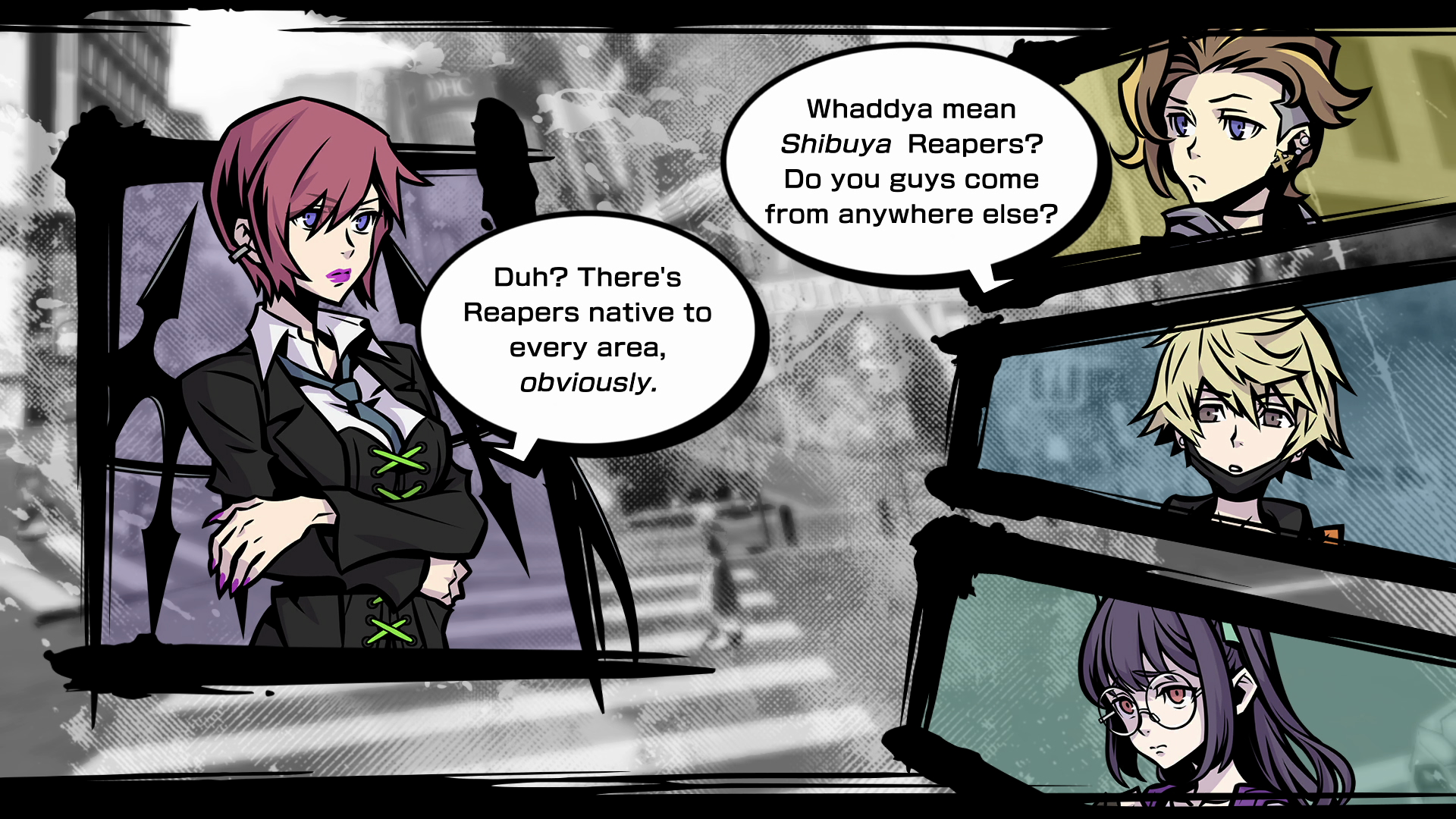
Kando: First of all, Rendo and Fret were originally friends, so they already have that kind of bond with each other. Then at the start of the game, Nagi and Minamimoto come into the scene and join the team to form what’s called [Wicked] Twisters. There will be different teams within the game itself with interactions between them all as well. Of course, there will be the Reapers that come into the mix, and there’ll be different kinds of interactions among various teams that you’ll see. That’s kind of how the story and the narrative unfolds and expands.
One thing that stands out a lot in games Nomura-san works on is the character design, which is often very expressive. It was a big part of the previous game and part of the reason why we love those characters. What kind of inspirations did you and the team have when designing these new characters?
Nomura: So for the three main protagonists in NEO TWEWY, we actually have different designers for each of them, with Rendo, Fret, and Nagi. I designed Rendo, but for Fret, the designer was Gan Kobayashi. And then for Nagi, a new female designer that joined the team this time around, Miki Yamashita. So, three main protagonists were designed by three different people, and this might be something that could become the norm for upcoming games, where we’re having different designers for these main characters. It’s great because they all have their own different aesthetic and their characteristics that stand out. And when I look at Fret or Nagi, there are ideas that I know Mira probably would not have thought of. It’s great to have different designers on board so that we can have a little bit more realism and variety.
With the designs that Kobayashi and Yamashita made, once they designed it, I looked through them, reviewed them, and then gave them [feedback], and they proposed a few different designs. I gave certain directives such as, “let’s use this part from this, and then let’s use this portion from this other design”. That being said, I try to make sure that their perspectives and their personalities stood out through their design. And then in terms of inspiration with the original title being released quite a long time ago, we made sure that this time around, the designs fit into the real life Shibuya of today.
I’m also wondering about how NEO ties into the original. Are you able to speak to some of the connections? As I understand Minamimoto and Kariya are back in NEO, but what’s the deal with the Reapers’ Game this time?
Kando: In this game, the protagonist is Rindo, so it’s different from the original title. And with that, we deliberately did not name the game “The World Ends with You 2.” We made it new, “NEO: The World Ends with You”. That was a deliberate choice on our end, because we want to make sure people that were jumping into the series would be able to do so from this upcoming title without feeling it being a little off. We wanted to make sure that it was a nice entry point for these new players. We do understand that there are a lot of players that have played the original game and are looking forward to this upcoming entry, so we wanted to make sure to meet their expectations.
As you mentioned, there are characters from the original game that are making their way into this game as well. It’s been three years since the original game’s story, so you’ll see how they progressed through those three years and how they’ve changed. That is something [we want you] to be able to experience in the game itself. In terms of how those characters from the original actually play into this new game, how they spent those three years really kind of highlights how they’ve evolved. That is something that you can look forward to in this game.
Nomura: Speaking specifically of Minamimoto–I had decided even before the story was finalized that Minamimoto would be an ally this time around. I had decided that from the beginning. And then for the other character, Kariya, he is just like he was in the original game. He is part of the Reapers that look over the players in the Reapers Game. That being said, the situation has changed with the three years that have passed. His stance has changed a little bit and in terms of how they really play into the game, that is something that you’ll need to look forward to and enjoy in the game itself.
The original was innovative with the gameplay highlight being how it used touch controls. It was a driving force behind that game’s appeal. Moving to more traditional-style platforms, how have you rebuilt the combat system while still having that level of appeal?
Ito: With the touch screen hardware for the original game, it was with that foundation that we were for sure going to have a new experience for players. But now with [current] platforms, [we use] traditional controls–the controllers or the Joy-Con and the buttons. So, it was a high hurdle thinking of ideas for how to deliver a new experience like we were able to do for the first title. But through deliberation, our approach was with the fact that you’re in a team this time around.
We wanted to create a system where the players are able to control the various members of the team simultaneously. For example, by using the different buttons, players are able to first control Nagi–she will have a pillar to push the enemy upwards into the sky. Then maybe next, Rindo would use an attack where rocks fall from the sky down onto enemies. And then as a decisive blow, Minamimoto can serve a kick to the enemies. So, there are these combinations that players will be able to experiment with, and the fact that players will be able to input these commands on the spot to create those different combos through this high speed action makes it interesting. We feel that we’ve been very successful in creating this sort of addictive battle gameplay that will serve this TWEWY title well.
Just to summarize it simply, you’re controlling a whole party simultaneously in real time action, which we feel is not seen in other games, and I feel that this stands out.
So, you’re not switching between them, instead they’re at your command all at once?
Nomura: Yes, that is correct. I can’t give you exact numbers, but you’ll end up being able to control a good number of characters at the same time, just to give you a hint!
It’s been 14 years since the original TWEWY’s release. So much has changed in RPGs since then, particularly with franchises like Final Fantasy and Kingdom Hearts. What’s the biggest thing that stood out creating a modern TWEWY game?
Kando: Of course, one big thing is the change from 2D to 3D that comes with the time. But when we’re comparing with the other games around us, there have been elements that have made games user-friendly, so we’ve tried to incorporate those elements to make it a little bit more accessible. And of course, we made sure to create a game that people can engulf themselves into. In terms of elements from the original, such as things like fashion, food, and music, those we feel are the essence of TWEWY and kind of make it what it is. Those are things that we definitely wanted to preserve moving forward with this second entry.
There are other features that we still haven’t been able to reveal, but we are planning to show later, so please look forward to those. We can’t reveal them right now, but yeah, they’re coming.
Click To Unmute
Size:
Want us to remember this setting for all your devices?